

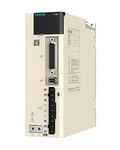
What a servo drive actually does
A servo drive is not a "beefier motor" — it is a closed-loop system: a servo motor with an encoder on the shaft plus a servo amplifier that compares the commanded position with the real one every millisecond and trims the current. A stepper motor turns "blind" by pulses. A servo motor always knows where it stands to a few thousandths of a degree and returns to the target point even if the shaft is pushed by hand.
What that buys you on the floor. Full torque from zero speed — the machine table moves under the cutter without sag. Accurate path following — interpolation across several axes at once. Dynamics: the servo motor spins up to a few thousand rpm in a fraction of a second and reverses just as fast, never loses steps and stays cool while holding. The amplifier and the motor always ship as a matched pair sized for a specific torque and load inertia — a standalone "servo motor without a drive" simply will not run.
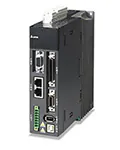
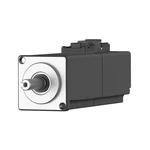
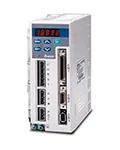
In the catalogue the servo line is split into three order formats: servo kits (amplifier + motor + cables — the simplest start, nothing to match for compatibility), servo drives on their own (when the motor is already in place), servo motors on their own (when the drive in the cabinet is fine but the motor burned out).
Servo series and brands we keep in stock
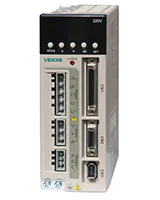
We carry two lines for different budgets and task classes: Delta Electronics (Taiwan) for the core industrial range and Veichi (China) for the budget segment. All from the Kyiv warehouse, 24-month manufacturer warranty.
| Series | Brand | Task class | Control |
|---|---|---|---|
| Delta ASDA-A2 | Delta Electronics | High-performance general purpose: machine tools, packaging, winding | Pulse/Direction, analog, built-in positioning |
| Delta ASDA-B2 | Delta Electronics | Basic economy: simple feed axes that do not need a fieldbus | Pulse/Direction, analog |
| Delta ASD-M | Delta Electronics | Multi-axis: one unit drives 3 axes, axis synchronisation | Internal multi-axis motion control |
| Veichi SD600 / SD700 / SD710 | Veichi | Budget segment: where price matters more than a brand name | Pulse/Direction, analog, EtherCAT (on SD700/SD710) |
Top sellers this year are the Delta ASDA-A2 (for instance the ASD-A2-1021-M 1 kW control unit for table feed) and the Veichi SD700-5R5A-EA with EtherCAT. If you already run a Delta PLC, a servo from the same platform stitches into it over SSCNET with no extra protocol converters.
Stock filters: Delta servo drives, Veichi servo drives, by power — 1.0 kW, 2.2 kW, 5.5 kW.
Servo drive vs stepper motor
A stepper motor is cheap, easy to wire and holds position without any sensor — until you give it too much load. Once you do, it skips a few steps and nobody finds out until a part comes out scrap. Torque also drops as rpm climb, the motor heats to 70-80 °C while holding, and at mid speeds it hits resonance and gets noisy.
A servo motor costs more, but the closed loop will not let it lose a single step: the amplifier sees the lag and adds current at once. Full torque holds at 3000 rpm, the motor stays almost cold while holding, runs quietly, and the dynamics are several times higher.
A stepper is fine when the load is small and predictable, speeds are moderate and the budget is tight: 3D printers, simple engravers, dosers with no hard cycle requirements. A servo is needed when there is precise positioning under varying load, a high cycle rate, on-the-fly reversals or long torque holding — that is where a stepper either stalls or burns out.
Servo drive vs VFD with vector control and an induction motor
A variable frequency drive in vector mode (sensorless or with an encoder) on an induction motor is cheaper and simpler than servo, and it is plenty where you need speed control and decent — but not extreme — accuracy: conveyors, pumps, fans, simple feed axes, mixers, extruders with a smooth ramp. We stock variable frequency drives for any power rating.
A servo drive wins where an induction motor plus VFD no longer copes: positioning to tens of microns, fast repeating cycles (hundreds to thousands per hour), synchronising several axes to each other (electronic gearing, electronic cam), holding torque at zero speed for a long time, low rotor inertia for sharp reversals. Roughly: a VFD regulates speed, a servo controls motion.
Both often live in the same machine: the VFD spins the main drive or conveyor while the servo handles the precise feed axes, cut-off or layup.
Key servo drive sizing parameters
The most common mistake is sizing a servo motor "by kilowatts" like an induction motor. A servo motor is sized by torque and inertia; the power figure follows on its own.
- Rated and peak torque. Rated is for steady running, peak (usually 2.5-3× rated for 1-2 seconds) is for acceleration and braking. Size for the heaviest moment of the cycle, not the average.
- Load inertia vs rotor inertia (mismatch ratio). The classic guideline is up to 10:1 for an ordinary drive; up to 30:1 is handled by the Delta ASDA-A2/A3 and Veichi SD700 with adaptive loop tuning. Beyond that the loop is hard to stabilise and the motor hums; a gearbox is added, which divides the reflected inertia by the square of the gear ratio.
- Maximum speed and encoder resolution. Speed so the machine keeps up with the cycle time; encoder resolution (thousands to millions of counts per revolution) sets positioning accuracy and low-speed smoothness.
- Holding brake. If the axis is vertical (Z lift, manipulator), you need a servo motor with a built-in electromagnetic brake — otherwise the load drops when power is removed.
- Supply. Single-phase 220 V for low power, three-phase 220/380 V from a kilowatt up. Check the cabinet has the right phase.
If you have a motion profile (distance, time, mass, lever arm), send it over for the calculation and we will propose an amplifier + motor pair sized for your torque and inertia rather than "the closest kW".
Where a servo drive belongs: applications and a checklist
Typical machines where a servo motor is a process requirement, not a luxury:
- CNC machine tools — X/Y/Z feed axes that need precise positioning under cutting load.
- Winding and rewinding — maintaining tension on film, wire or paper with torque feedback.
- Packaging machines — synchronising the feed, knife and labeller via electronic gearing and cam profiles.
- Flying shears and cut-on-the-fly — the servo motor accelerates to web speed, cuts, returns.
- Manipulators and pick-and-place — fast repeating moves with an accurate landing in position.
- Precise dosing and filling — volume set by the rotation angle of a screw or plunger.
- Robotic axes — rotary tables, indexers, gripper axes.
For tasks like these we size the servo motor and amplifier to the torque, inertia and cycle dynamics, not to a power chart. Quick drive-choice checklist:
- Need precise positioning under load, high dynamics or torque at speed — servo.
- Need speed control with moderate accuracy (conveyor, pump, fan) — a VFD with vector control on an induction motor.
- Small load, moderate speeds, tight budget — a stepper motor.
- Size the servo by load torque and inertia, not by kilowatts; for a vertical axis pick a motor with a holding brake.
Not sure what fits your machine? Message an engineer and we will work it out from the motion profile.