Skip to content
Selection by parameters
Series
Robot Type

Collaborative Robots (Cobots)

Found 5 products
VCC ×
Скинути фільтри

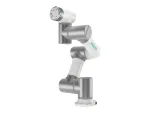
Collaborative Robots (Cobots) — What They Are and Where They Are Used

A collaborative robot (cobot) is an industrial manipulator certified for operation alongside human workers without permanent safety fencing (EN ISO 10218-1/2, ISO/TS 15066). The defining feature compared to conventional industrial robots is integrated force-torque sensing: on contact with an operator, the cobot stops automatically. Typical payload range: 3–20 kg; working radius: 300–1,300 mm.

Application areas in Ukraine: packaging and labelling on food production lines, electronics sub-assembly, vision-guided quality inspection, small-box palletizing, and pick-and-place. The key advantage for 2024–2026: cobots deploy without facility redesign and work alongside existing staff — no dedicated robot enclosure or extended shutdown required. For higher payloads and high-speed operations, see 6-axis industrial robots.

How to Choose a Cobot for Manufacturing

ParameterWhat to evaluateTypical values
Payload (kg)Part weight + end-effector mass3 / 5 / 10 / 16 / 20 kg
Reach (mm)Base to end-effector at full extension500 / 800 / 1000 / 1300 mm
Repeatability (mm)Precision of repeated positioning±0.03 / ±0.05 / ±0.1 mm
IP ratingIP54 for dust/splashes; IP67 for washdownIP54 / IP65 / IP67
Safety certificationsISO 10218, CE, STO (IEC 62061)CE mandatory
Deployment timeUnboxing to first task4–8 hours for simple tasks

1. Payload. Include end-effector mass: a typical pneumatic gripper adds 0.5–1.5 kg, a vacuum gripper 0.3–0.8 kg. If the part weighs 5 kg and the gripper weighs 1.2 kg, you need a cobot rated at least 7 kg.

2. Hand-guiding programming. The best cobots support lead-through (hand-guiding) teaching: the operator physically guides the arm through the required path and saves it. For food plants with frequent product changeovers, this is a critical selection criterion.

3. STO and functional safety. Safe Torque Off (STO) cuts motor torque on fault without removing power. Mandatory for shared human-robot workspaces. Verify SIL2 or PLd certification per EN 62061.

4. End-effector compatibility. ISO 9283 Tool Flange standard allows mounting any manufacturer's end-effector. Check flange diameter. Our gripper catalogue is compatible with most cobots.

5. Controller and software. Evaluate programming ease, ROS/ROS2 compatibility, and availability of Python/C++ libraries. If the facility already runs Mitsubishi or Siemens PLCs, check integration protocols (Modbus, EtherNet/IP, ProfiNet).

Manufacturers in the Catalogue

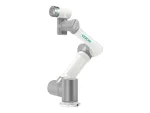
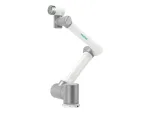
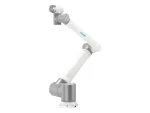
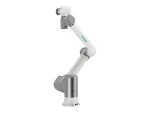
Veichi VCC series — cobots for 5–16 kg payloads with direct ecosystem integration: RB drive modules, servo drives, and INVT frequency converters. Full Veichi Robotics catalogue. Also available: 6-axis industrial robots and SCARA robots.

Cobots by Specification

Warranty and Support

12-month warranty. Commissioning, operator training, and service — available on request. Pre-purchase technical consultation includes task specification, payload calculation, and end-effector selection. Our team has 10+ years of experience deploying frequency converters and servo drives in production environments. Delivery via Nova Poshta or freight carrier for large-format shipments.

Frequently Asked Questions

What is a cobot and how does it differ from an industrial robot?

A cobot is a manipulator certified to operate alongside people without permanent safety fencing. It has integrated force-torque sensors and stops automatically on contact. Industrial robots are typically faster and handle higher payloads (100–1,000 kg) but require full workspace isolation. Cobots are for flexible tasks near operators; industrial robots are for fixed high-speed lines.

How much does a cobot cost and are leasing options available?

Cobot pricing depends on payload and brand: entry-level 5–10 kg models from Asian manufacturers start around $15,000–25,000 USD. Universal Robots or KUKA range from $35,000–60,000 USD. Leasing through Ukrainian financial institutions is available — ask at enquiry stage. Provide a task specification for an accurate quote.

Does operating a cobot require specialised training?

Basic operation (running programmes, changeovers) can be mastered in 4–8 hours. Programming new tasks takes 1–3 days for staff with no robotics background. Most manufacturers provide online training. We include initial commissioning training with every deployment.

Can a cobot be integrated with our existing factory PLC?

Yes. Most cobots support Modbus RTU/TCP, EtherNet/IP, or ProfiNet — the same protocols used by Mitsubishi, Siemens, and INVT PLCs. For more complex integrations, OPC UA and ROS2 bridge adapters are available.

What is the maximum payload for collaborative robots?

Standard cobots cover 3–35 kg. For payloads above 20 kg in shared workspaces, consider heavy cobots such as the KUKA LBR iisy 30 or ABB GoFa 20. Above 35 kg in a shared space becomes technically complex due to ISO/TS 15066 contact force limits.