Short answer: it's a marketing and certification strategy, not a technical necessity. Hardware-wise, such devices are full-fledged vector VFDs that can physically control any asynchronous or synchronous motor — manufacturers simply deliberately "narrowed" the positioning to the most massive sales market.
What's actually inside
Both devices — INVT GD100-PV and Veichi SI23 — are based on the standard topology of an industrial VFD:
- Rectifier — DC current from solar panels or grid → DC bus
- DC bus with capacitors
- IGBT-inverter → variable frequency/voltage to the motor
Veichi SI23 explicitly indicates support for vector control for synchronous and asynchronous motors, including sensor and sensorless closed-loop, servo positioning functions, and PID control. INVT GD100-PV is built on the standard GD100 platform (which is an general industrial vector VFD) and includes V/f and sensorless vector control. That is, the hardware base is the same as in conventional industrial series.
Why then "only pumps"? 5 reasons
1. Built-in MPPT — a specific function for PV
The main "superstructure" over a conventional VFD is the MPPT (Maximum Power Point Tracking) algorithm, which constantly adjusts the DC bus operating point to the current power of the solar panels. This function is only useful when the power source is a photovoltaic battery with an unstable power characteristic. For a fan or conveyor from the grid, this function is simply not used.
2. AC/DC mixing mode — killer feature for autonomous objects
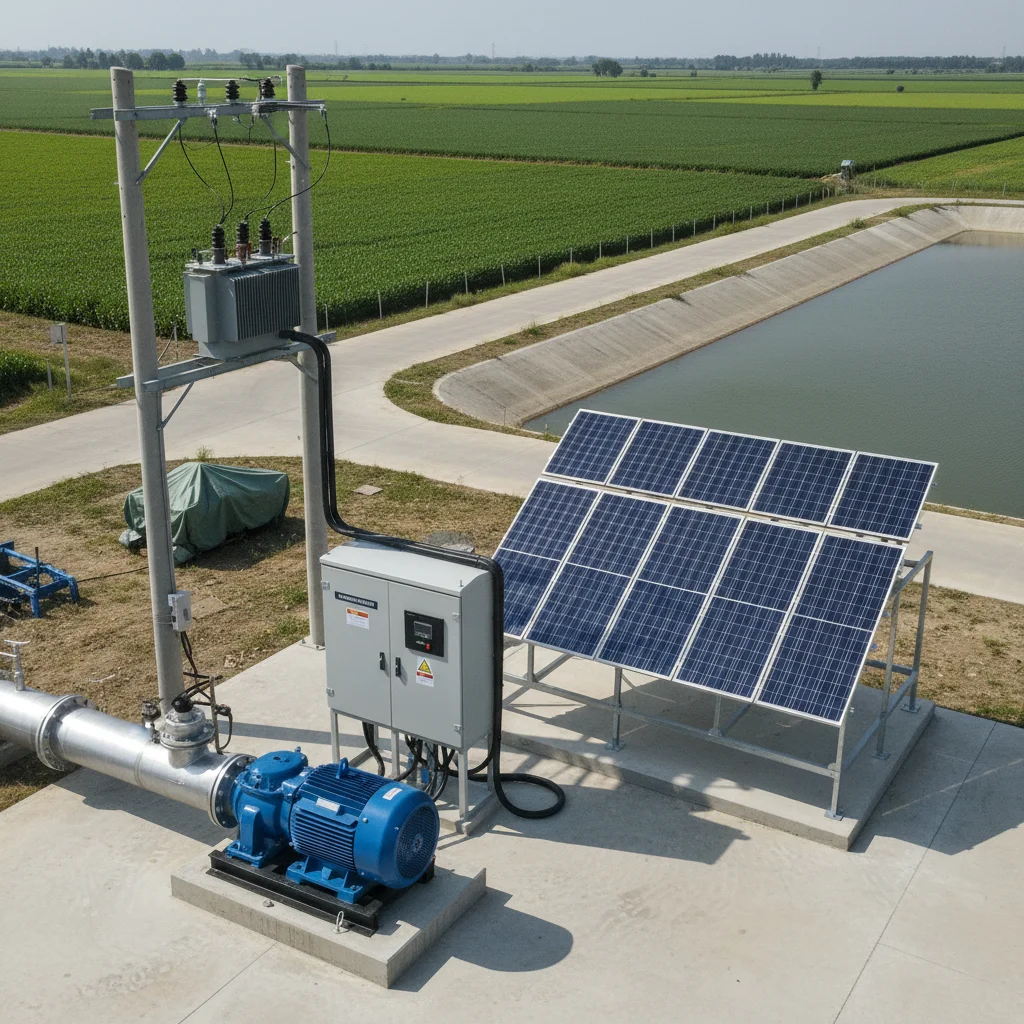
The key "hybrid" feature: automatic switching between PV DC and AC grid ensures 24/7 operation without maintenance. This is extremely valuable for pumping stations in the field, where there is sun during the day and grid power at night or during cloudy weather. For urban industrial facilities (where the grid is always available), this mode is an unnecessary option that simply doesn't pay for itself with the extra cost.
3. Protections for pump specifics
The firmware is loaded with pump algorithms:
- Dry-run protection
- Minimum frequency in low light
- Sleep mode at zero water consumption
- Water level control
- Monitoring of accumulated flow
- These functions make no sense for, for example, a lathe or a ventilation unit.
4. Target market with mass demand and government support
The solar pump VFD market is estimated at $2–28 billion and is growing at a CAGR of 7–13%. The agricultural sector in Asia, Africa, and the Middle East is the largest consumer due to solar irrigation subsidy programs. Manufacturers deliberately certify and promote the product in this niche to:
- Gain access to government programs and subsidies
- Simplify the selection process for agricultural engineers
- Avoid competition with Siemens/ABB/Danfoss in the general industrial segment
5. Price differentiation and avoidance of competitive pressure
General industrial vector VFDs from Siemens SINAMICS, Danfoss FC-302, or ABB ACS880 — a very competitive market with strict requirements for reliability, certifications (IEC 61800-5, UL, ATEX, etc.), and warranty service. Chinese manufacturers (INVT, Veichi, Inovance) win in the solar pump niche, where there are lower brand requirements and the simplicity of "plug-and-forget" connection is more valued.
Can GD100-PV / SI23 be used for conventional industrial motors?
Technically — yes, with certain caveats:
| Parameter | Solar pump VFD | Standard industrial VFD |
| Motor control | V/f + sensorless vector | V/f + closed-loop vector + encoder |
| Power input | PV DC + AC grid | AC grid (or DC bus) |
| MPPT | Yes (for PV) | No |
| Dry-run protection | Built-in | Needs configuration |
| Precise positioning functions | Limited | Full (in servo series) |
| Certification | CE (IEC 61800-3) | CE + industry-specific (ATEX, SIL, etc.) |
| Operation with fan/compressor | Yes, but without passive tuning | Optimal |
| Price | +20–40% compared to similar industrial | Basic |
Veichi SI23 even indicates support for servo control — pulse tracking, zero servo, indexing positioning, which goes far beyond "only pumps." INVT GD100-PV, when connected to the grid (AC mode), actually becomes a conventional VFD with vector control.
Conclusion in essence
Your intuition is correct: these are hybrid VFDs with built-in PV input and MPPT, not highly specialized pump devices. The "for pumps" marketing is explained by:
- The primary target market (agro-irrigation without grid access)
- Built-in pump protections in the firmware
- Strategic avoidance of direct competition in the general industrial segment
For the VFD business, this means that such models can be positioned more broadly — as a "hybrid VFD powered by solar panels or the grid" for any tasks where partial PV power makes sense (pumps, ventilation, compressors on farms, industrial facilities with solar panels). This allows differentiation from competitors who sell either "pure" VFDs or "pure" solar inverters.