Industrial Robots in Ukraine 2026: What They Are, How to Choose, What They Cost
An industrial robot is an automated programmable manipulator that performs repetitive production tasks: welding, palletizing, assembly, painting, part transfer. It differs from a CNC machine in two ways — it has three to seven axes of motion and handles different tasks without mechanical changes. Change the program, change the job.
For a Ukrainian factory in 2026, a robot is no longer futurism but a regular line in the capex plan. Prices start from UAH 247,000 for a Chinese Veichi VCC10 cobot and reach UAH 3 million for a heavy KUKA KR 240. On top of the manipulator price add 25-40% for integration — control cabinet, PLC, servo drive for the positioner, safety sensors. That is why "just buying a robot" ends up costing more than the robot itself.
In this guide we break down five real brands on the Ukrainian market, show 2026 price ranges, and give a "task to robot type" selector so you do not overpay for axes or payload you will not use.
Industrial Robot Structure: The Four Building Blocks
Every industrial robot is four blocks that must work in sync. Pick one wrong and the whole system stumbles.
- Mechanical part (manipulator): the skeleton with axes, gearboxes and servo motors. It determines payload and reach.
- Controller: industrial computer in the control cabinet. Calculates the trajectory, drives the servo motors, talks to the line PLC. KUKA uses KR C4/C5, FANUC uses R-30iB, Veichi uses its own VRC100.
- Teach pendant: touchscreen controller with a joystick that the operator uses to walk the robot point by point during programming.
- End effector (tool): welding torch, gripper, suction cup, milling head, glue dispenser — whatever the robot holds. Often 20-30% of the cell cost.
In practice the effector is what gets swapped most often. Today the robot palletizes bags, tomorrow — after a gripper change — it assembles boxes. The mechanics stay, the program and the "hand" change.
Classification: By Kinematics, Payload and Task
In 2026, kinematics is the first thing that decides whether a robot can even handle your operation. Then payload and task.
By kinematics
- 6-axis articulated: the most universal type. Reach 500-4700 mm, payload 3-1300 kg. Welding, palletizing, CNC tending, assembly. Examples — KUKA KR 6, Veichi VCR20, FANUC M-20iD.
- SCARA (4 axes): fast horizontal motion, accuracy 0.01-0.02 mm. Electronics assembly, pick & place, dispensing. Veichi VCSH100 is a working pick for small parts.
- Delta (parallel): "spider" mounted on the ceiling, up to 300 pick-and-place cycles per minute. Candy sorting, packaging, bulk food.
- Cartesian (gantry): motion along three straight X/Y/Z axes. Plasma cutting, laser engraving, industrial-scale 3D printing.
- Collaborative (cobots): work next to humans without fencing thanks to joint torque sensors. Payload usually 3-16 kg. Veichi VCC10, KUKA LBR iiwa, UR5/UR10.
By payload
| Class | Payload, kg | Typical tasks |
|---|---|---|
| Light | up to 10 | Assembly, dispensing, labs, cobots |
| Medium | 10-50 | Welding, CNC tending, packaging |
| Heavy | 50-300 | Palletizing, automotive, stamping |
| Super-heavy | 300+ | Body lifting, forging, large molds |
By task
Welding, palletizing, assembly, packaging, painting, grinding, plasma cutting. Our chastotnik.ua catalog filters by exactly that logic: the operator picks a task, not a model, and the system surfaces relevant options.
Top 5 Industrial Robot Brands in Ukraine
Over 13 years working with Ukrainian factories we have seen them all, from lone Japanese veterans of 2005 to fresh Chinese Veichi units from 2023. Here is a short take on the five brands that actually sell in 2026.
| Brand | Country | Series | Payload, kg | Reach, mm | Focus | Price from, UAH |
|---|---|---|---|---|---|---|
| KUKA | Germany | KR Agilus, Quantec, Fortec, Titan, LBR iiwa | 3-1300 | 541-4200 | Welding, palletizing, automotive | 523,000 |
| Veichi | China | VCSH SCARA, VCC cobots, VCR 6-axis, VCSG welding, VCP 4-axis | 3-120 | 400-3200 | Universal, best price/quality | 247,000 |
| FANUC | Japan | LR Mate, ARC Mate, R-2000, M-20 | 3-2300 | 550-4683 | Welding, CNC tending, palletizing | 400,000 |
| ABB | Sweden | IRB 120, 1200, 1600, 4600, 6700, YuMi | 3-800 | 580-3500 | Electronics, chemistry, assembly | 600,000 |
| MOTOMAN (Yaskawa) | Japan | HP, MH, GP, HC | 3-900 | 500-3100 | Welding, palletizing, painting | 500,000 |
KUKA is the classic for automotive. German precision, service in Kyiv, spares in Lviv, KRL programming language. Expensive but reliable. If you run a 3-shift welding conveyor, a KUKA KR 16 arc will run 15-20 years.
Veichi is our main workhorse for 2024-2026. The Chinese maker has been investing seriously in R&D since 2010. Price is 2-2.5x lower than KUKA, spares are stocked in Kyiv, a base VCR20 cell with native controller costs the same as a bare KUKA manipulator without cabinet. For small and mid-sized factories, a solid pick.
FANUC — the yellow Japanese. Fans say: "if it breaks, it was the 25th shift of the day." Strong position in CNC tending because Fanuc historically builds both machines and robots, so the integration is mature. ABB is Swedish engineering, IRB 4600 and IRB 6700 sit on assembly lines at large Ukrainian plants. MOTOMAN (Yaskawa) is strong in welding and painting; in Ukraine it ships mostly via resellers.
Industrial Robot Prices in Ukraine 2026
Short answer: from UAH 247,000 for a cobot up to 3+ million for a heavy articulated robot. In detail — here is how the 2026 market looks at roughly UAH 46/EUR.
| Category | Price, UAH | Typical models |
|---|---|---|
| Cobots up to 10 kg | 247,000 - 700,000 | Veichi VCC10, UR5, KUKA LBR iiwa |
| SCARA | 300,000 - 800,000 | Veichi VCSH100, FANUC SR-6iA |
| 6-axis up to 20 kg | 500,000 - 1,500,000 | KUKA KR 6 R900, Veichi VCR20, FANUC LR Mate |
| 6-axis 20-100 kg | 1,500,000 - 3,000,000 | KUKA KR 90, KR 210, Veichi VCR120 |
| Heavy 100+ kg | from 3,000,000 | KUKA KR 240, Titan 1000, FANUC R-2000iC |
| + Integration | +25-40% on top of robot | Cabinet, PLC, positioner servo, HMI, sensors |
Customs clearance adds another 7-12% depending on HS code and available exemptions. If you buy through us, the turnkey price already includes customs — no surprises after payment.
Six-Step Selection Checklist
This is the algorithm we run on every inquiry. Skipping steps saves an hour at selection and costs six months in rework.
- Describe the task in 2-3 sentences. "Weld two seams on a 300×200 mm part, 45-second cycle, 2 shifts." Without a task the rest of the steps are meaningless.
- Set the payload. Part weight + effector + 30% reserve. If the welding torch weighs 8 kg and the robot does not hold the part, 10-16 kg is enough.
- Compute the reach. Maximum distance from base center to the farthest working point. For a 1.5×1.5 m cell, pick a robot with 1200-1500 mm reach.
- Choose axis count. 4 axes — SCARA, planar pick & place. 6 axes — arbitrary orientation, welding, assembly. 7 axes — obstacle avoidance.
- Pick the brand for budget and support. Got budget for German quality and 15 years of service — KUKA. Optimizing capex — Veichi. Existing FANUC CNC fleet — logical to stay with FANUC.
- Plan integration. Who writes the program, who builds the cabinet, who installs. Robots do not rise on their own — a team builds the cell in 2-4 weeks.
If step 1-2 is fuzzy — write to us, we help with payload and reach calculation free of charge. Over 13 years working with VFDs, servos and PLCs we have accumulated hundreds of real-world projects.
Task-to-Robot Selector
Usually the customer arrives with "we need a robot that can..." Here is the translation from plain speech to engineering.
| Task | Robot type | Example models |
|---|---|---|
| MIG/TIG welding | 6-axis articulated | KUKA KR 16 arc, Veichi VCSG welding |
| Bag/box palletizing | 4-axis or heavy 6-axis | KUKA KR 240 palletizer, Veichi VCP120 |
| Electronics assembly | SCARA | Veichi VCSH100 |
| Small-part pick & place | Delta or SCARA | Veichi VCSH, ABB FlexPicker |
| Painting, gluing | 6-axis explosion-proof | KUKA KR 60 HA, FANUC P-Series |
| Work next to humans | Cobot | Veichi VCC10, KUKA LBR iiwa |
| Automotive body assembly | Heavy 6-axis | KUKA KR 210, FANUC R-2000iC |
| CNC machine tending | Compact 6-axis | FANUC LR Mate 200iD, Veichi VCR20 |
For most Ukrainian small and mid-sized factories the working pick is a 6-axis mid-class robot rated 10-20 kg. It covers 70% of tasks without overpaying for specs nobody uses.
Line Integration: More Than Just the Robot
The robot itself is the skeleton. Muscles and nerves are the peripherals around it. This is where chastotnik.ua beats distributors selling "bare" manipulators — we supply the whole chain on one invoice.
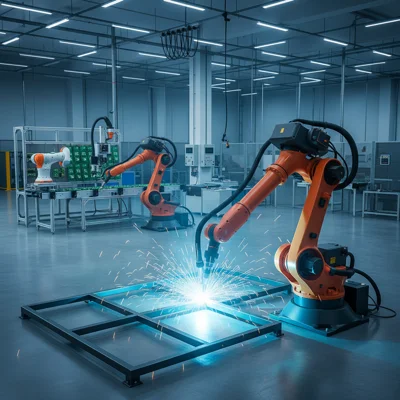
A typical welding cell looks like this:
- Robot: 6-axis KUKA KR 16 arc or Veichi VCSG, payload 16 kg, reach 1610 mm.
- Part positioner: 2-axis turntable on Veichi SD7 servo, synchronized with the robot over EtherCAT.
- Cell PLC: Delta DVP-SX2 or Mitsubishi FX5U. Drives the robot through DI/DO, handles safety signals, logs cycles.
- Operator HMI: Veichi HMV 10". Cycle start/stop, program selection, statistics.
- Safety sensors: Sick/Banner laser scanner around the perimeter, e-stops, interlocked gates. Browse our sensor catalog.
- Control cabinet: Schneider/ABB contactors, breakers, 24 V PSUs, terminals.
On a real 2024 project — a welding line for solar tracker brackets near Dnipro — the setup paid back in 18 months on a 2-shift schedule. Before, 6 welders produced 450 parts per shift; now 1 operator plus the robot deliver 900-1000 parts with better weld quality and less scrap.
If your plant already runs VFDs on conveyors, integrating a robot into that setup is easier than it looks. The PLC sees both the VFD and the robot on a single fieldbus, and the operator works from one HMI.
Robotics in Ukraine: A Short Backstory
Ukrainian factories started deploying robots at scale after 2015, when the EU-integration push moved manufacturers toward automation. We wrote about it earlier — see understanding the robotics industry and industrial robotics in Ukraine.
Since 2022 the trend has accelerated: mobilization takes away workers, welder and operator salaries have grown 2-3x. A robot now pays back in 12-36 months at average load — five years ago the math was 5-7 years. For more on the near future, read smart robotics at factories of the future and our piece on cobots that work alongside humans.
Frequently Asked Questions
How much does an industrial robot cost in Ukraine in 2026?
From UAH 247,000 for a Chinese Veichi VCC10 cobot up to 3+ million for a heavy articulated KUKA KR 240. The mid-segment of 6-axis robots rated 10-20 kg sits at UAH 500,000 - 1,500,000. Add 25-40% on top of the manipulator for integration (cabinet, PLC, sensors) and 7-12% for customs clearance.
What is the payback period for a welding cell robot?
12-36 months on a 2-shift schedule. A typical KUKA KR 16 arc cell with a Veichi SD7 servo positioner pays back in about 18 months at mid-volume production, when a single robot replaces 3-4 welders. On a single shift the number stretches to 30-36 months.
How is a cobot different from a standard industrial robot?
A cobot (collaborative robot) works next to humans without fencing thanks to torque sensors on every joint — it stops on the slightest touch. A standard industrial robot needs fencing, laser scanners and light curtains because it develops much higher force and speed. Cobots usually carry up to 16 kg at up to 1 m/s; standard robots go up to 2300 kg and 4 m/s.
Should I buy a used robot?
Probably not, unless you run your own service department. The main concern is reducer lifetime (Nabtesco RV or Harmonic Drive). After 40,000-60,000 hours the reducer develops backlash, and replacement costs 15-25% of a new robot. A used 2010 KUKA may cut 40% off the sticker, but you have no mechanical warranty. For a first project, take a new Veichi — same price as a used KUKA, with warranty and service.
What certifications and standards should industrial robots meet?
Core standards: ISO 10218-1 (safety requirements for the robot itself), ISO 10218-2 (integrated robot system requirements), ISO/TS 15066 (cobot-specific, addressing human contact). In the EU, CE marking per Machinery Directive 2006/42/EC is mandatory. In Ukraine — DSTU EN ISO 10218. Authorized KUKA, Veichi and FANUC dealers ship equipment with the full document package. Service runs through dealer centers in Kyiv, Dnipro and Lviv, and we operate our own field team for commissioning.
Next Steps
If you are ready to pick — jump into the chastotnik.ua industrial robots catalog and filter by task or payload. If in doubt — leave a request, our engineer builds a turnkey cell calculation free of charge, with robot, cabinet, PLC, servo and sensors. Over 13 years with drive equipment we have logged enough projects to skip the usual mistakes at selection time. We ship across Ukraine with delivery and commissioning included.