What is intelligent robotics and why it is transforming manufacturing
Modern industrial manufacturing is undergoing a fundamental transformation. While twenty years ago factory robots performed simple repetitive movements following rigid programs, today intelligent robotics can analyze the environment, make decisions, and adapt to changes in real time. This is not science fiction but reality, known as Industry 4.0 or the fourth industrial revolution.
The concept of smart manufacturing is based on the fusion of physical and digital systems. Programmable logic controllers (PLCs) coordinate equipment operation, servo drives provide precise positioning, variable frequency drives control electric motors, and machine vision systems monitor product quality. All of this is united by the Industrial Internet of Things (IIoT) into a single ecosystem where every element exchanges data with others.
Collaborative robots: working alongside humans
One of the most important developments in modern robotics is cobots, or collaborative robots. Unlike traditional industrial manipulators that operate behind safety barriers, cobots are designed for direct interaction with humans in the same workspace.
Cobots are equipped with force and torque sensors, machine vision systems, and collision detection algorithms. If a person accidentally touches the robot or gets in its path, the cobot stops instantly. This fundamentally distinguishes them from conventional industrial robots, collisions with which can cause serious injuries.
The applications of cobots in modern factories are remarkably broad:
- Assembly of electronic components and printed circuit boards
- Packaging and palletizing of finished products
- CNC machine tending: loading and unloading workpieces
- Polishing, grinding, and other finishing operations
- Quality control using built-in cameras and sensors
- Application of adhesives, sealants, and coatings with precision accuracy
According to the International Federation of Robotics (IFR), more than 540,000 industrial robots were installed worldwide in 2024, and the share of cobots among them is steadily growing. Annual installations are projected to reach 700,000 units by 2028.
Autonomous mobile robots (AMR) and automated guided vehicles (AGV)
In-plant logistics has traditionally been considered a support operation that does not create added value. However, moving materials between workstations, warehouses, and shipping zones can account for up to 30% of the total production cycle time. Autonomous mobile robots (AMR) and automated guided vehicles (AGV) solve this problem.
AGVs travel along fixed routes, following magnetic tapes or lines on the floor. They are reliable and time-proven but have limited flexibility. AMRs, on the other hand, build a map of the surrounding space using lidars and cameras, independently plot the optimal route, and navigate around obstacles. Variable frequency drives are used to control AMR wheel drive motors, providing smooth acceleration, precise speed regulation, and energy regeneration during braking.
In modern automotive plants, AMRs deliver components to the assembly line at exactly the right moment following the Just-in-Time principle. This allows reducing inventory levels, decreasing production floor space, and significantly improving manufacturing efficiency.
Machine vision systems: the eyes of smart manufacturing
Product quality directly depends on the ability to control every stage of the manufacturing process. Machine vision systems, integrated with industrial controllers, provide automatic part inspection with speed and accuracy unattainable by the human eye.
Modern AI-based quality control systems achieve defect detection accuracy of over 95%. For example, Audi uses AI vision systems to analyze approximately 1.5 million spot welds on 300 vehicles per shift. Triple verification at the PLC level reduces false positives by 28% compared to camera-only classification.
Key tasks of machine vision in manufacturing:
- Detection of surface defects: scratches, cracks, chips, discoloration
- Verification of geometric dimensions and tolerances
- Checking assembly correctness and presence of all components
- Reading barcodes, QR codes, and markings for traceability
- Robot navigation during pick-and-place operations
The role of variable frequency drives and servo drives in robotics
Every movement of an industrial robot requires precise motor control. Depending on the task, two main types of drive technology are used: variable frequency drives (VFDs) and servo drives.
Servo drives provide precision control of position, speed, and torque. They are indispensable for robotic manipulators where each axis requires precise positioning with accuracy to hundredths of a millimeter. Servo systems operate in a closed feedback loop, continuously correcting the motor shaft position according to the specified trajectory.
Variable frequency drives are optimal for tasks requiring speed control without strict positioning requirements. In robotic systems, VFDs are used for:
- Conveyor system drives that feed parts to robots
- Travel motors of AGVs and AMRs
- Cooling pumps for welding and laser systems
- Exhaust fans in paint booths
- Compressors of pneumatic systems powering robot grippers
Learn more about the diverse applications of VFDs in our article Applications of Variable Frequency Drives. To expand VFD functionality with communication modules, we recommend reading Expansion Boards for Variable Frequency Drives.
Comparison: traditional factory vs. smart manufacturing
| Parameter | Traditional factory | Smart manufacturing (Industry 4.0) |
|---|---|---|
| Quality control | Selective human inspection | 100% automated machine vision inspection |
| Internal logistics | Forklifts, manual handling | AMRs and AGVs with autonomous navigation |
| Line changeover | Hours or days of downtime | Minutes thanks to flexible robotic cells |
| Maintenance | Scheduled or after breakdown | Predictive: AI forecasts part wear |
| Motor control | Direct start, contactors | VFDs and servo drives with network control |
| Data collection | Manual logs, paper reports | IIoT sensors, cloud analytics, digital twins |
| Human-robot interaction | Complete isolation behind barriers | Cobots work alongside operators |
| Energy efficiency | Motors running at full power | VFDs reduce consumption by 30-50% |
Digital twins and predictive maintenance
A digital twin is a virtual copy of a physical object, process, or entire production facility that receives data from IoT sensors in real time. This technology enables modeling various scenarios, optimizing production processes, and predicting failures before they occur.
In practice, a digital twin of a robotic system includes models of all its components: the manipulator mechanics, servo drives for each axis, variable frequency drives for auxiliary systems, the controller, and the operator panel. Vibration, temperature, and current sensors continuously transmit information to a cloud platform where machine learning algorithms detect anomalies.
For example, if bearing vibration in a gearbox gradually increases, the system predicts the remaining service life and schedules replacement during the next planned shutdown. This helps avoid emergency downtime that costs manufacturers thousands of dollars per hour.
Real-world implementation examples
Aviation industry: Airbus
Assembling a commercial aircraft involves a million components and tens of thousands of stages. Airbus implemented the Factory of the Future program, integrating sensors into tools and equipment and equipping workers with industrial smart glasses. During pilot seat labeling, these technologies increase productivity by 500% and virtually eliminate errors.
Automotive industry
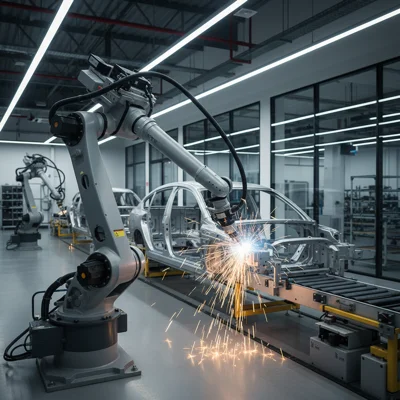
Automotive plants are pioneers of robotization. A modern body welding line uses hundreds of robots, each equipped with servo drives for precise positioning of the welding gun. Conveyor systems between stations are controlled by variable frequency drives that synchronize body feed speed with the robot cycle time.
Electronics industry
Semiconductor and electronics manufacturing requires cleanrooms with controlled environments. AMRs move silicon wafers between processing stages, while cobots perform testing and packaging of finished products. Machine vision systems inspect microscopic defects on areas smaller than a square millimeter.
Communication technologies in robotic systems
Intelligent robotics requires reliable and fast data exchange between all components. Modern industrial networks provide deterministic transmission of control commands with minimal latency:
- EtherCAT: cycle time under 100 microseconds, ideal for synchronizing servo drives in multi-axis robots
- PROFINET IRT: provides isochronous control with accuracy up to 1 microsecond
- EtherNet/IP: widely used for PLC communication with upper-level management systems
- OPC UA: unified protocol for data exchange between equipment from different manufacturers
- MQTT: lightweight protocol for transmitting IoT sensor data to cloud platforms
Special expansion boards supporting various communication protocols are used to integrate variable frequency drives into industrial networks. This enables centralized control of dozens of drives from a single controller, monitoring their status on an operator panel, and collecting diagnostic data for predictive maintenance.
What it takes to build smart manufacturing
The transition to intelligent robotics does not happen overnight. It is a gradual process that can be broken down into several key stages:
- Audit current processes and identify bottlenecks where robotization will deliver the greatest return
- Upgrade drive technology: replace direct motor starting with variable frequency drives and install servo drives for precision operations
- Implement industrial controllers supporting modern communication protocols
- Install operator panels for process visualization and equipment control
- Integrate robots and cobots into production chains
- Deploy machine vision systems for quality control
- Connect IIoT sensors and create digital twins for analytics
Each of these steps is self-sufficient and delivers measurable results. It is not necessary to implement everything at once. Even simply replacing an unregulated conveyor drive with a variable frequency drive can save 30% to 50% on electricity and extend the life of mechanical equipment. An overview of modern VFD capabilities is provided in the article VEICHI Variable Frequency Drive Concept.
The future: what awaits industrial robotics
Investment in the industrial robotics sector remains at record levels. In the first half of 2025, deal volume reached $7.3 billion. The key trends that will shape the development of smart factories in the coming years:
- Generative AI for programming robots using natural language instead of writing code
- Humanoid robots for unstructured environments where classical manipulators are ineffective
- Swarm robotics: dozens of simple robots coordinating actions to accomplish complex tasks
- Cloud robotics: computationally intensive AI tasks are performed on a server rather than onboard the robot
- 5G networks for wireless communication with ultra-low latency at factory scale
The factory of the future is not a deserted workshop where robots work in the dark. It is a harmonious combination of human experience and machine precision, where technology frees people from routine and hazardous work for creative and strategic tasks.