WEG W22: What This Series Is and Why It Stands Out
The WEG W22 is a line of three-phase asynchronous electric motors produced by WEG, one of the largest electrical equipment manufacturers in the world. The series covers a power range from 0.12 to 375 kW and meets IE2 and IE3 efficiency classes as defined by IEC 60034-30. Frames are manufactured in cast iron or aluminium alloy depending on the frame size — cast iron delivers mechanical rigidity for heavy-duty installations, while aluminium keeps weight low in smaller sizes.
WEG designed the W22 around three priorities: minimum energy consumption, low noise and vibration, and a long service life with minimal maintenance. Those priorities make it a natural fit for applications where unplanned downtime is expensive.
IE2 vs IE3 Efficiency Classes: Understanding the Difference
IE2 (High Efficiency) satisfies EU Directive 640/2009 and is the minimum standard permitted for new installations across most markets. IE3 (Premium Efficiency) exceeds IE2 by an average of 1–3 percentage points of motor efficiency depending on rated power. The gap sounds modest, but on a 75 kW motor running 6,000 hours per year it translates to several thousand kilowatt-hours saved annually.
WEG recommends W22 IE3 as the default choice for new projects driven by a variable frequency drive. Pairing an IE3 motor with a VFD typically cuts electricity consumption by 30–60 % compared with an unregulated IE2 drive on the same application.
Comparison Table: W22 IE2, W22 IE3, and Competitors
| Parameter | WEG W22 IE2 | WEG W22 IE3 | ABB M2AA IE2 | Siemens 1LE1 IE3 |
|---|---|---|---|---|
| Power range, kW | 0.12–375 | 0.75–375 | 0.18–355 | 0.75–315 |
| Insulation class | F | F | F | F |
| Protection degree | IP55 | IP55 | IP55 | IP55 |
| Frame material | Cast iron / aluminium | Cast iron / aluminium | Cast iron | Cast iron / aluminium |
| VFD compatible | Yes | Yes (optimised) | Yes | Yes |
| Relative price | Medium | Medium+ | High | High |
The W22 outperforms its closest rivals primarily on price-to-performance ratio and the breadth of available frame sizes. ABB M2AA and Siemens 1LE1 are dependable alternatives, but they carry a noticeably higher price tag for comparable technical specifications.
Where WEG W22 Motors Are Used
The W22's universal construction makes it suitable for the vast majority of industrial drive applications:
- Pumps — water supply, wastewater, irrigation. B5 and B35 mounting options allow direct flange coupling to pump housings.
- Fans and ventilation — industrial HVAC, process cooling, exhaust systems.
- Compressors — reciprocating and screw types where stable starting torque is critical.
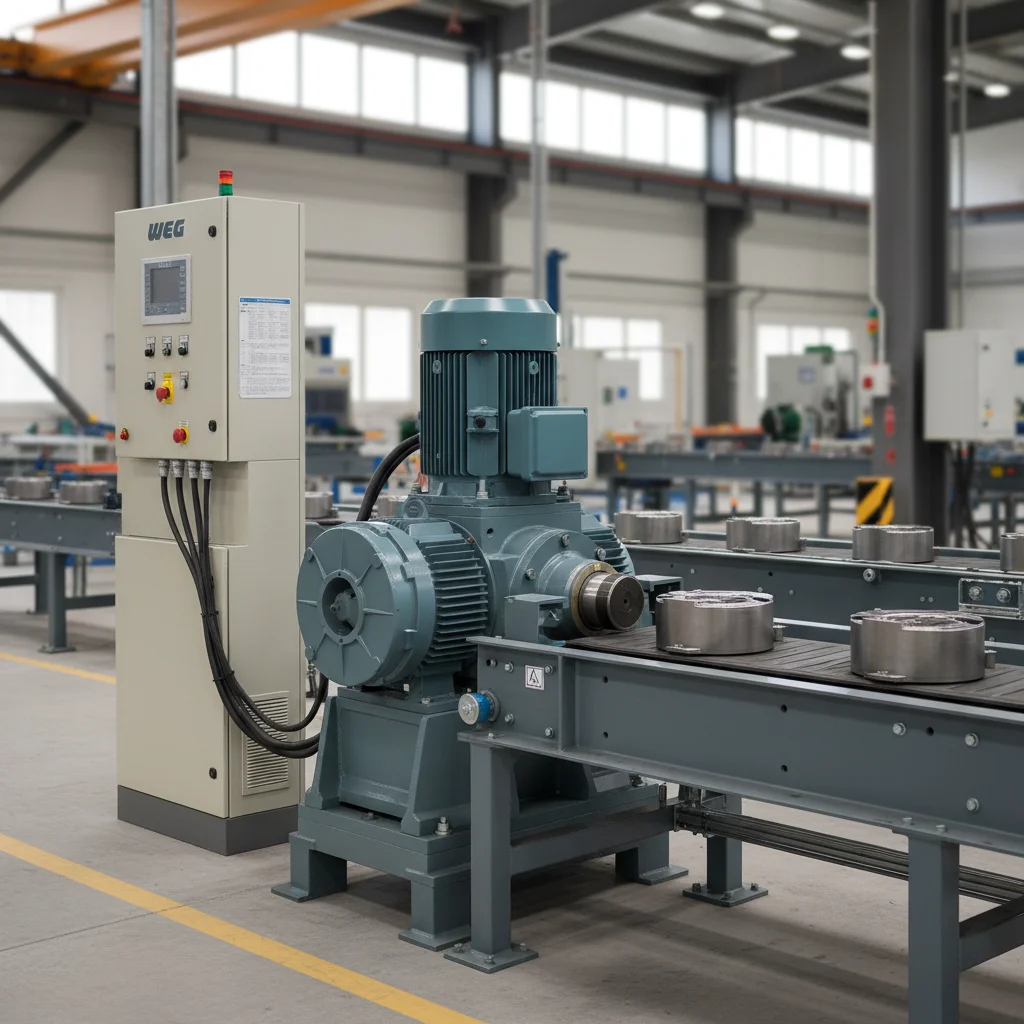
- Conveyors and transport systems — food processing, logistics, mining.
- Mixers and extruders — chemical and polymer processing industries.
For variable-load applications the recommended combination is a WEG W22 motor paired with a soft starter or VFD. This protects the supply network from inrush currents and significantly extends the service life of the mechanical drivetrain.
How to Select a WEG W22 Motor: Step-by-Step Guide
Step 1. Calculate the required power. Determine the load power accounting for the mechanical transmission efficiency and a 10–15 % safety margin. For pumps and fans use the formula P = Q·H·ρ·g / η, where η is the pump efficiency.
Step 2. Choose the number of poles. 2-pole (3,000 rpm) is ideal for centrifugal pumps and fans. 4-pole (1,500 rpm) is the all-purpose choice for conveyors and compressors. 6-pole (1,000 rpm) suits applications requiring a lower starting torque or a slow-speed drive without a gearbox.
Step 3. Select the mounting arrangement. B3 — foot-mounted, horizontal. B5 — large-diameter flange (pumps). B14 — small square flange. B35 — combined foot and flange. The W22 is available in all four arrangements without surcharges for special configurations.
Step 4. Assess the environmental conditions. The standard W22 carries IP55 protection and Class F insulation with a thermal margin to Class B. This is sufficient for most wet and dusty environments. For chemically aggressive conditions WEG offers versions with enhanced coating or stainless steel hardware.
Step 5. Decide on the control method. If variable-speed operation is required, specify the W22 IE3 in VFD-duty (Inverter Duty) configuration from the outset. This ensures correct operation at reduced frequencies without winding overheating.
Why Choosing WEG W22 Makes Business Sense
First, energy savings. Upgrading from an older non-IE-rated motor to a W22 IE3 typically pays back within 1–3 years through reduced electricity bills alone. Second, reliability: mean time to bearing failure exceeds 40,000 hours thanks to the enhanced lubrication system and G2.5-class rotor balancing. Third, supply chain confidence — WEG's authorised distribution network in Ukraine means replacement parts and service support are genuinely accessible, not a multi-week import exercise.
If you're looking for a complete drive solution — a frequency inverter matched to a W22 motor — our engineers are ready to help. We'll identify the optimum combination for your application and support you through commissioning.