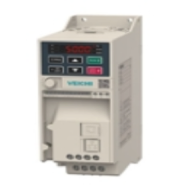
Main causes of emergency stops of Veichi frequency inverters
To minimize equipment downtime, always start diagnostics by analyzing the error log in parameter group F13 and checking the integrity of the power circuits. Veichi frequency inverters are high-tech devices that use complex vector control algorithms to ensure motor operation accuracy. However, external factors such as power grid instability, sudden load changes, or natural wear of motor insulation can trigger protective systems. When the microprocessor detects parameter deviations from set limits, it immediately blocks the operation of power transistors to prevent their destruction. The error codes that appear on the control panel are the primary tool for a service engineer. They allow localizing the problem without the need for complete equipment disassembly. The first step in the event of any fault should be referring to the error log, which stores data on current, voltage, and frequency at the moment the fault occurred. This helps determine whether the error was caused by an accidental grid disturbance or if it is systematic, related to equipment defects.
Overcurrent error E.OC (Overcurrent): IGBT and insulation diagnostics
If the E.OC error appears, immediately disconnect the motor from the VFD and measure the insulation resistance of the windings with a 500 V megohmmeter, and also check the integrity of the IGBT power transistors using a multimeter. The overcurrent error is one of the most dangerous, as it directly threatens the integrity of the power semiconductor modules. In Veichi VFDs, this error is divided into three subcategories for more precise diagnostics. Code E.OC1 indicates overcurrent during acceleration, E.OC2 during deceleration, and E.OC3 during constant speed operation. If the error occurs instantly at startup even without a connected motor, it almost certainly indicates a breakdown of the IGBT power module. To check the transistors, follow these steps:
- Completely de-energize the device and wait at least 10 minutes for the DC bus capacitors to discharge fully.
- Switch the multimeter to diode test mode.
- Connect the positive probe to the DC- terminal, and touch the output terminals U, V, W one by one with the negative probe. A healthy device will show a voltage drop within 0.3–0.7 V.
- Repeat the procedure by connecting the negative probe to the DC+ terminal and touching U, V, W with the positive probe.
Any zero readings or an open circuit indicate module failure. If the IGBT is healthy, the cause of the E.OC error may be a phase-to-phase short circuit in the motor or a ground fault. Check the cable line and motor windings using a megohmmeter. Also check parameter F01.22 (acceleration time) — excessively fast acceleration of a heavy rotor often leads to an instantaneous current spike.
Overvoltage error E.OU (Overvoltage): working with regenerative energy
To eliminate the E.OU error, increase the deceleration time (parameter F01.23) or install a braking resistor of the appropriate rating and power. In Veichi manuals this code is labelled exactly as E.OU (over-voltage); if you search for it as "E.OV", it is the same overvoltage protection. The overvoltage error occurs when the voltage on the internal DC bus exceeds a safe limit. For three-phase 380 V models, this limit is about 820 V. Code E.OU1 signals overvoltage during acceleration, E.OU2 during deceleration, and E.OU3 during constant speed operation or in coasting mode. The most common scenario is E.OU2, which occurs when attempting to quickly stop a motor with a high moment of inertia (for example, a high-power fan or centrifuge). In this case, the motor starts acting as a generator, returning kinetic energy back to the frequency inverter. Since more energy is returned than the filter capacitors can absorb, the voltage on the DC bus rises rapidly. To solve this problem, increase the deceleration time in parameter F01.23. If the technological process requires a fast stop, the only solution is to install an external braking resistor. The resistor is connected to the dedicated VFD terminals P+ and PB, and the overvoltage-suppression-during-braking function is configured by parameter F10.11 (the trip point is set in F10.12). Also check the voltage level in the power grid: prolonged overvoltages in the grid exceeding 420 V can also cause the E.OU3 error at standstill or when operating with minimal load.
Undervoltage error E.Lu (Undervoltage): configuring auto-restart
In case of frequent grid voltage drops, configure the automatic restart function after power recovery by setting parameter F07.06=2 and delay time F07.07=0.00 (or another required value), and also check the protection parameters in group F07. The E.Lu error is typical for industrial grids where voltage fluctuations often occur due to the connection of high-power equipment. When the DC bus voltage drops below a critical level (about 350 V for three-phase models), the VFD stops operation to prevent damage to the input rectifier and unstable operation of the control system. To automate the process of resuming operation after short-term voltage drops, Veichi offers special tools. Parameter F07.06 defines the device's action upon undervoltage: setting the value to 2 allows the VFD to automatically restart as soon as the grid voltage returns to normal. Parameter F07.07 sets the waiting time before restarting. Setting the value to 0.00 avoids delays, which is critical for continuous production lines. Additionally, the undervoltage protection trip point is set by parameter F10.19, below which the drive registers the E.Lu error. Also check the condition of the input magnetic contactor and fuses, as poor contact or burning of the contactor power plates often causes a significant voltage drop under load.
Comparison table and quick diagnostics algorithm
Use the systematized code table for quick fault identification before changing factory settings or dismantling the device. Proper diagnostics saves time and money on repairs. Below is a comparison table to help you quickly navigate when emergency codes E.OC, E.OU, and E.Lu occur. If you need a new reliable frequency inverter, pay attention to the range offered by the specific category of our website.
| Error code | Fault name | Possible cause | Remedy |
|---|---|---|---|
| E.OC1 / E.OC2 / E.OC3 | Overcurrent | Short circuit, IGBT module damage, excessively short acceleration time | Check motor insulation, test IGBT with a multimeter, increase parameter F01.22 |
| E.OU1 / E.OU2 / E.OU3 | Overvoltage | Regenerative motor mode during deceleration, high grid voltage | Increase deceleration time F01.23, install a braking resistor, check grid voltage |
| E.Lu | Undervoltage | Grid voltage drop, phase loss, input contactor failure | Configure auto-restart (F07.06=2, F07.07=0.00), check input contacts and the F10.19 threshold |
Recommendations for prevention and maintenance
Perform regular cleaning of the cooling heatsink and tightening of the power terminal block screw terminals every six months to prevent local overheating and false protection trips. Most problems with frequency inverters arise from improper operating conditions. Accumulation of dust, especially conductive metal dust or moisture, on the control boards can lead to current leakage and false E.OC protection trips. Regular blowing with compressed air is a mandatory maintenance procedure. Also, over time, under the influence of vibration, the screw connections of the power terminals can loosen. This leads to an increase in contact resistance, local heating of the terminal block, and can cause the E.Lu error due to a voltage drop directly at the device input. Using input AC line reactors allows smoothing voltage ripples and protecting the input bridge from surge interference, which significantly reduces the likelihood of E.OU and E.Lu errors. Compliance with these simple rules will significantly extend the service life of the equipment and ensure its stable operation under any conditions.