AIR motors — the workhorse of post-Soviet industry
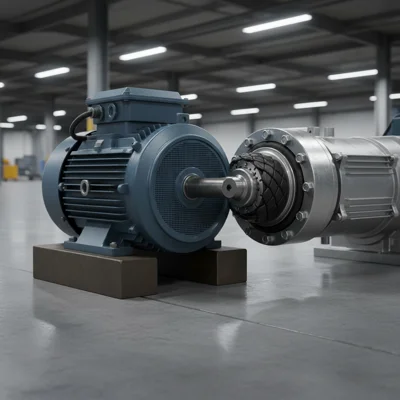
AIR is a series of asynchronous three-phase motors that became the de facto standard across the former Soviet Union. If a general-purpose drive sits on a factory floor in Ukraine — there is roughly a 70% chance it is an AIR or its predecessor, the 4A series. Power ratings span 0.18 to 315 kW, frame dimensions follow the "Interelectro" standard, and spare parts are available even in small towns. These motors have held their ground for over 30 years, and below we explain why — and how to pick the right model.
Designation system explained
AIR stands for: A — asynchronous, I — Interelectro standard, R — drive (earlier models used "S" for machine-tool duty). The number-letter code after that determines the frame size and pole count.
Example: AIR 100L4 means frame size 100 mm (shaft height), long body (L), 4 poles — which translates to 1500 rpm at 50 Hz. The letter S means short body, M means medium.
- Frames 56–80 — small drives up to 1.5 kW: fans, small pumps
- Frames 90–132 — mid range 1.5–11 kW: compressors, conveyors, mixers
- Frames 160–250 — heavy-duty 15–90 kW: large pumps, crushers, mills
- Frames 280–355 — heavy industry up to 315 kW and above
AIR series: how modifications differ
The base AIR series has dozens of modifications. The key point — do not mix them up, because mounting dimensions may match while performance specs do not.
| Series | Feature | Typical application |
|---|---|---|
| AIR (base) | IP54, insulation class F, standard | General industrial equipment |
| AIRM | Modernized, smaller frame at same power | Tight spaces, replacing old 4A motors |
| AIRU | Enhanced moisture resistance | Agriculture, water utilities |
| AIRP | Low vibration precision grade | Machine tools, precision equipment |
| AIS (DIN) | IEC Euro standard, different mounting dims | Imported equipment, EU projects |
In practice, 90% of orders are base AIR or AIRM. When replacing an old motor, check the mounting dimensions first: shaft height, shaft diameter, foot-hole spacing. This is probably the most common mistake during replacement.
Power ratings and speeds: reading the table
Each AIR frame is produced with different pole counts. More poles means lower speed but higher torque.
| Frame | 2-pole (3000 rpm) | 4-pole (1500 rpm) | 6-pole (1000 rpm) | 8-pole (750 rpm) |
|---|---|---|---|---|
| 71 | 1.1 kW | 0.75 kW | 0.37 kW | 0.25 kW |
| 100 | 4.0 kW | 3.0 kW | 1.5 kW | 1.1 kW |
| 132 | 11 kW | 7.5 kW | 5.5 kW | 4.0 kW |
| 160 | 18.5 kW | 15 kW | 11 kW | 7.5 kW |
| 200 | 37 kW | 30 kW | 22 kW | 15 kW |
| 250 | 75 kW | 55 kW | 37 kW | 30 kW |
Note that the actual shaft speed is always below the synchronous value. A 2-pole motor delivers roughly 2880–2920 rpm, not exactly 3000. This difference — called slip — is normal for induction machines.
How to choose pole count
- 2-pole (3000 rpm) — centrifugal pumps, high-pressure fans, grinding machines
- 4-pole (1500 rpm) — the most common option: conveyors, compressors, most pumps
- 6-pole (1000 rpm) — mixers, low-speed equipment, some fans
- 8-pole (750 rpm) — rare: slow-speed drives, special equipment
AIR vs imported motors: an honest comparison
AIR falls behind modern WEG and ABB motors in energy efficiency. Most AIR units meet IE1 class, while WEG W22 and ABB M2AA ship with IE3. The efficiency gap is 2–5 percentage points, which on high power and continuous duty translates into real savings.
But there is a flip side. AIR costs 2–3 times less than the imported equivalent. If the motor does not run around the clock, or the power is modest, that IE3 premium may take 7–10 years to pay back. So it is not always justified.
- Pick AIR when: budget is tight, drop-in replacement, non-critical load
- Pick imported (WEG, ABB) when: 24/7 operation, power above 15 kW, EU standard requirements
There is a third way — pair an AIR motor with a variable frequency drive. A VFD compensates for the lower efficiency class and adds speed control, which saves 20–40% on fans and pumps. We see this combination at customer sites more often than any other.
Selecting an AIR motor: 5 steps
- Determine load power. If replacing an old motor — read the nameplate or measure current with a clamp meter.
- Choose rotation speed. Check the driven equipment: if a gearbox is present — usually 1500 rpm; direct-drive pump — often 3000 rpm.
- Verify mounting type. Foot (B3), flange (B5), or combined (B35). Measure shaft height and shaft diameter.
- Confirm voltage. 380 V is the standard for three-phase. If you only have single-phase 220 V — AIR will not work without a converter.
- Consider the environment. Humidity, temperature, dust. For harsh conditions pick AIRU or a motor rated IP55.
And above all: if you are unsure — send a photo of the old motor nameplate to our team. We will find a replacement in 10 minutes. We do this every day.
Soft starting an AIR motor
Starting current of an AIR motor is 5–7 times the rated value. For a 15 kW motor that means a 150–200 A inrush on direct-on-line start. The circuit breaker may trip, and if the supply is a generator — the generator will stall.
Two solutions: a soft starter or a variable frequency drive. A soft starter limits inrush to 2–3 times rated current and costs less. A VFD provides soft start plus speed control, but is more expensive. For simple tasks (conveyor, fixed-speed fan) a soft starter is enough.
Frequently Asked Questions
What is the difference between AIR and AIRM?
AIRM is a modernized version with a smaller frame at the same power rating. For example, AIR 132M4 (7.5 kW) and AIRM 112M4 (7.5 kW) deliver the same power, but AIRM is one frame size smaller. Mounting dimensions differ — compare drawings before swapping.
Can I connect an AIR motor to a 220 V supply?
Not directly — AIR is designed for a three-phase 380 V supply. However, a single-phase-input VFD can convert 220 V single-phase into three-phase output, and the motor will run fine.
How long does an AIR motor last?
Under normal operating conditions — 15 to 20 years. The main enemies are overheating and moisture. If the motor runs in a dusty room without maintenance, bearing life drops to 3–5 years.
How do I find the power if the nameplate is worn off?
Measure the shaft centre height (from the foot to the shaft centre) and determine the pole count (or measure no-load current with a clamp meter). Cross-reference with the AIR frame table to identify the power rating within one frame size.
AIR or WEG — which is better for a pump?
For a household pump at a country house — AIR is cheaper and easier to source. For an industrial pump at 30+ kW running 24/7 — a WEG W22 IE3 will pay for itself in 3–4 years through energy savings.
Summary
AIR is a time-proven motor for applications that do not demand peak efficiency. Affordable, widely available, easy to repair. For new projects with heavy loads, consider WEG or ABB, and keep AIR for replacing existing drives or non-critical uses. Need help choosing? Browse our AIR motor catalog or contact our team — we will match a model to your machine.