Mitsubishi MELSERVO Servo Drives: when benchmark Japanese precision is justified, and when it is overpaying
Mitsubishi Electric MELSERVO is a premium Japanese servo drive that has held a reputation as the benchmark for reliability and precision for decades. Our catalogue holds 138 items of the full line: two amplifier series, MR-J4 and MR-J5, matching servo motors, and ready servo kits. This brand shines where a Mitsubishi MELSEC PLC ecosystem is already in place, or in CNC, packaging, semiconductor and robotics tasks where positioning repeatability is critical. Honestly: MELSERVO costs more than Delta or Veichi. If you have a single axis with a typical PLC and budget matters, below we explain plainly when it is more rational to look at Delta or Veichi, which we also carry.
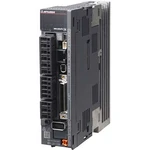
Before selection we ask three things: which control interface you need (pulse/analog or the SSCNET fibre-optic bus), the voltage class (200V for 1-ph/3-ph 220V or 400V for 3-ph 380V), and the required power and load type. Power in MELSERVO is coded simply: the number in the designation is watts divided by 10. The amplifier range runs from 100 W to 7 kW. 24-month warranty, delivery across Ukraine.
Two MELSERVO Series: MR-J4 and MR-J5
MR-J4: Proven workhorse series with a 22-bit absolute encoder
MR-J4 is the classic series installed in millions of machines worldwide. Servo motors in this series carry a 22-bit absolute encoder, so position is retained without a homing pass after power-off (with a backup battery). We choose MR-J4 when a reliable, proven drive is needed, when MELSEC controllers for SSCNET III/H are already in place, or when repairing or extending a line already built on MR-J4. MR-J4 and MR-J5 share mounting dimensions, so upgrading from J4 to J5 needs no mechanical rework.
MR-J5: New generation with a 26-bit batteryless encoder
MR-J5 is the next MELSERVO generation. Servo motors carry a 26-bit absolute encoder with higher resolution (26 vs 22 bits), and absolute position is retained without a battery (batteryless) — removing maintenance and the risk of losing position to a dead battery. The control loop is faster, vibration suppression is better, and dynamic tasks are tracked more precisely. We choose MR-J5 for new projects where maximum precision, service life and zero encoder maintenance matter: semiconductors, precision packaging, robotics, CNC.
The -A and -B Interfaces: the key choice before ordering
-A amplifiers: pulse/analog, a universal link to any PLC
The -A build is the classic pulse/direction and analog interface. A single axis, controlled from any PLC: Siemens, Delta, Omron, Schneider — any vendor. This is the universal option: if you already have a non-Mitsubishi controller and need one precise axis, choose -A. Our ready servo kits are built on this interface. If the task is typical and single-axis, it is worth honestly comparing the price against Delta or Veichi — for many simple tasks they are more rational, and the -A interface is available there too.
-B amplifiers: SSCNET III/H for Mitsubishi multi-axis synchronization
The -B build runs on SSCNET III/H — a high-speed fibre-optic bus for multi-axis synchronization. It delivers minimal latency and precise coordination of several axes, but it works only with Mitsubishi MELSEC controllers (Simple Motion / Motion). It is not a universal interface: to use -B you need the Mitsubishi ecosystem. Choose -B when building a multi-axis machine on the Mitsubishi platform and you want the most out of synchronization — packaging lines, gantry systems, CNC. If there is no Mitsubishi controller and none is planned, -B is not the way — it is an integration dead end.
MELSERVO Servo Motors
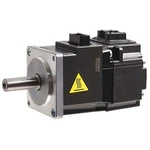
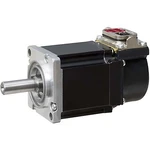
The catalogue holds 39 servo motors for both series. For MR-J4 — HG-KR and HG-SR motors; for MR-J5 — HK-KT and HK-ST. Flanges from 40 to 176 mm, absolute encoder. The selection logic is simple: the KR/KT series are low-inertia, for dynamic tasks with frequent acceleration and reversal; the SR/ST series are medium-inertia, for inertial loads where smooth, stable motion is required. We size by torque, speed and load inertia, not by "kilowatts" — for servo that distinction matters. All brand motors are on the servo motors page.
Ready Servo Kits: motor + amplifier as an assembly
39 ready "servo motor + amplifier" kits with an -A interface. Choose this when you would rather not verify encoder, cable and rating compatibility yourself: the kit pairs the motor with a matched amplifier, parameters already agreed. It is the fastest and safest way to bring one axis online without selection errors. For a multi-axis machine on the Mitsubishi platform, we configure separate -B amplifiers for SSCNET instead.
Which Mitsubishi Build to Choose?
A single axis with any PLC where maximum precision matters — take an -A amplifier or a ready servo kit on MR-J4/MR-J5. A multi-axis machine on Mitsubishi MELSEC controllers — take -B over SSCNET III/H. A new project with zero encoder maintenance and maximum service life — MR-J5; repair or expansion of an existing line — MR-J4. The full Mitsubishi servo range is on this page, with amplifiers in the servo amplifiers section and motors in the servo motors section. If budget decides and the axis is single — compare with Delta and Veichi. Unsure about the choice — send us the machine parameters and we will select together and tell you honestly where the premium is not worth it.