How a Solar Panel Pump Works
A solar panel pump is an autonomous water supply system that uses solar energy to pump water without connecting to the electricity grid. The principle of operation is simple: photovoltaic panels generate direct current (DC), which is fed to a solar pump inverter. This specialized device converts DC into alternating current (AC) with the required frequency and voltage to power the pump's electric motor.
The key element of the system is precisely the solar pump inverter, not a regular grid inverter. Why? There are three fundamentally different connection schemes, and only one of them is efficient:
Panels → solar pump inverter → pump — the most efficient scheme. The inverter with an MPPT tracker extracts maximum power from the panels at any time of the day and smoothly regulates the pump's speed depending on the available solar power. The system efficiency is 90-95%.
Panels → grid inverter → grid → pump — inefficient, because it requires connection to the grid (which itself costs 50,000-200,000 UAH in rural areas). And what's the point of solar panels then?
Panels → batteries → household inverter → pump — the most expensive scheme. A set of batteries for a 2.2 kW pump will cost 40,000-80,000 UAH, while they lose 15-20% of energy during charging-discharging and degrade in 3-5 years. For water supply tasks, this is economically impractical.
A water pump on solar panels with a specialized inverter works on a simple principle: the sun shines – the pump pumps water into an accumulation tank. Water in the tank is, in essence, a "battery" without losses or degradation.
Types of Pumps for Solar Panels
Not every pump is suitable for operation with solar panels. The main requirement is a three-phase asynchronous motor (or single-phase for small capacities) that can work with frequency regulation. Let's consider three main types.
Submersible (Borehole) Pumps
A submersible pump from solar panels is the most popular solution for autonomous water supply in Ukraine. Such pumps are installed directly into the borehole at a depth of 20 to 200 meters. Typical power is from 0.75 to 7.5 kW.
Key characteristics for selection:
- Borehole depth (determines the required head)
- Borehole yield (determines maximum capacity)
- Casing pipe diameter (determines pump dimensions – 3" or 4")
- Static and dynamic water levels
For boreholes 30-80 meters deep, pumps with a power of 1.5-2.2 kW and a capacity of 3-5 m³/h are most often used – this is sufficient for a farm or a small village.
Surface Pumps
Used for drawing water from open reservoirs: ponds, rivers, canals, shallow wells. Suction depth – up to 8-9 meters. Surface pumps are simpler to install and maintain, but are limited by the depth of the source. An ideal solution for irrigation from solar panels when the water source is an open reservoir near the field.
Circulation Pumps
Used in heating and cooling systems. For solar systems, this is a rare option, but it makes sense in industrial greenhouses where solar panels simultaneously power the circulation of the coolant in the heating system.
What is a Solar Pump Inverter and Why is it Needed?
A solar pump inverter is the heart of the entire system. It is not a regular frequency converter, but a specialized device designed specifically for working with photovoltaic panels and pumps. Here's what it does:
MPPT tracking (Maximum Power Point Tracking) — an algorithm that constantly seeks the maximum power point of solar panels every second. In the morning, when the sun is low, the panels produce less power, but the MPPT controller "squeezes" the maximum out of them. During the day, with full sun, it ensures peak performance. Without MPPT, you lose 20-30% of potential energy.
Frequency regulation — the inverter smoothly changes the motor's power frequency (from 0 to 50 Hz and above), regulating the pump's speed proportionally to the available solar power. In the morning, the pump works slowly, during the day – at full power, in the evening – it slows down again. No jerks, no water hammer.
Protective functions:
- Dry run protection – if the water in the borehole runs out, the inverter stops the pump
- Overvoltage protection – in case of panel or cable damage
- Overload protection – in case of pump jamming
- Lightning protection – built-in varistor at the DC input
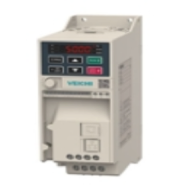
On the Ukrainian market, the most popular series are Veichi SI30 for household and farm systems (0.75-7.5 kW, single-phase/three-phase input) and Veichi SI23 for industrial (7.5-110 kW, three-phase input). The full catalog of solar pump inverters is in the solar inverters for pumps section.
How to Connect a Submersible Pump to Solar Panels – Step-by-Step Instructions
Let's analyze a specific example: connecting a 2.2 kW borehole pump for autonomous water supply to a farm.
Step 1. Determine the Pump's Power
The pump's power depends on two parameters: the required capacity (m³/h) and the borehole depth (head in meters). For a typical borehole 40-60 meters deep with a need for 3-4 m³/h, a pump with a power of 2.2 kW is sufficient.
Important: use the actual consumed power from the pump's passport, not the "maximum" from promotional materials.
Step 2. Calculate the Number of Solar Panels
The formula is simple: the panel power should be 30-50% greater than the pump's power. Why? Because panels rarely produce nominal power (clouds, sun angle, temperature, dust).
For a 2.2 kW pump: 2200 × 1.4 = 3080 W — minimum total panel power.
Using 400 W panels: 3080 ÷ 400 = 7.7, round up to 8 panels of 400 W = 3200 W. But a minimally functional system is 6 panels (2400 W), it's just that the pump will only work at full power in ideal sun conditions.
Solar panels can be selected in our catalog.
Step 3. Choose a Solar Pump Inverter
For a 2.2 kW pump (single-phase, 220V), we choose Veichi SI30-SS2-2R2G-R — a 2.2 kW solar pump inverter with a built-in MPPT controller. MPPT range: 150-450V DC, which is ideal for 6-8 series-connected panels.
If the pump is 1.5 kW – a younger model SI30-SS2-1R5G-R will fit. For industrial needs (from 45 kW) – the SI23 series.
Step 4. Installation and Connection
Connection diagram:
- Solar panels are connected in series (string). 6 panels × ~40V = 240V DC — falls within the MPPT range of the inverter (150-450V).
- DC cable (solar, 4 mm² or 6 mm², with MC4 connectors) from panels to the inverter.
- Inverter is mounted near the well in a protected box (IP54 or higher) or in a technical room.
- AC cable from the inverter to the pump (cross-section according to power – usually 2.5 mm² for 2.2 kW).
- Water level sensor is connected to the corresponding input of the inverter for dry run protection.
Attention: connection is carried out only with panels switched off (covered with opaque material) and the pump disconnected. The string voltage from 6-8 panels – 240-320V DC, is life-threatening.
Irrigation from Solar Panels: Autonomous System for Farmers
Let's consider a real scenario, relevant for thousands of Ukrainian farmers: a field of 5 hectares, a borehole 40 meters deep, the nearest power line – 2 kilometers away. Connection to the grid – from 100,000 UAH (if at all possible within a reasonable time).
Solution: autonomous solar pump system.
Equipment:
- 8 solar panels of 400 W (total 3.2 kW)
- Solar pump inverter Veichi SI30-SS2-2R2G-R (2.2 kW)
- Submersible borehole pump 2.2 kW (capacity 4 m³/h)
- Accumulation tank 5-10 m³ (plastic, installed on an elevation)
- Drip irrigation system for 5 hectares
How it works daily: from 7:00 to 18:00 (10-11 hours of a sunny day in summer) the system pumps water from the borehole into the accumulation tank. With an average capacity of 3 m³/h, we get 30-33 m³ of water per day – this is enough for drip irrigation of 5 hectares of vegetables or a garden.
Economics:
- Electricity cost: 0 UAH/month (compare with 5,000-8,000 UAH/month for a generator)
- Fuel costs: 0 UAH (a generator consumes 15-20 liters of diesel per day)
- Maintenance: minimal – clean panels once a month, check connections
- Payback: 1-2 irrigation seasons, after which the system works practically for free
- Additional bonus: the system can be expanded by adding panels and a second inverter for another borehole or for powering household needs.
How Much Does a Solar Water Supply System Cost?
Here is an approximate budget for a typical autonomous water supply system from solar panels (2.2 kW pump, 40-60 m borehole):
| Component | Cost, UAH |
| Solar panels 6-8 pcs. × 400 W | 30,000 — 42,000 |
| Solar pump inverter SI30-SS2-2R2G-R | 20,880 |
| Submersible pump 2.2 kW | 10,000 — 18,000 |
| Cables, connectors, protection | 3,000 — 5,000 |
| Mounting structure for panels | 5,000 — 8,000 |
| Accumulation tank 5 m³ | 8,000 — 15,000 |
| Total | 77,000 — 108,000 |
For comparison – alternative options:
Diesel generator + pump: 5 kW generator – 25,000 UAH, but diesel fuel costs – 6,000-10,000 UAH/month during the season. In 2 seasons – already more expensive than a solar system, plus noise, exhaust, maintenance.
Connection to the power grid: in rural areas – from 100,000 UAH (project, approvals, line, transformer). In remote areas – up to 500,000 UAH and a wait of 6-18 months. Plus monthly electricity bills.
A solar pump system is an investment with a clear payback horizon and zero operating costs after commissioning.
Advantages and Disadvantages of Solar Pump Systems
Advantages:
- Zero electricity costs – the sun doesn't send bills
- Full autonomy – works anywhere, even 100 km from the nearest substation
- Minimal maintenance – no moving parts (except the pump itself), no filters to replace, no oil to top up
- Quiet – unlike a generator, a solar system operates silently
- Durability – solar panels serve 25-30 years, inverter – 10-15 years, pump – 5-10 years
- Environmental friendliness – no CO₂ emissions
- Scalability – you can start with a small system and increase power
Disadvantages:
- Works only during the day – but this is solved by an accumulation tank. Water pumped during the day is used around the clock.
- Initial investment – 77,000-108,000 UAH for a 2.2 kW system. But the payback is 1-2 seasons.
- Seasonality – in winter, productivity drops by 60-70%. For year-round water supply, a backup option or an increased number of panels is needed.
- Dependence on weather – on cloudy days, productivity decreases. But the MPPT inverter maximizes output even with diffused light.
Common Mistakes When Choosing a Solar Powered Pump
We see these mistakes regularly – clients come to us after unsuccessful attempts to assemble the system themselves. Here's what they waste time and money on:
Mistake 1: Using a regular grid inverter instead of a solar pump inverter. A regular frequency converter is designed for a stable 380V grid. It cannot work with DC from panels, has no MPPT tracker, and does not regulate speed according to available solar power. The result – the inverter either doesn't start, or works with minimal efficiency and quickly fails.
Mistake 2: Insufficient number of solar panels. "They told me that 4 panels of 400 W are enough for a 2.2 kW pump" – a typical phrase. 1600 W nominal is 1000-1200 W of actual power with good sun. A 2.2 kW pump simply won't start or will work 2-3 hours a day. Rule: there should be 30-50% more panels than the pump's power.
Mistake 3: Ignoring the MPPT voltage range. Every solar inverter has its own DC input voltage range (e.g., 150-450V for SI30). If you connect 4 panels at 40V = 160V – it's at the limit. And in winter, when the voltage drops – it's below the minimum. 6-8 panels are needed to stay within the comfortable range of 240-320V.
Mistake 4: Absence of dry run protection. A pump running without water burns out in 30-60 seconds. The SI30 solar inverter has a built-in input for a water level sensor – but it needs to be physically connected. Otherwise – pump replacement for 10,000-18,000 UAH.
Mistake 5: Incorrect cable cross-section. From panels to the inverter can be 20-50 meters – with a thin cable, voltage losses consume up to 10-15% of power. Use solar cable 4 mm² (up to 30 m) or 6 mm² (30-50 m).
If you are planning an autonomous water supply system from solar panels – contact our engineers for a free calculation. We will help you choose the optimal configuration for your borehole, water needs, and budget. Equipment catalog – in the solar pump inverters section.