Soft starters: what a soft starter actually does
A soft starter works with voltage, not frequency. During ramp-up, three-phase thyristors raise stator voltage from about 30% to 100% over 5-20 seconds; the starting current of an induction motor drops from a typical 6-8·In down to 2-4·In. Once the motor reaches nominal speed, the thyristors are either shorted by an internal bypass contactor or work continues through an external bypass, after which the motor runs directly from the 50 Hz mains. This is a hard limit: a soft starter does not regulate speed and does not save energy under steady-state load. If you need to vary the speed or hold it under changing load, use a VFD; if speed is constant but direct-on-line start damages the network or mechanics, use a soft starter.
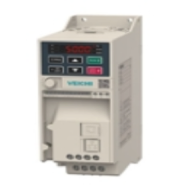
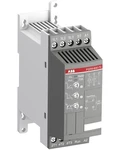
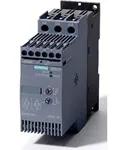
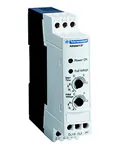
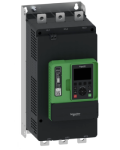
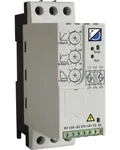
We stock 475 models from six manufacturers: Danfoss 180 SKU (MCD200 / MCD500), Schneider Electric 136 (Altistart ATS01, ATS22, ATS48, ATS480, ATS130, ATS430, ATS490), ABB 54 (PSR, PSE, PSTX), Motortronics 42 (Synergy, Agility, PFE), Siemens 36 (SIRIUS 3RW30, 3RW40, 3RW44), Veichi SS70 27. 12-month CRM bestsellers: Danfoss MCD500 (top-1, pump groups 200-1600 A), Schneider ATS01 and ATS130 (light motors), Siemens 3RW30 (panel automation).
Brands and series of soft starters we have
| Series | Current / power | Bypass | Where it fits |
|---|---|---|---|
| Schneider Altistart ATS01 | 3-32 A, up to 15 kW | none | small motors, infrequent starts |
| Schneider Altistart ATS22 | 17-590 A, up to 400 kW | built-in | universal: pump, compressor, conveyor |
| Schneider Altistart ATS48 | 17-1200 A, up to 800 kW | external | torque-controlled ramp and pump stop |
| Schneider Altistart ATS480 | 17-1200 A, 8-900 kW | built-in | new generation, ATS48 replacement with internal bypass |
| Danfoss MCD500 | 21-1600 A | built-in | pump groups, water utilities, boiler plants |
| Danfoss MCD200 | 18-200 A | model-dependent | mid-range motors 7.5-110 kW |
| ABB PSR | 4-105 A | built-in | compact panels, OEM |
| ABB PSE / PSTX | 18-2160 A | built-in | heavy industry, adaptive control |
| Siemens SIRIUS 3RW30 | 6-106 A | none | panel automation, base ramp |
| Siemens SIRIUS 3RW40 / 3RW44 | 12-432 A | model-dependent | mid-range and heavy motors with torque control |
| Veichi SS70 | 15-1100 A, 5.5-630 kW | built-in | budget segment, pump / fan |
Series we advise customers against picking just because they are cheaper: ATS01 on a loaded conveyor (no torque control and no bypass, the thermal trip fires on the first heavy start); SIRIUS 3RW30 on a 75 kW motor with frequent starts (IP20 with no bypass, thyristors overheat); SS70 in applications with more than 10 starts per hour (the series has no proper thermal model).
Real failure modes a soft starter solves
Water hammer in a centrifugal pump. When the pump motor stops directly from the mains, the water column behind the check valve keeps moving by inertia, the valve slams shut, pressure spikes by 5-10 bar. Valves break, welds tear, gauges blow out. A soft starter with a pump stop function (Schneider ATS48, ATS480, Danfoss MCD500) lowers the voltage smoothly over 10-30 seconds so the pump speed and the water column slow down together.
Jerk on a loaded conveyor. A loaded conveyor started direct-on-line takes 200-250% instantaneous torque. The belt slips, couplings break, chains snap. A torque-controlled soft starter (Schneider ATS48 TQ-Control, ABB PSTX, Siemens 3RW44) raises torque along a programmed ramp from an initial torque (typically 30-50%) to 100% over 8-15 seconds without peaks.
High-inertia fan or induced-draft motor. Here there is a trade-off. A soft starter can ramp a motor over 30-40 seconds — but a self-cooled motor barely ventilates at low speed. If you set a 60-second ramp "to be gentle", the winding overheats and the protection trips before reaching nominal speed. For motors with high inertia (fans above 75 kW, crushers) calculate the ramp against the PTC thermistor in the motor, or move to a VFD with vector control.
Piston compressor with torque dips. A piston compressor has torque peaks when the piston crosses top dead centre. Direct-on-line ignores it, but a soft starter with low initial torque stalls. So on piston compressors we set initial torque at no less than 60-70% and a short 5-8 s ramp — or pick ATS480 / MCD500 with adaptive control.
Soft starter vs VFD vs direct-on-line — how to choose
A question we get almost every day: why use a soft starter when a VFD exists? There is a separate article on the site, with the short version below:
- You need to regulate speed or hold it under a varying load: that needs a VFD, a soft starter does not apply.
- Speed is constant, but direct-on-line damages the network or mechanics (voltage dips, coupling damage, water hammer): use a soft starter. Two to three times cheaper than a VFD of the same rating, no harmonics injected back to the mains, less heat in the panel.
- Motor up to 4-5 kW, 1-2 starts per hour, soft load: use a contactor + thermal relay. A soft starter here is overkill, payback measured in years.
- You want energy savings under steady-state load: that is a VFD with PID, not a soft starter. A soft starter only saves on starting losses and equipment wear.
Soft starter thermal limits: AC-53a and AC-53b
All industrial soft starters are rated under IEC 60947-4-2. The nameplate carries a string like "AC-53a: 3.0-15:85-10". The decoding matters for correct sizing:
- 3.0: starting current multiplier (3·In). The heavier the load, the higher the figure (4-5·In for crushers).
- 15: start time in seconds. If your installation wants a 30-second ramp, a "15" series no longer fits, so a model rated for 30-60 s is needed.
- 85: duty cycle as percentage. 85% means 85 s on, 15 s off. For continuous 24/7 service the rating must be 100%.
- 10: starts per hour.
AC-53b classification (with an internal bypass contactor) uses another format: "AC-53b: 3.0-15:345". The "345" is the cool-down interval after a series of starts. Series with internal bypass (ATS22, ATS480, MCD500, PSR / PSE / PSTX, SS70) move into bypass right after ramp-up, the thyristors do not heat up, and 20-30 starts per hour are feasible. Series without bypass (ATS01, SIRIUS 3RW30) typically tolerate 6-10 starts per hour before the thyristors overheat and the thermal trip fires.
A special case is drainage and sewage pumps that start dozens of times per hour by tank level. A soft starter normally does not fit here — neither the thermal model nor the thyristor lifetime hold up. The right tool is a VFD for pumps with minimum speed and sleep mode.
What to check before buying a soft starter
A baseline checklist we run with every customer before placing the order:
- Motor nameplate current (not the starter datasheet). For standard duty take a soft starter at par or +10%; for heavy duty (loaded conveyor, crusher), +30-50%.
- AC-53 load category. Not just motor kW, but also start current multiplier, ramp time, starts per hour. The most expensive mistake to make: the unit fits by kW but the power section dies in a month.
- Mechanism type. Pump: pump stop required, hence ATS48 / ATS480 / MCD500. Conveyor: torque control (TQ-Control, ABB PSTX). Piston compressor: adjustable initial torque. Fan: plain ramp plus PTC monitoring.
- Internal or external bypass. 10+ starts per hour or a compact panel: internal bypass only (ATS22 / ATS480, MCD500, PSR, SS70). External means a separate contactor, extra wiring, panel space.
- Interfaces. Modbus RTU is standard on most series except ATS01 / 3RW30. For Profinet / Ethernet/IP look at ATS480, PSTX, 3RW44 with modules.
- Service and spare parts. Ask the customer: planned 7+ years of operation? If yes, Schneider / Danfoss / ABB / Siemens have official service in Ukraine, original control boards and thyristor modules. Budget series are replaced as a whole unit.
- Documentation. Verify upfront: is the manual available in your language? Schneider, Danfoss, ABB, Siemens: yes; Motortronics and some Veichi series: English only.
Soft starter by application
Soft starter for pumps (water supply, boiler plants, surface-mounted well pumps). We ask the pump type. Horizontal centrifugal — pump stop function required, pick ATS48 (H075N4 - C32N4) or MCD500. Vertical or submersible: calculate the water-column inertia separately, add a 20-40 s ramp. If the pump starts more than 12 times per hour, switch to a VFD, since a soft starter will not last by lifetime.
Soft starter for conveyor, crusher, mill. A loaded conveyor starts heavy: start multiplier 3.5-4·In, ramp duration 10-15 s. Pick ATS48 with TQ-Control, ABB PSTX with adaptive control or 3RW44 with torque control. A crusher starts with an empty chamber, but on material jam a quick stop is needed, so select models with the quick stop function.
Compressors (screw and piston). A screw compressor starts unloaded in under 5 seconds, and almost any soft starter sized for the motor fits. A piston compressor has a pulsing torque; initial torque 60-70% and a short 5-8 s ramp are required. ATS22 / ATS480 or MCD500 work best.
High-inertia fans and induced-draft fans. A fundamental trade-off: a self-cooled motor overheats at low speed, but high inertia wants a long ramp. Above 75 kW, fit a force-cooled motor plus a soft starter with a 20-30 s ramp, or move to a VFD with fan V/f curve.
Selection by application
- Soft starter for pumps: pump stop, no water hammer
- Soft starter for motors: conveyors, crushers, compressors, fans
- Veichi SS70: series in stock, budget segment
Warranty and delivery
All soft starters carry an official manufacturer warranty of 12 to 24 months. Kyiv warehouse, Nova Poshta shipping in 1-3 days across Ukraine. Bank-transfer VAT invoicing for FOP and legal entities, card payment or cash-on-delivery for individuals. Free model selection against a technical brief and parameter setup by an engineer with 10+ years of practice.