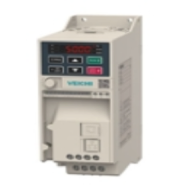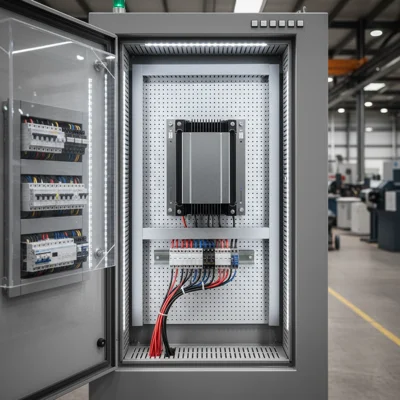
To guarantee the safety of the internal components of the Veichi frequency inverter, it is necessary to strictly limit the value of parameter F10.12 (nominal input voltage) to no more than 253 V for single-phase 220-240 V networks. This directly prevents the failure of the DC link power capacitors and IGBT power transistors. When the mains voltage exceeds allowable limits, the VFD's internal protection may not have time to react to rapid pulse surges, leading to hardware damage. Parameter F10.12 in the Veichi frequency inverter software defines the reference point for calculating the under-voltage and over-voltage protection trip thresholds. If this parameter is set too high, the control system will shift the protection thresholds upward. As a result, the device will attempt to operate at critical voltage levels that physically destroy the electrolytic capacitors of the DC bus. Setting F10.12 to 230 V or a maximum of 253 V (which corresponds to the upper limit of power quality standards) ensures timely shutdown of the VFD with a protection fault before the voltage reaches the physical endurance limit of the semiconductors. In addition, correctly setting this parameter allows optimizing vector control algorithms, as the motor mathematical model in the microprocessor memory uses the F10.12 value to calculate the stator magnetization curve and rotor slip compensation.
A frequency inverter is not capable of stabilizing the input voltage for its own needs: any increase in the supply mains voltage above 260 V leads to a proportional increase in the voltage on the internal DC bus, causing overheating, swelling, and explosion of the filter capacitors. Many installers mistakenly believe that because the VFD regulates the output voltage to the motor using pulse-width modulation (PWM), it can compensate for input fluctuations. This is a dangerous misconception that leads to warranty voiding and expensive repairs. The input stage of a frequency inverter consists of an uncontrolled diode bridge that rectifies the AC mains current. The rectified voltage goes directly to the smoothing filter, which is built on powerful electrolytic capacitors. Since the diode bridge is unregulated, the DC bus voltage is tightly coupled to the peak value of the input voltage. The formula for calculating the DC bus voltage is as follows: V_DC = V_input * 1.414. With an input voltage of 220 V, the DC bus voltage is approximately 311 V. If the mains voltage rises to 265 V, the voltage across the capacitors will increase to 375 V. Taking into account dynamic surges during motor braking (when the motor operates in generator mode and returns energy back to the DC link), this value easily exceeds the maximum allowable 400 V, leading to boiling of the electrolyte and destruction of the capacitor casing. It is important to understand that the VFD power board does not have a switching step-down transformer for the power circuit — all energy goes directly through the diodes to the capacitors.
To ensure stable operation of the equipment, it is necessary to calculate a safe headroom for the VFD power circuits based on the maximum mains voltage values and dynamic motor operating modes. The standard tolerance for most industrial networks is plus or minus ten percent of the nominal value, but in real-world conditions, fluctuations can be significantly larger. When calculating a safe threshold, it should be taken into account that electrolytic capacitors have a limited operating lifespan, which is sharply reduced when operating temperature and voltage increase. Every 10-degree increase in temperature inside the VFD enclosure due to elevated voltage cuts the lifespan of the capacitors in half. Therefore, setting parameter F10.12 to 230 V allows the Veichi VFD control system to initiate a protective shutdown in time when the safe voltage threshold is exceeded. Below is a comparison table of the relationship between internal voltage and mains parameters.
In addition, the influence of the PWM carrier frequency should be considered. At high carrier frequency values (for example, above 8-12 kHz), thermal losses in the IGBT transistors increase. If the input voltage is also elevated at the same time, the transistor crystals operate at the limit of their thermal capabilities. The combination of high DC bus voltage and high switching frequency creates critical conditions for the occurrence of shoot-through currents and thermal breakdown of semiconductor junctions.
Correct programming of the Veichi frequency inverter allows minimizing the risks of emergency situations. Changing parameter F10.12 must be performed on a stopped drive with mandatory monitoring of the actual mains voltage using a multimeter. Below is the sequence of actions to change the nominal voltage parameter:
After completing these settings, the VFD's internal controller will recalculate the mathematical model of overvoltage protection, which will preserve the functionality of the power board even during unstable operation of the external power grid. It is also recommended to check the overvoltage protection parameters in group F09, where you can configure the protection trip delay time and the automatic error reset level after the mains voltage stabilizes.
Operating a frequency inverter at a voltage higher than nominal leads to instantaneous failure of the IGBT modules due to gate breakdown and thermal destruction of the crystal. Ignoring the requirements for limiting the input voltage and incorrectly configuring parameter F10.12 leads to irreversible damage to the power section of the frequency inverter. The most vulnerable elements are the IGBT modules and the DC link capacitors. When a capacitor breaks down, a short circuit occurs on the DC bus, leading to the burning of the board's conductive tracks and the explosion of the power transistors. In addition, high voltage negatively affects the control board. Although it is powered through a switching power supply, its primary circuit is also connected to the DC bus. Exceeding the voltage can lead to a breakdown of the primary switch of the power supply unit, after which high voltage will enter the low-voltage control buses (COM, GND, +10V, +24V), completely burning out the microprocessor and the analog inputs of the VFD. To safely protect your equipment, we recommend using only certified protection devices at the VFD input, such as line reactors, varistors, and voltage control relays. If you are looking for an effective solution for motor speed regulation in difficult operating conditions, visit our catalog, which features a specific category of equipment with advanced overvoltage protection functions. The correct choice of model and professional configuration of parameters, in particular F10.12, guarantee long-term operation of your automation system without emergency stops and expensive repairs.