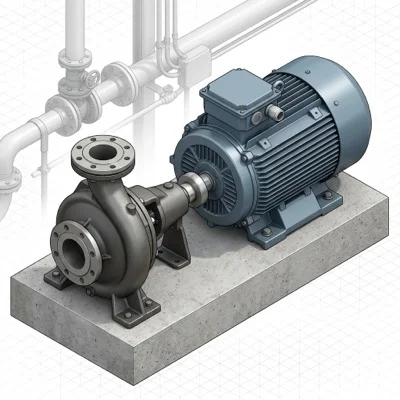
A pumping system without an activated sleep mode is guaranteed to fail due to impeller overheating and water boiling inside the pump chamber when all water outlets are closed. Configuring the sleep function allows the electric motor to stop when water consumption ceases, preserving equipment lifespan and saving energy. When all taps on the premises are closed, the pressure in the pipeline quickly reaches the user-defined Set Point. Guided by signals from the pressure sensor via the PID controller, the variable frequency drive begins to reduce the output frequency, attempting to maintain the pressure at the set level. However, due to the lack of water flow, the pump continues to rotate at minimum speed. If the motor runs at 25-35 Hz without fluid movement, all consumed mechanical energy is converted into thermal energy due to component friction and hydrodynamic resistance. The water inside the pump's working chamber boils within minutes. This leads to the deformation of plastic diffusers, destruction of the mechanical ceramic-graphite seal, water leakage into the motor stator, and its complete burnout. Sleep mode completely prevents this scenario by shutting down the inverter's power IGBTs in a timely manner.
Step-by-Step Configuration of Sleep Parameters F13.11 and F13.12 in Veichi VFDs
For a correct transition to standby mode, set the sleep frequency F13.12 in the range of 30-35 Hz, and the wake-up pressure delta F13.11 at 0.5-1.0 bar below the target value. This will ensure a clear boundary between operating and standby modes without unnecessary motor starts. The parameter configuration process, using modern Veichi frequency inverters as an example, follows a clear algorithm. First, ensure that the pressure sensor is connected correctly and the PID controller feedback is stable. After that, proceed to programming the specialized pump parameter group F13.
Step 1: Determining the sleep frequency (parameter F13.12). Switch the pump to manual mode or observe its operation in automatic mode with all taps fully closed. Note the frequency at which the pressure stops rising and there is no water flow. Typically, this frequency lies within 30-35 Hz. Enter this value into parameter F13.12. If you set it too low (e.g., 20 Hz), the pump will never go to sleep, continuing to heat the water. If set too high (e.g., 40 Hz), the device will go to sleep even during low water consumption.Step 2: Setting the wake-up pressure delta (parameter F13.11). This parameter determines how many bars the system pressure must drop relative to the target value for the VFD to restart the motor. The recommended range is 0.5 to 1.0 bar. For example, with a target pressure of 3.5 bar and F13.11 = 0.7 bar, the restart will occur when the pressure drops to 2.8 bar.Step 3: Setting the sleep delay time (parameter F13.13). This parameter prevents the pump from shutting down instantly during short-term pressure fluctuations. It is recommended to set a value between 5 and 15 seconds. The VFD will only turn off the output frequency when the operating frequency remains below the F13.12 value for the specified duration.Step 4: Setting the wake-up delay time (parameter F13.10). Determines the duration for which the pressure must remain below the wake-up threshold before the motor starts to ramp up smoothly. Usually, 1-3 seconds is sufficient.
Below is a table of basic parameters for quick commissioning of sleep mode on Veichi VFDs:
Parameter CodeParameter NameSetting RangeRecommended ValueDescription of System ImpactF13.11Wake-up pressure delta0.00 - 10.00 bar0.50 - 1.00 barDetermines the pressure drop threshold for restarting the pump. Prevents frequent cycling.F13.12Sleep frequency0.00 - 50.00 Hz30.00 - 35.00 HzFrequency threshold below which the VFD starts counting down to enter sleep mode.F13.13Sleep delay time0.0 - 3600.0 sec5.0 - 10.0 secFilters out accidental pressure fluctuations, eliminating false motor stops.F13.10Wake-up delay time0.0 - 3600.0 sec2.0 secDelay before starting after pressure drops below the set delta.Impact of Pipeline Configuration on Sleep Mode Operation
The choice of sleep algorithm directly depends on the pressure tank volume and pipe rigidity: systems with a large receiver require a larger wake-up delta, while tankless systems require rapid VFD response and minimal delay times. The presence of a diaphragm tank (pressure tank) is a key factor stabilizing the operation of a variable frequency drive water supply system. In systems without a pressure tank, any micro-leak or water droplet from a tap leads to an instantaneous pressure drop to zero, forcing the VFD to constantly restart the motor. This creates excessive thermal load on the IGBT power modules and stator windings.
Let's look at the differences in settings for various system types in more detail in the comparative table:
Comparison ParameterSystem with Pressure Tank (24-50 liters)Direct Feed (No Diaphragm Tank)Recommended delta F13.110.8 - 1.2 bar. Large water volume allows smooth pressure reduction without frequent starts.0.3 - 0.5 bar. Fast response is required so the user does not feel a drop in pressure.Sleep delay time F13.138 - 15 seconds. A longer delay can be allowed for complete pressure stabilization.2 - 4 seconds. The pump must be turned off as quickly as possible to prevent water hammer.Sleep frequency F13.1232 - 34 Hz. Standard value corresponding to zero flow at nominal pressure.34 - 36 Hz. Often set slightly higher to guarantee sleep during micro-consumption.Motor cycling riskMinimal. The pressure tank compensates for minor leaks and stabilizes pressure.High. Any non-return valve leakage causes continuous start-stop cycles.
For systems without a pressure tank, it is extremely important to use additional VFD functions, such as Leakage Detection and dry-run protection based on motor current consumption. If the non-return valve holds pressure poorly, water will drain back into the well, pressure will drop, and the VFD will continuously restart, leading to rapid failure of the inverter's power switches.
Technical Nuances of Pressure Sensor Integration and Equipment Protection
For error-free sleep mode operation, use industrial pressure sensors with a 4-20 mA output connected to terminals AI1/AI2 and GND (or COM depending on the control board), as they are the most resistant to electromagnetic interference from the motor power cable. Using sensors with a 0-10 V voltage output is not recommended for industrial or domestic systems with cable lengths exceeding 3 meters. The 4-20 mA current loop signal is virtually unaffected by voltage drops across conductors and electromagnetic noise from the VFD's PWM modulation.
When connecting the pressure sensor, the following technical rules must be observed:
The shield of the pressure sensor signal cable must be grounded on one side only — at the variable frequency drive to the PE terminal. Double-sided grounding creates a ground loop through which equalizing currents can flow, distorting the signal.The sensor signal cable must be routed at least 20-30 cm away from the motor power cable. If they cross, the crossing must be at a 90-degree angle.The PWM carrier frequency in the VFD parameters must be optimized. Too high a carrier frequency (above 12 kHz) increases high-frequency noise and leakage currents through the motor cable capacitance, which can distort pressure sensor readings. It is recommended to set a value within 4-8 kHz.To smooth out pressure pulsations caused by piston or multistage pumps, use software filtering of the analog input (AI filtering parameters in group F05). This prevents false wake-ups from sleep mode due to hydrodynamic noise in the pipeline.Equipment Selection and Energy Efficiency Recommendations
The optimal solution for water supply automation is a specialized specific category of variable frequency drives that feature built-in dry-run protection algorithms, leakage detection, and integrated multi-pump control logic. Using standard general-purpose industrial inverters often requires connecting external controllers or complex programming of logic blocks to implement basic water supply functions. Specialized Veichi pump VFDs already have pre-configured macros, allowing the system to be commissioned in just a few minutes.
Thanks to the implementation of frequency control and correct sleep mode configuration, the following advantages are achieved:
Cost efficiency: Reduction of electricity consumption by up to 30-50% compared to direct-on-line starting or pump operation via a mechanical pressure switch. The pump runs only at the frequency required to meet current water demand and shuts down completely when there is none.Reduced starting currents: Smooth motor acceleration eliminates high inrush currents, which exceed the rated motor current by 5-7 times during direct-on-line starting. This reduces stator winding heating and extends insulation life.Water hammer protection: Smooth adjustment of the shaft rotation speed prevents sharp pressure fluctuations in the pipeline when valves are opened and closed, protecting valves, pipe connections, and household appliances.Extended mechanical lifespan: Reducing the average rotation speed of bearings and pump impellers decreases their mechanical wear several times over.
A properly configured sleep mode on a Veichi variable frequency drive guarantees long-term, trouble-free, and energy-efficient operation of the entire water supply system, completely eliminating the risk of equipment overheating and ensuring stable pressure at every water outlet.
If sleep mode is not configured, the pump will continue to rotate at minimum frequency when the valves are closed. This will lead to rapid boiling of water inside the pump chamber due to the lack of flow. As a result, plastic parts will deform, and the mechanical seal will be destroyed, causing motor flooding and burnout.
To determine the sleep frequency, close all valves and observe the frequency on the device display when the pressure reaches the set point. Typically, the frequency at which the pump is no longer capable of producing useful flow is 30-35 Hz. The obtained value is written to parameter F13.12 with a small margin of 1-2 Hz on the higher side.
The recommended value for the wake-up pressure delta is 0.5 to 1.0 bar below the target pressure. For example, if the set pressure is 4.0 bar and the delta is set to 0.8 bar, the VFD will start the pump when the pressure drops to 3.2 bar. This prevents the motor from starting too frequently during minor fluctuations.
Yes, sleep mode can be used without a pressure tank, but it requires very precise tuning and rapid system response. In such cases, the wake-up delta F13.11 is reduced to 0.3-0.5 bar, and the sleep delay time F13.13 is shortened to 2-4 seconds. However, for stable operation and protection against cycling, it is recommended to install at least a small diaphragm tank of 8-24 liters.
The best choice is an industrial pressure sensor with a 4-20 mA current loop analog output. This signal is highly resistant to electromagnetic interference generated by the motor power cable and the inverter's PWM modulation. Sensors with a 0-10 V output are not recommended due to their high sensitivity to noise and voltage drops over long communication lines.