Autonomous Tractors: How Industrial Automation Is Transforming Agriculture
Agriculture is no longer an art whose secrets are passed down from generation to generation. Today it is a high-tech industry where algorithms make decisions, not intuition. GPS navigation accurate to 2 centimeters, automatic steering systems, unmanned tractors operating without a driver in the cab — these are no longer science fiction but everyday practice on the fields of leading agricultural corporations.
Back in 2015, John Deere demonstrated that the autonomous vehicle revolution would be led not by Google or Tesla, but by a manufacturer of agricultural equipment. Their 8R series tractors with the AutoTrac system provide fully autonomous operation: from plowing to harvesting. But behind each such tractor stands a complex industrial automation system in which variable frequency drives, programmable logic controllers, and sensors of various types play key roles.
GPS Navigation and Automatic Steering: Technical Details
A modern agricultural tractor autopilot system consists of several key components. An RTK-GPS receiver provides positioning accuracy of up to 2.5 centimeters. This is critically important for precision farming, where every square meter of the field is treated according to an individual program. The automatic steering controller receives coordinates from GPS and calculates the required wheel turning angle. The electric steering drive, controlled by a variable frequency drive, ensures smooth and precise execution of the controller commands.
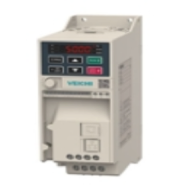
The variable frequency drive performs a fundamentally important function in this system. Instead of abruptly turning the wheels, it provides smooth speed regulation of the steering motor. This allows the tractor to follow the set trajectory without jerks or deviations. Modern frequency inverters with vector control can maintain the set speed with an accuracy of 0.1% even under variable load, which is critically important when traveling over uneven terrain.
Precision Farming Systems
Precision farming is based on the principle of treating each section of the field according to its individual needs. A comprehensive automation system is used for this purpose:
- Multispectral cameras and NDVI sensors determine the condition of plants in real time
- Soil sensors measure moisture, pH, and nutrient content at depths of up to 30 centimeters
- PLCs process data from all sensors and create a field yield map
- Variable frequency drives control pumps for variable application of fertilizers depending on the needs of each specific zone
- GPS controllers coordinate tractor movement with the field map for precise application of crop protection agents
According to the International Society of Precision Agriculture, implementing such systems reduces fertilizer costs by 15-25%, fuel consumption by 10-18%, and increases yields by 8-15%. Return on investment typically takes 2 to 4 seasons, making automation an economically viable solution even for medium-sized farms.
Variable Frequency Drives in Irrigation Systems
A separate and extremely important area of VFD application in agriculture is controlling irrigation pumps. The traditional approach, where a pump operates at full power and flow is regulated by a valve, leads to enormous energy waste. A variable frequency drive allows changing the pump motor speed in proportion to the water demand.
Consider a specific example. An irrigation system covering 100 hectares uses a 55 kW pump. Without a VFD, the pump consumes full power regardless of whether maximum water flow is needed. With a VFD, consumption decreases proportionally to the cube of speed reduction. If only 80% of water flow is needed, electricity consumption is only 51% of the rated value.
Comparison of Irrigation Systems With and Without VFDs
| Parameter | Without VFD | With VFD |
|---|---|---|
| Flow regulation method | Gate valve or bypass | Pump speed variation |
| Consumption at 80% flow | 95-100% of rated power | 51% of rated power |
| Consumption at 60% flow | 85-95% of rated power | 22% of rated power |
| Water hammer at startup | Yes, significant | No, soft start |
| Pipeline wear | Increased due to throttling | Minimal |
| Pump service life | 8-12 years | 15-20 years |
| Energy savings | Baseline | 30-50% depending on operating mode |
| Pressure stability | Fluctuations of 15-20% | Stable within 2-3% |
Integrating a VFD with a programmable logic controller enables the creation of a fully automatic irrigation system. The PLC reads data from soil moisture sensors, air temperature sensors, and weather forecasts, then automatically determines the optimal watering schedule. The VFD receives commands from the PLC via Modbus RTU or Ethernet interface and smoothly adjusts the pumping station output.
Compressed Air as a Commodity: The Kaeser Kompressoren Business Model Revolution
The German company Kaeser Kompressoren, founded in 1919, has achieved a genuine breakthrough in industrial automation. Instead of selling compressor equipment, it began selling compressed air as a service. The customer pays for cubic meters of consumed air with specified pressure, purity, and humidity parameters, while Kaeser takes responsibility for all equipment, its maintenance, and energy-efficient operation.
This Industry 4.0 concept became possible thanks to digital twin technology. Each compressor has its virtual copy in a cloud system where all operating parameters are analyzed in real time: pressure, temperature, vibration, power consumption, oil and filter condition. The system predicts the need for maintenance long before a failure occurs.
The Role of VFDs in Compressor Systems
An air compressor is one of the largest electricity consumers at most industrial facilities. According to various estimates, compressor systems consume 20% to 35% of a plant's total electricity. This is precisely why applying variable frequency drives to compressors produces the most significant economic impact.
A traditional screw compressor operates in a load-unload cycle. When the pressure in the receiver reaches the upper threshold, the compressor switches to idle mode, but the motor continues to run and consume 25-30% of rated power. A variable frequency drive fundamentally changes this situation: it smoothly adjusts the screw block rotation speed according to actual air consumption. If production requires only 60% of maximum capacity, the motor rotates at the corresponding speed and consumes significantly less electricity.
Compressor System Comparison
| Characteristic | Compressor Without VFD | Compressor With VFD | Kaeser Sigma Air Manager System |
|---|---|---|---|
| Output regulation | On/Off or load/idle | Smooth speed variation | Coordination of multiple VFD compressors |
| Idle consumption | 25-30% of rated power | None (motor stops) | Minimal for entire system |
| Pressure fluctuation | 0.5-1.5 bar | 0.1-0.3 bar | 0.1 bar across entire network |
| Typical energy savings | Baseline | 20-35% | 30-50% (coordination + VFD) |
| Starting current | 6-8 times rated | Does not exceed rated | Staged startup without peaks |
Digital Twins and Predictive Maintenance
The digital twin concept, actively used by both John Deere for tractors and Kaeser for compressors, is based on continuous data collection from physical equipment and its analysis in a virtual environment. Key components of this system include vibration, temperature, pressure, and electrical parameter sensors, as well as industrial controllers that collect and transmit this data.
Industrial protocols are used to connect sensors to the cloud analytics system: Modbus TCP/IP, MQTT, OPC UA. The programmable logic controller serves as the central data collection node, processing information from dozens of sensors and transmitting aggregated data to the cloud server. Machine learning algorithms analyze parameter change trends and predict when equipment will require maintenance.
The results of implementing predictive maintenance are impressive. According to McKinsey, it can reduce unplanned downtime by 30-50%, lower maintenance costs by 10-25%, and extend equipment lifespan by 20-40%. For an agricultural enterprise where tractor downtime during harvest can cost tens of thousands of dollars per day, these figures are particularly significant.
Automation of Air Systems in Industrial Facilities
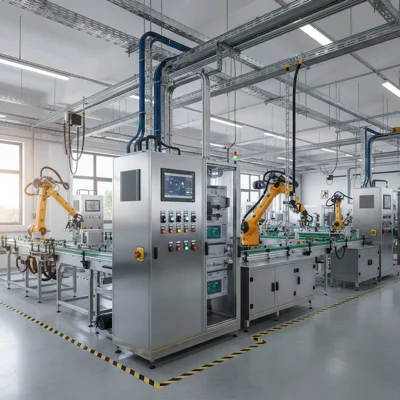
Let us return to compressed air. At a modern industrial facility, the pneumatic system powers hundreds of pieces of equipment: from pneumatic cylinders on conveyor lines to painting systems and sandblasting operations. Reliable and efficient supply of compressed air with the required parameters is a critical condition for uninterrupted production.
A modern compressor station with intelligent control includes several compressors of different capacities, each equipped with a variable frequency drive. The central controller, such as the Kaeser Sigma Air Manager 4.0, analyzes current air consumption and determines the optimal combination of compressors to provide the required output with minimum energy costs.
- Pressure sensors monitor line pressure with accuracy of 0.01 bar
- Flow sensors measure actual air consumption by each workshop
- Dew point sensors monitor air drying quality
- Bearing vibration sensors warn of mechanical wear
- Variable frequency drives smoothly regulate each compressor's output
- PLCs coordinate all components and ensure optimal operating mode
Economic Impact of Automation: Real Numbers
Implementing industrial automation in both agriculture and compressor systems requires significant initial investment. However, the return on these investments has been confirmed by the experience of thousands of enterprises worldwide.
In agriculture, an automatic tractor guidance system with GPS navigation costs between 8,000 and 25,000 USD depending on the level of automation. The savings from reduced overlap alone (less double-treating of strips) amounts to 5-8% of total fuel and material costs. For a 500-hectare farm, this means savings of 15,000 to 40,000 dollars per year.
In compressor systems, installing a VFD on a 75 kW compressor typically pays for itself in 12-18 months. With round-the-clock operation, energy savings amount to 150,000 to 300,000 kWh per year, which at current electricity rates translates to hundreds of thousands in annual savings.
Development Prospects: What Lies Ahead
Trends in industrial automation point to further integration of artificial intelligence, robotics, and the Internet of Things. In agriculture, fully autonomous tractors without cabs are already appearing, such as the John Deere 8R Autonomous, capable of working around the clock without human involvement. Robotic harvesting systems for berries, fruits, and vegetables are actively developing and approaching commercial maturity.
In the compressed air sector, further development is associated with the Air-as-a-Service model, where artificial intelligence optimizes not only the operation of individual compressors but entire compressed air networks at industrial sites. Predictive analytics will further reduce energy consumption by an additional 10-15% compared to the best current solutions.
Both of these fields demonstrate the same pattern: industrial automation using variable frequency drives, PLCs, and modern sensors is transforming traditional industries, delivering significant cost reductions, improved quality, and new business models that were previously impossible.