Star-Delta: When the Scheme Still Makes Sense in 2026
Short version: the star-delta scheme cuts starting current by a factor of three, but only fits motors from 5.5 kW with easy-start loads and six terminals in the junction box. For a compressor, a crusher, or a piston pump it is not the right tool at all. For 2.2-4 kW motors a soft starter or a VFD is already cheaper in practice.
Back in 2014 the Y-Δ scheme was the default. Today we install it mostly in old workshops where the electrician inherited a legacy panel, the motor is still alive, and the budget sits at zero. Our Chastotnik.ua team fitted about 40 Y/Δ cabinets over the last year for repairs, plus hundreds of VFDs and soft starters that replaced the same scheme. The difference is below.
What Δ/Y Really Means and Where the Current Reduction Comes From
A three-phase induction motor has three windings. They can be wired two ways:
- Star (Y): three winding ends meet at a common neutral point. Each winding sees the phase voltage — 220 V on a 380 V line.
- Delta (Δ): the end of each winding connects to the start of the next. Each winding gets the full line voltage — 380 V.
The current difference is simple: in star the winding current equals the line current; in delta it is √3 times smaller than the line current. And the star starting torque drops to one-third of the delta value. So Y-Δ only pays off when the driven machine accelerates freely — fan, centrifugal pump, unloaded belt conveyor. You start on Y with low torque, the motor reaches 70-80% of rated speed, the timer relay switches to Δ, and from there the motor pulls its load at full power.
The Numbers You Actually See at the Terminals
| Parameter | DOL start | Star-Delta | Soft Starter | VFD |
|---|---|---|---|---|
| Starting current | 6-7 In | 2-2.3 In | 2-4 In (adjustable) | 1-1.5 In |
| Starting torque | 100% | 33% | 30-70% (adjustable) | 100-150% |
| Price for 11 kW, UAH | ~3,000 (contactor+breaker) | ~7,500 (3 contactors+relay) | ~11,000 (Veichi SJR2) | ~14,000 (INVT GD20) |
Which Motors Actually Support Y-Δ
The first step is looking at the nameplate and inside the junction box. A motor qualifies for star-delta only if:
- The terminal box has six leads — U1, V1, W1 (starts) and U2, V2, W2 (ends). Not three, not four. Six.
- The nameplate reads Δ/Y 380/660 V. That means: in delta the motor is designed for 380 V, in star for 660. On a 380 V line this is exactly what you need.
- If the plate says Δ/Y 220/380 V — the motor is meant for delta at 220 V and star at 380 V. On our 380 V grid the Y-Δ scheme will not reduce anything: in the "starting" star configuration each winding sees 220 V, which is a normal running regime. No benefit from switching.
Older Ukrainian AIR series came in both flavors. Newer motors like ABB M2BAX and AIR carry 400/690 V marking — functionally identical to 380/660.
How to Check Without a Nameplate
If the nameplate is gone: measure resistance between terminals with a multimeter. U1-U2, V1-V2, W1-W2 should show matching resistance (2-15 ohm depending on power). U1-V1 or any pair of starts — open circuit. If every pair rings through — the motor has three leads (internal star or delta factory-bonded). You cannot reconfigure that one.
Power Circuit: Three Contactors and an Interlock
A classic Y-Δ circuit uses three contactors and a timer relay:
- KM1 (line): feeds the winding starts U1, V1, W1. Always energized while the motor runs.
- KM2 (star): ties the winding ends U2, V2, W2 to a common neutral point. Energized for the first 5-10 seconds.
- KM3 (delta): bridges U2 to V1, V2 to W1, W2 to U1. Energized after KM2 releases.
Critical: KM2 and KM3 must never be closed at the same time. If they do, the windings shortcut across phases. Motor, contactors, and upstream breaker all die. The circuit needs both mechanical and electrical interlock: normally-closed KM2 contacts in the KM3 coil line and vice versa. Ready-made Y-Δ assemblies like Schneider LC3D or ETI CES ship with the mechanical interlock built into the housing.
Timer Relay: What to Pick
The timer counts from the "start" command to the Y→Δ transition. In practice 5-10 seconds covers ordinary fans and pumps, up to 15 seconds for heavy flywheel loads. Working options on the market:
- REV-201, REV-203 — cheap, 600-900 UAH, electromechanical. Works but timing drifts.
- ABB CT-AHS, CT-AHD — 2,800-3,500 UAH, a dedicated Y-Δ relay with a built-in interlock and a 50 ms gap between KM2 release and KM3 pull-in. The gap lets the arc on KM2 contacts die out before KM3 closes, so the circuit will not short.
- Schneider RE17LAMW — ~4,000 UAH, ABB equivalent, same feature set.
- Finder 80.91 Y-Δ — ~2,200 UAH, compact 22.5 mm DIN.
If the timer lacks a built-in gap, you add a small auxiliary relay for 50-100 ms delay. Without the gap roughly one in twenty transitions trips the breaker because the arc on KM2 meets the already-closed KM3.
Breaker and Cable Sizing
Protective breaker rating and cable cross-section are chosen for the delta regime — the motor's rated running current. Y-Δ starting current sits at 2-2.3 In, so a class D thermal element has plenty of margin.
Example for an 11 kW motor, In = 22 A:
- Breaker: ETI EB2 3p 32A D or similar (~1,400 UAH).
- Feed cable to the motor: 4×4 mm² copper (three phases + PE).
- Cable from the Y-Δ cabinet to the motor terminals: 6 conductors, 2.5 mm² each, because each winding only sees full phase current once the motor is in delta. The cross-section is sized for In/√3 rounded up.
- Contactors: all three are sized at In/√3 = 22/1.73 ≈ 13 A. Use ABB AF16 or Schneider LC1D18 (~800 UAH each).
Step-by-Step Wiring
- Turn off the incoming breaker and verify no voltage with a tester.
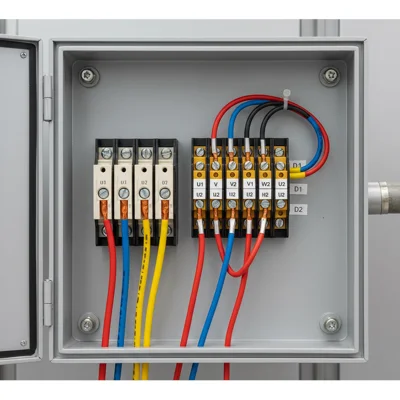
- Remove the factory bridges between U1-V2, V1-W2, W1-U2 in the motor terminal box. The six terminals must stand separate.
- Run six conductors from the cabinet. Three (L1, L2, L3) to the winding starts U1, V1, W1. Three more (to KM2 and KM3) to U2, V2, W2.
- In the cabinet, feed KM1 input from the breaker (terminals 1/3/5). Take KM1 output (2/4/6) to U1, V1, W1 and in parallel to the KM3 input.
- Bridge KM2 outputs together at a common neutral point. KM2 inputs go to U2, V2, W2.
- Wire KM3 outputs in the delta pattern: L1' to U2, L2' to V2, L3' to W2. Same supply line that feeds KM2, but wired as Δ.
- Connect the timer relay per the manufacturer datasheet: input from the start button through a KM1 auxiliary, output to the KM3 coil through a KM2 NC contact.
- Test the interlock manually (cover off, breaker off): press the KM2 armature by hand — KM3 must not pull in. And vice versa.
- Close the breaker and hit start. Watch the clock: first click (KM1+KM2) means the motor is accelerating. After 5-7 seconds a second click (KM2 drops, KM3 pulls in) means the motor is now in delta.
Rotation Direction Check
If the motor spins the wrong way, swap two phases at the cabinet input, not inside the motor terminal box. That keeps the U1-V1-W1 sequence intact for the Y-Δ logic. Swap them inside the motor and you scramble the winding polarity, which can short the windings on the next maintenance visit.
Field Mistakes We See All the Time
- Running Y-Δ on a 2.2-4 kW motor. Starting current at that power sits at 15-28 A, the grid takes it easily. Three contactors plus a timer cost ~6,000 UAH, while a 4 kW soft starter runs around 7,500 UAH and adds smooth deceleration. Below 5.5 kW the savings on Y-Δ are imaginary.
- Switching under full load. If a compressor already holds receiver pressure, star will not accelerate the motor. The timer flips to delta at half speed and you get a 5-6 In current spike. Those loads need a soft starter or a VFD full stop.
- Timer set too short. Two seconds is not enough for the motor to reach 70% speed. Switching to delta then causes a current surge equivalent to a DOL start. The breaker trips and nobody can figure out why the "scheme does not work".
- No dead-time between KM2 and KM3. The arc on KM2 opening lives 30-50 ms. If KM3 has closed by then — short circuit across phases. Classic issue with REV-201 relays that ship without a gap timer.
- Wrong delta pattern. One misrouted pair on KM3 and you end up with a lopsided star instead of a proper delta. The motor hums, does not pull, overheats. Always ring the entire circuit with a meter before you apply power.
Y-Δ vs Soft Starter vs VFD by the Numbers
We compared the three options on a 15 kW irrigation pump motor. April 2026 budgets:
| Solution | Component cost | Install time (man-hours) | Starting current | Energy savings |
|---|---|---|---|---|
| Y-Δ (3 contactors, timer, cabinet) | ~9,200 UAH | 6-8 h | ~75 A | 0% |
| Soft starter Veichi SJR2-0075-3 | ~12,500 UAH | 2-3 h | ~45 A adjustable | 0-5% |
| VFD INVT GD200A-015G | ~22,000 UAH | 3-4 h | ~25 A | 20-35% (from speed regulation) |
Practical takeaway: Y-Δ is mostly a repair-grade solution for old cabinets. Any new pump or ventilation install — go VFD. Constant-speed compressor — soft starter. Conveyor with frequent start-stop cycles — VFD mandatory, because Y-Δ at 30 starts per hour kills the contactors within six months.
Frequently Asked Questions
Why does the motor hum after the switch to delta?
First guess — wrong delta wiring on KM3. Measure voltage between each pair of phases at the motor terminals; all three pairs must read 380 V. A pair showing zero or 220 V means the KM3 contacts are cross-wired. Second guess — single-phasing from a burnt KM1 or KM3 contact. Open the contactors and confirm all three poles close.
Can Y-Δ work on a 2.2 kW motor?
Technically yes, if the motor has six terminals and a 380/660 V rating. Economically no. A full Y-Δ set costs ~6,000 UAH, while a 2.2 kW soft starter runs 6,500-7,500 UAH and adds smooth deceleration, undervoltage protection, and dry-run protection for pumps. Save the contactor scheme for motors 5.5 kW and up.
What time delay should the relay be set to?
Fans and centrifugal pumps — 5-7 seconds. Belt conveyors with low inertia — 3-5. Motors of 22 kW and above with heavy rotors — 8-12. The exact number is tuned with a clamp ammeter: run several starts at different delays, pick the one where current after the switch does not jump above 2.5 In.
Can I run the motor straight on delta without the star phase?
You can, if your grid handles the 6-7 In inrush. For a 5.5 kW motor that is 70 A for half a second — most 3×50 A feeders behind a 400 A transformer swallow it. For 22 kW it becomes 280 A, which dips the neighbors. The motor windings also pay: each DOL start eats insulation life. Ten starts per hour on direct — the motor dies in 2-3 years instead of 15.
When does Y-Δ fail even on a correct motor?
When the load is already pulling on the shaft during startup. Examples: a screw compressor without unloader, a crusher with material in the chamber, a high-pressure piston compressor, a fully loaded belt conveyor without slip. Star gives 33% of rated torque, not enough to accelerate loads like that. The motor stalls around 30-40% speed, the timer still flips to delta, and at that moment the current spikes to 5-6 In just like a DOL start. Those jobs need a soft starter or a VFD.
Bottom Line: When Y-Δ Wins and When It Does Not
Install star-delta when: the motor is 5.5 kW or larger with six 380/660 V terminals, the load is light (fan, centrifugal pump, unloaded conveyor), start frequency stays at or below 6 per hour, the budget is tight, and you already have a cabinet for three contactors. In every other case — VFD or soft starter: higher capex, but it pays back through lower running costs, energy savings from speed control, and longer motor life. For a walkthrough on a specific installation talk to our engineer — we will calculate payback together. Further reading: star-delta current calculations, timer relay wiring for Y-Δ, Y-Δ vs soft start vs VFD in depth, single vs three-phase motor, replacing an old motor.
---