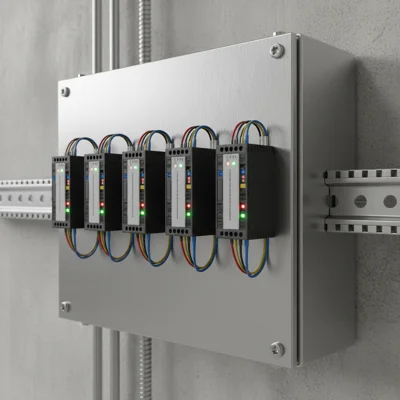
Braking module — what it is and why your VFD needs one
A braking module (also called a brake chopper) is needed when a variable frequency drive must stop a motor quickly and its built-in braking capacity is not enough. It is essentially a power switch that dumps excess energy from the DC bus onto a braking resistor. Without it, the VFD can trip on DC bus overvoltage — and shut down your entire line.
Most variable frequency drives rated below 7.5 kW have a built-in braking transistor. But from 11 kW and above, you almost always need an external module. This is not an optional extra — it is a requirement for any drive with cyclic braking.
When you cannot do without a braking module
Three typical situations where an external module is mandatory:
- Lifting and hoisting equipment — elevators, cranes, hoists. The motor enters regenerative mode when lowering a load, pushing energy back into the VFD.
- Centrifuges and flywheel mechanisms — high inertia demands rapid braking, sometimes from 1500 RPM to zero in 3-5 seconds.
- Sawmills and cutting machines — frequent acceleration-braking cycles every 10-30 seconds. The built-in chopper will simply overheat.
If your drive works with high inertia loads or has frequent stops, the DC bus voltage will climb without an external module and the VFD will trip with an OV (overvoltage) fault. We have seen this dozens of times on site.
How a braking module works: diagram and principle
The principle is straightforward. When the motor brakes, it becomes a generator and returns energy to the VFD DC bus. Voltage on the bus rises. The braking module monitors this voltage, and when it exceeds the threshold (typically 380-400 V for 220 V networks, or 700-720 V for 380 V) it switches on an IGBT transistor that connects the bus to the braking resistor. The energy is converted to heat.
There are two module types by design:
- Single-channel — one IGBT switch, one resistor. For drives up to 30-55 kW.
- Multi-channel — several parallel switches. For high-power drives 75-500 kW and above.
Some manufacturers (INVT, Veichi) produce modules with a built-in resistor for lower power ratings — convenient because you do not need to separately select resistance and wattage.
How to choose a braking module: selection criteria
Correct selection comes down to three parameters. Here is a matching table:
| Parameter | What to check | Example |
|---|---|---|
| DC bus voltage | Must match the VFD voltage class | 380V mains → 530V DC → module rated 800V |
| Maximum braking current | Not less than peak braking current of the drive | 22 kW VFD → ~45A braking current |
| Duty cycle (ED%) | What % of time the module is actively braking | 10% ED = 6 sec braking per 60 sec cycle |
Probably the most common mistake is selecting a module based only on VFD power rating while ignoring the duty cycle. A crane with 25% ED needs a module one class higher than a conveyor with 5% ED.
Compatibility with the VFD
Not every module fits every VFD. Check these points:
- DC bus voltage (some VFDs have non-standard levels — 250V or 900V)
- Connection type (terminals P+, PB or DB, proprietary connector)
- Feedback protocol — some modules integrate via RS-485
We recommend getting braking modules from the same manufacturer as the VFD. INVT DBU series for INVT GD drives, Veichi AC-BU for Veichi AC series. This way compatibility is guaranteed.
External braking module vs built-in chopper: comparison
A common question — maybe the built-in chopper is enough? Here is an honest comparison:
| Feature | Built-in chopper | External module |
|---|---|---|
| Power range | Up to 7.5-15 kW | Up to 500+ kW |
| Duty cycle (ED) | 5-10% | 10-50% |
| Overheat protection | Limited | Own heatsink + thermal sensor |
| Cost | Included in VFD | 15-30% of VFD price |
| Replacement on failure | VFD repair | Module swap in 15 min |
For a packaging line that brakes once per minute, the built-in chopper is enough. For an elevator or crane — no. The rule is simple: if in doubt, install an external module. It costs far less than repairing a burned-out VFD.
Common installation mistakes
Over years of work we have compiled a "collection" of mistakes that keep recurring on sites:
- Resistor in a sealed cabinet with no ventilation — it dissipates serious heat (several kW!). The cabinet overheats and the VFD thermal protection trips. Mount the resistor outside the cabinet or add forced ventilation.
- Cable between module and resistor too long — over 5 metres. Inductive spikes can damage the IGBT.
- Reversed polarity on P+ and P- — the module burns on the first braking event. Check twice.
- No fuse on the DC bus line. If the resistor short-circuits — everything burns.
One more practical tip: always verify correct braking resistor selection before starting up. Wrong resistance means the module works at its limit or does not brake at all.
Frequently Asked Questions
Can a VFD be used without a braking module?
Yes, if the motor decelerates slowly (coast to stop) or the load has low inertia. For fans and pumps a module is usually unnecessary. But for cranes, elevators and centrifuges it is mandatory.
What is the difference between a braking module and a braking resistor?
The module is an electronic switch (IGBT transistor with control circuitry) that switches the resistor on and off. The resistor is the load that converts electrical energy to heat. They work as a pair: a module without a resistor is useless, and a resistor without a module has nowhere to connect (unless the VFD has a built-in chopper).
How much does a braking module cost?
It depends on the power rating. For 11-22 kW VFDs — roughly 3,000-6,000 UAH. For 55-90 kW — 8,000-15,000 UAH. Modules for 200+ kW can cost 30,000+ UAH. Price depends on the brand and whether a resistor is built in.
Will a braking module from one brand work with a VFD from another?
Technically yes, as long as the DC bus voltage and connection method (P+/PB terminals) match. In practice we recommend modules from the same manufacturer — less risk with compatibility and warranty service.
How can I tell if a braking module has failed?
The main sign is the VFD tripping with OV (overvoltage) during braking when it previously worked fine. Use a multimeter to check the resistor and the IGBT transistor. A burned transistor typically shows a short circuit between P+ and PB terminals.
Summary
A braking module is insurance for your VFD when working with inertial loads. For drives from 11 kW with frequent braking it is mandatory. Select based on DC bus voltage, braking current and duty cycle — and do not forget proper resistor mounting.
Our catalogue has braking modules from INVT, Veichi and other manufacturers. We will match one to your VFD in 5 minutes — call or message us.