Line reactor for a variable frequency drive — what it is
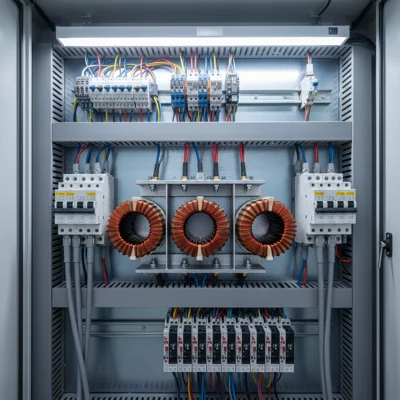
A line reactor (AC reactor) is an inductance installed at the input of a variable frequency drive between the power supply and the VFD. Its job is to smooth inrush currents during start-up, reduce harmonic distortion and protect the VFD from voltage spikes in the mains. In plain terms, a reactor makes the VFD power supply "softer" and more stable.
For variable frequency drives rated at 15 kW and above, a line reactor is practically standard. For lower ratings it depends on grid quality and distance to the transformer.
Why you need a line reactor: 4 reasons
- Protection from voltage spikes — the reactor limits the rate of current rise (di/dt). If the mains experience brief overvoltages (load switching, lightning) the reactor dampens them and protects the VFD input rectifier.
- Reducing total harmonic distortion (THD) — a VFD draws pulsed current that distorts the mains sinewave. The reactor smooths these pulses and lowers THD from 80-90% down to 30-40%. This matters for neighbouring equipment and for the utility company.
- Short-circuit protection — if a short circuit occurs between the VFD and the mains, the reactor limits the fault current and gives circuit breakers time to trip.
- Extending DC bus capacitor life — smoother charging current puts less stress on the electrolytic capacitors inside the VFD. They last longer — and capacitors are typically the first component to fail.
When a reactor is mandatory
Specific situations where skipping the reactor risks the VFD:
- Transformer rated above 500 kVA with a small VFD — a large transformer presents low source impedance, and inrush currents when the VFD powers up can be enormous. The reactor limits them.
- Several VFDs on one supply — they interact through harmonics. A reactor on each VFD isolates their influence.
- Long cable from the transformer — over 50 metres. Resonance in the cable can cause overvoltages at the VFD input.
- Unstable mains — frequent sags or spikes, heavy loads switching nearby.
In practice we install a reactor on every VFD from 15 kW. For smaller drives — if there are mains problems or multiple VFDs in one cabinet.
Reactor types: line vs motor
Do not confuse a line reactor with a motor choke — they are different devices.
| Parameter | Line reactor (AC line reactor) | Motor choke |
|---|---|---|
| Location | Mains → VFD input | VFD output → motor |
| Protects against | Voltage spikes, harmonics, inrush current | du/dt pulses, winding insulation breakdown |
| When needed | Large transformer, unstable mains | Long motor cable (>30 m) |
| Voltage drop | 2-4% of rated | 1-3% of rated |
Sometimes both are installed — line and motor. This makes sense for high-power drives (from 55 kW) with a long motor cable.
Selecting a line reactor
Selection is based on two parameters: rated current and impedance percentage.
Rated current
Must be at least equal to the VFD rated current. For a 32A VFD — a 32A reactor or higher. A 10-20% margin is recommended.
Impedance percentage
Typical value is 3-5%. This means the reactor creates a 3-5% voltage drop at full current. Higher percentage means better filtering but more voltage drop.
- 3% — standard for most applications
- 5% — for tough conditions (unstable mains, large transformer)
- 1-2% — minimum protection when voltage drop is critical
Installation: what to watch for
A reactor generates heat during operation — that is normal. But:
- Do not mount the reactor tight against the VFD — leave a 10-15 cm gap for ventilation
- The reactor heats up to 60-80°C — do not touch during operation
- Cables from mains to reactor and from reactor to VFD — keep as short as possible
- Grounding the reactor enclosure is mandatory
One of our customers installed a reactor in a sealed IP65 cabinet without ventilation. A month later the VFD started tripping on overheat — because the reactor was heating the air inside the cabinet to 55°C. We added a fan and the problem disappeared.
Reactor vs EMC filter: what to choose
These are different devices with different jobs. A reactor protects the VFD from the mains, while an EMC filter protects the mains (and nearby equipment) from the VFD. Ideally install both. But if budget is limited:
- Unstable mains, large transformer → reactor
- Sensitive equipment nearby, EMC requirements → filter
- Both issues → both devices
Frequently Asked Questions
Is a line reactor mandatory for a VFD?
Not always. For VFDs up to 7.5 kW with stable mains — no. For VFDs from 15 kW or with unstable supply — yes, we strongly recommend it.
Can a reactor replace an EMC filter?
No, they serve different functions. A reactor protects the VFD from the mains, an EMC filter protects the mains from the VFD. One does not replace the other.
How much does a line reactor cost?
From 1,200 UAH for a 10A reactor to 8,000+ UAH for 80A and above. Price depends on rating and manufacturer.
Does a reactor affect motor performance?
A reactor creates a 2-5% voltage drop. At 380V that is 8-19V. In practice the motor barely notices it because the VFD compensates automatically (boost function).
Where should the reactor be installed — before or after the circuit breaker?
After the circuit breaker (between breaker and VFD). The breaker protects both the reactor and the VFD from overload.
Conclusion
A line reactor is an affordable way to extend VFD lifespan and protect it from mains issues. For drives from 15 kW — install without hesitation. For smaller drives — if the mains are unstable or a large transformer is nearby.
Our catalogue has variable frequency drives and accessories including line reactors. Contact us and we will help you put together the right package for your application.