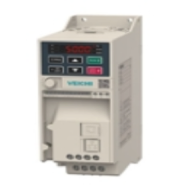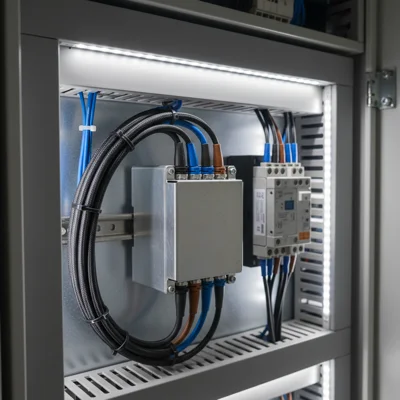
EMC filter for a variable frequency drive — what it is
An EMC filter (electromagnetic compatibility filter) suppresses electromagnetic interference generated by a variable frequency drive. Every VFD produces high-frequency noise during operation that travels back into the power supply and disturbs nearby equipment: sensors, PLCs, medical devices, radio communications. The filter is installed at the VFD input or output and cuts this noise down to acceptable levels.
In practice, a VFD can run for years without an EMC filter — until someone installs a sensitive instrument nearby. Or until an EMC compliance inspector shows up with measurement gear. That is when problems start.
Why you need an EMC filter: real situations
Here are specific cases from our experience where a filter turned out to be necessary:
- Bakery, packaging line — a 7.5 kW VFD on a conveyor was throwing off the scale readings. After installing a filter on the VFD input, the problem disappeared within a day.
- Hospital, ventilation system — medical equipment on the same floor was picking up interference. EN 61800-3 category C1 standard — filter is mandatory.
- Residential building, pump station — a 4 kW VFD was creating interference for residents' TVs and Wi-Fi routers.
The general rule: if the VFD is in a residential or medical environment, or works near sensitive electronics — you need a filter. In an industrial workshop with no sensitive gear — probably not.
Types of EMC filters by purpose
EMC filters for VFDs come in two main types: input and output. The difference matters.
Input EMC filter (line filter)
Installed between the power supply and VFD input. Its job is to stop noise from the VFD leaking back into the mains. This is the most common type, and it is what EMC standards (EN 61800-3, IEC 61800-3) require.
Output EMC filter (du/dt filter)
Installed between the VFD output and the motor. Protects motor windings from steep voltage pulses (du/dt) that the VFD generates during PWM switching. Needed when the cable to the motor is long (over 30-50 metres) or for older motors with weak insulation.
| Filter type | Installation point | What it protects against | When needed |
|---|---|---|---|
| Input (line) | Mains → VFD | Noise into mains | Residential, medical, certification |
| Output (du/dt) | VFD → motor | Voltage spikes at motor | Cable >30m, older motors |
| Sinusoidal | VFD → motor | PWM waveform → clean sine | Long cables >100m, high requirements |
EMC classes and standards: what you need to know
The EN 61800-3 standard divides environments into two categories:
- First environment (C1/C2) — residential, commercial, hospitals. Strict requirements. Filter is mandatory.
- Second environment (C3/C4) — industrial sites. Looser requirements. Filter as needed.
Look for the category marking on the filter nameplate. Some variable frequency drives already have a built-in EMC filter rated C3 — enough for a factory, but not for a hospital or residential building.
How to determine which class you need
- Where is the VFD installed? Residential/commercial → C1 or C2. Industrial → C3.
- Is there sensitive equipment nearby? Medical, measurement, communications → C1.
- Do you need certification/declaration of conformity? → C1 or C2 is mandatory.
Selecting an EMC filter by power rating
A filter is selected by rated current, not by VFD power. This is a common mistake — people write "filter for 15 kW" when they should write "filter for 32A".
Approximate selection table for three-phase 380V:
| VFD power | Rated current | Filter (min. current) |
|---|---|---|
| 1.5 kW | 3.7 A | 6 A |
| 4 kW | 9 A | 10 A |
| 7.5 kW | 17 A | 20 A |
| 15 kW | 32 A | 36 A |
| 22 kW | 45 A | 50 A |
| 37 kW | 75 A | 80 A |
Allow a 10-20% current margin. No less. If the VFD runs at 150% overload — factor that peak in.
EMC filter installation: common mistakes
A filter can be expensive and correctly rated — and still not work. The reason is installation.
- Grounding — an EMC filter MUST have quality grounding. Short wire, copper busbar, large cross-section. Without grounding, the filter works at 20-30% of its capability.
- Input and output cables — must not run parallel and close together. Otherwise noise couples around the filter. Separate them by at least 15-20 cm.
- Shielded cables — between VFD and motor, use shielded cable and ground the shield at both ends.
- Wire length to filter — shorter is better. Ideally, mount the filter right next to the VFD.
We had a case where a customer bought a filter for 4,000 UAH and it did not help. Turned out the grounding was through 2 metres of thin wire. We replaced it with 30 cm of copper busbar — and the noise disappeared.
Frequently Asked Questions
Is an EMC filter mandatory for a VFD?
It depends on the installation location. In an industrial workshop — no, if there is no sensitive equipment nearby. In a residential building, hospital or office — yes, it is required by EN 61800-3.
Do VFDs come with built-in EMC filters?
Yes, many models have a built-in C3 class filter. This is enough for industrial use. For residential installations you need an external C1 or C2 filter.
How much does an EMC filter cost?
From 1,500 UAH for a 6A filter to 15,000+ UAH for 80A and above. Price depends on the class (C1 is more expensive than C3) and the manufacturer.
Will an EMC filter help if a VFD is disrupting a PLC?
Most likely yes, if the interference travels through the power supply. But sometimes noise is radiated through the air. Then you need shielded cable and proper grounding in addition to the filter.
Where can I buy an EMC filter for a VFD?
Our catalogue has EMC filters for variable frequency drives of various power ratings. We will match one to your VFD and conditions — message us or call.
Conclusion
An EMC filter is a necessity in residential and medical installations, not a luxury. Select by current (not power!), consider the environment class, and above all — install with short grounding. Without that, even an expensive filter will not do its job.
Need help choosing? Browse our EMC filter catalogue or contact our engineers — we will help you pick the right model for your variable frequency drive.