What a main switchboard (ГРЩ) is
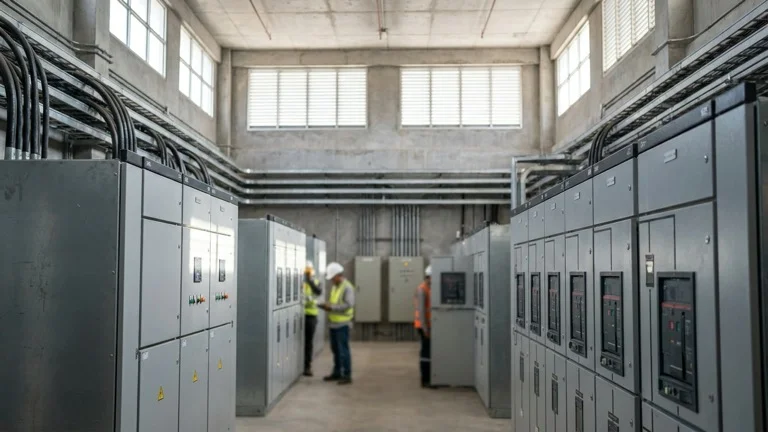
A main switchboard (ГРЩ in Ukrainian terminology) is the main distribution board that takes power from the incoming supply — from a transformer substation or an intake unit — and distributes it across the groups and individual loads of a facility. In plain terms, it is the point where electricity enters the building and branches out further: to lighting, sockets, power lines and shop-floor equipment. The main switchboard is a low-voltage assembly (НКП, LV switchgear per DSTU EN/IEC 61439) that combines three functions: receiving the supply, distributing it across lines, and protecting against short circuits and overloads.
In practice, a main switchboard (ГРЩ) is installed wherever an ordinary apartment-level consumer unit is no longer enough: in industrial workshops, boiler rooms, shopping centres, hospitals, administrative and multi-apartment buildings. It sits first after the intake and sets the entire distribution logic for everything downstream.
How the main switchboard differs from the ВРУ and the РЩ
These three abbreviations are often confused, because they all relate to power distribution. The difference lies in the position within the supply chain and in the set of functions. Below is the short comparison we use ourselves when explaining a facility's structure to a customer.
| Parameter | Main switchboard (ГРЩ) | Main intake distribution unit (ВРУ) | Distribution board (РЩ) |
|---|---|---|---|
| Purpose | Receiving power from the intake and distributing it across the main groups of the facility | Bringing the supply into the building plus first-level distribution | Distributing power at the level of a floor, workshop or group of loads |
| Position in the chain | The main node immediately after the intake | The intake node, often combined with the main-switchboard function on smaller facilities | Below the ГРЩ or ВРУ, closer to the end loads |
| What it contains | Incoming and outgoing circuit breakers, busbars, sectionalising, and an ATS where required | Intake apparatus, metering, protection, part of the distribution lines | Group circuit breakers, RCDs, control apparatus for local lines |
| Scale | The whole facility or a large part of it | A building or a section of a building | A floor, an area, an individual workshop |
On smaller facilities the functions of the ВРУ and the ГРЩ are often combined in a single unit, and that is normal practice. On large facilities they are split: the ВРУ receives the supply, the ГРЩ distributes the main flows, and further down the РЩ boards sit on each floor and in each workshop. The more complex the infrastructure, the more clearly these three levels are separated.
What a main switchboard contains
The composition of a ГРЩ depends on the number of incoming feeders and on the nature of the load, but the typical set of components is consistent. Let us go through what each unit is responsible for.
- Incoming circuit breakers — receive power from the intake and protect the whole system against short circuit and overload at the input.
- Outgoing circuit breakers — protect each individual group or line running to the loads.
- Busbars — copper or aluminium, distributing current between the intake and the outgoing lines.
- Metering unit — the commercial metering device is usually installed on the intake or in the ВРУ (because of the distribution operator's sealing requirements), rather than inside the ГРЩ itself; on high-power feeders metering works together with current transformers.
- Residual current devices (RCD, ПЗВ) — respond to earth-leakage currents. At main-switchboard level these are typically fire-protection RCDs (usually 100–300 mA), whereas the 30 mA personal-protection RCDs are placed lower down, on the outgoing lines of the РЩ.
- Sectionalising and ATS — a sectionalising device splits the board into parts, and an automatic transfer switch (ATS, АВР) switches the supply to the reserve feeder if the main one is lost.
- Enclosure with a defined IP rating — floor-standing, wall-mounted or recessed, depending on the room conditions and the project.
If there is a single incoming feeder, the board has one intake and line section. With two or three feeders, intake panels, sectionalising and, as a rule, an ATS are added. The specific breaker ratings, busbar cross-section and protection class are determined by the project for the facility's design load.
How to select a main switchboard: a checklist
Selecting a switchboard is not about picking a ready-made box off the shelf — it is a calculation for a specific facility. Here are the parameters worth defining before ordering.
- Intake rating. The facility's design power and current set the rating of the incoming device and the busbar cross-section. They are taken with a margin to allow for future load growth.
- Number and type of outgoing groups. How many lines leave the board and what load each carries — this determines the number and ratings of the outgoing breakers.
- Number of feeders. A single feeder, or two or three with redundancy — this decides whether sectionalising and an ATS are needed.
- IP rating. A dry heated room is fine with a lower class; a dusty workshop or a damp environment needs a higher one — depending on the operating conditions.
- Selectivity (discrimination). Protection must trip "from the bottom up": in a fault on one line, only that line's breaker should trip, not the whole intake. This is achieved by selecting device ratings and characteristics.
- Enclosure design. Floor-standing, wall-mounted or recessed — chosen by available area, geometry and access for maintenance.
Custom assembly makes it possible to account for the room geometry and the actual load layout, rather than forcing the facility to fit a standard arrangement. All ratings, IP class and the protection scheme are defined in the project, without guesswork.
Where VFDs and soft starters sit in the chain
The main switchboard is responsible for receiving and distributing power, but it does not control motors. Motor control sits lower in the chain, on the outgoing power lines. That is where variable frequency drives (VFDs) and soft starters work: the ГРЩ supplies power to the line, and the drive or soft starter then regulates the start-up and operation of a specific motor.
This matters at the design stage: motor inrush currents, harmonics from VFDs and the nature of the load all influence the choice of ratings and protection inside the ГРЩ itself. If a facility has many drives with frequency control, this is factored into the switchboard calculation in advance. When you need to match the main switchboard with the drive side, our engineers will help bring distribution and motor control into one consistent scheme.
Assembly and consultation
We assemble main switchboards from certified components for the design load of a specific facility — from single-section boards to constructions with several feeders and an ATS. We match the design to the real supply scheme rather than to an abstract template, so the board stays easy to maintain and keeps a margin for future expansion.
To select a main switchboard for your facility or to match it with the drive side, write to us by email, call (099) 091-35-02, or use our contacts page. We will advise on ratings, the protection scheme and the enclosure design.
Frequently asked questions about the main switchboard
What is a ГРЩ (main switchboard)?
A ГРЩ is the main switchboard — a low-voltage assembly that takes power from the incoming supply and distributes it across the groups and loads of a facility, while simultaneously protecting the lines against short circuits and overloads.
How does the main switchboard differ from the ВРУ?
The ВРУ (main intake distribution unit) both brings the supply into the building and distributes it at the first level, whereas the ГРЩ focuses specifically on the further distribution of the main flows across the facility. On smaller facilities these functions are often combined in a single unit; on large ones they are separated.
What does a main switchboard contain?
A typical ГРЩ contains incoming and outgoing circuit breakers, busbars, residual current devices (RCD), and, where required, sectionalising and an ATS, all in an enclosure with a suitable IP rating. The metering device, however, is more often placed on the intake or in the ВРУ rather than inside the ГРЩ itself.
How do you select a main switchboard by rating?
You start from the facility's design power and current: they set the rating of the incoming device and the busbar cross-section, which is taken with a margin. Next you determine the number of outgoing groups, the need for redundancy and the IP rating — the specific values are fixed by the project.
Is an ATS needed in the main switchboard?
An ATS (automatic transfer switch) is needed when a facility has a second feeder or a reserve source and cannot tolerate interruptions in supply. With a single feeder and no reserve, an ATS is not installed — the decision depends on the continuity-of-supply requirements of the specific facility.