Starting a three-phase motor from a single-phase supply: a complete practical guide
Three-phase asynchronous motors remain the backbone of industrial and domestic equipment: pumps, compressors, machine tools, ventilation systems, and conveyors all run on them. However, the need to connect a powerful three-phase motor to a standard single-phase 220 V supply arises constantly — in private workshops, garages, farms, and buildings without industrial power. In this guide, we will thoroughly examine all available methods for starting three-phase motors from a single-phase supply, compare them, and explain why a variable frequency drive (VFD) is the optimal solution for most applications.
Why a three-phase motor cannot be connected directly to 220 V
A three-phase asynchronous motor creates a rotating magnetic field through three stator windings offset by 120 electrical degrees. A single-phase supply can only feed one winding, so an additional device is required to create the starting torque and rotating field — either by providing a phase shift or by generating full three-phase voltage.
Without proper connection, the motor either will not start at all, or will operate with significant power loss, excessive heating, and reduced lifespan. This is precisely why choosing the correct method of converting single-phase supply to three-phase power is crucial.
Three methods for starting a three-phase motor from a single-phase supply
Three main approaches are used in practice. Each has its own advantages and limitations, which we examine below.
Method 1: Starting and running capacitors
The simplest and cheapest option is connection through a capacitor circuit. A running capacitor creates a phase shift of approximately 90° (instead of the ideal 120°), while a starting capacitor is connected briefly to increase starting torque.
Advantages: low cost, simple circuit design, does not require specialized knowledge for installation.
Disadvantages: loss of 30-40% of the motor's rated power, uneven magnetic field causes increased vibrations, overheating of windings shortens motor life, no speed control, difficult starting under load.
Method 2: Static or rotary phase converter
A phase converter is a specialized device that generates a third phase from a single-phase source. A rotary converter uses an auxiliary three-phase motor as a phase generator, while a static converter uses an electronic circuit.
Advantages: lower power loss (10-15%) compared to capacitor circuits, ability to power multiple three-phase devices simultaneously.
Disadvantages: high equipment cost, large size of rotary converters, no speed control, noise from auxiliary motor, complex maintenance, limited availability on the Ukrainian market.
Method 3: Variable frequency drive (VFD)
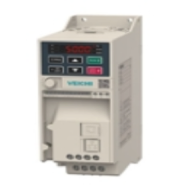
A VFD with single-phase 220 V input takes single-phase AC voltage, rectifies it to DC, and then uses an IGBT inverter to synthesize full three-phase voltage with adjustable frequency and amplitude. This is the most modern and efficient method.
Advantages: retention of 100% rated motor power, soft start without inrush currents (protecting the supply and mechanisms), smooth speed control from 0 to rated speed and above, built-in motor protection (overload, overheating, short circuit, phase loss), energy savings of up to 30-50% on pump and fan applications, regenerative braking, process automation capability through analog and digital inputs.
Disadvantages: higher initial cost compared to capacitors, requires basic knowledge for parameter setup.
Comparison table of starting methods
| Parameter | Capacitor circuit | Phase converter | Variable frequency drive |
|---|---|---|---|
| Power loss | 30-40% | 10-15% | 0% (full power) |
| Speed control | No | No | Yes, 0-400 Hz |
| Soft start | No | No | Yes |
| Motor protection | None | Minimal | Comprehensive |
| Starting current | 5-7 In | 3-5 In | 0.5-1.5 In |
| System efficiency | 55-65% | 80-88% | 93-97% |
| Approximate cost | $3-15 | $150-750 | $90-450 |
| Energy savings | No | Minimal | Up to 30-50% |
| Payback period | None | 3-5 years | 1-2 years |
| Installation complexity | Low | High | Medium |
How to check if your motor is suitable for single-phase VFD operation
Before purchasing a VFD, make sure your motor is compatible with this connection method. Check the motor nameplate:
- Voltage 220/380 V (Δ/Y): the motor is perfectly suitable. When connected to a VFD with single-phase 220 V input, the windings are connected in delta (Δ), and the motor will operate at full rated power.
- Voltage 380 V only (Y): you need a VFD with 380 V output or a special model with a step-up converter (220 V to 380 V VFDs).
- Nameplate unreadable: open the terminal box. If there are 6 leads with star/delta connection capability, the motor is suitable. Measure winding resistance to verify condition.
Important: pay attention to the motor's rated current — the VFD is selected based on current, not on the kilowatt rating on the nameplate.
Wiring diagram: three-phase motor via single-phase VFD
A typical connection of a VFD with single-phase input involves the following steps:
- Input connection: the live wire (L) and neutral wire (N) from the 220 V supply are connected to the L and N terminals (or L1, L2) of the drive. Grounding is mandatory to the PE terminal.
- Output connection: three phase wires from terminals U, V, W (or T1, T2, T3) of the drive are connected to the motor windings in delta configuration.
- Protection: an appropriately rated circuit breaker and a line reactor are recommended on the input side for harmonic protection.
- Control: connect external control signals (potentiometer for speed adjustment, start/stop buttons) to the VFD's control terminal block.
Note: installing a contactor or circuit breaker between the VFD and the motor is strictly prohibited — this can damage the IGBT power modules of the inverter.
Selecting VFD power rating for single-phase operation
When selecting a VFD for operation from a single-phase 220 V supply, several key factors should be considered:
Standard power range
Most manufacturers produce single-phase models rated from 0.2 to 2.2 kW. This is due to residential supply limitations: a 16 A circuit breaker at 220 V provides a maximum of approximately 3.5 kVA. Popular single-phase series available on chastotnik.ua:
- Danfoss VLT 2800 / ic2 — 0.7 to 3.7 kW, high reliability
- Delta Electronics MS300 / VFD-E / VFD-C200 — 0.7 to 2.2 kW, optimal price/quality ratio
- Siemens SINAMICS V20 — 0.12 to 3.0 kW, German engineering quality
- INVT GD10 / GD20 — 0.4 to 2.2 kW, budget option with good functionality
- Veichi AC10 / AC70E — 0.4 to 2.2 kW, excellent value for simple applications (AC10 series review)
Higher power models (up to 7.5 kW)
Some manufacturers (Danfoss, Bosch Rexroth, Lenze) offer single-phase VFDs rated up to 7.5 kW. However, these require reinforced wiring and a higher-rated circuit breaker (32-40 A). Such models are used in small workshops where three-phase supply is unavailable.
Derating rule
If you plan to use a standard three-phase VFD with single-phase power (connecting only two input terminals), apply the derating rule: multiply the rated output current by a factor of 0.5-0.6. This means for a 2.2 kW motor, you would need a three-phase VFD rated at 4-5 kW. It is better to choose models specifically designed for single-phase input.
Basic VFD parameter setup for three-phase motor operation
After connection, initial setup of the drive must be performed. Most modern VFDs have an auto-tune function that automatically identifies the parameters of the connected motor. Key parameters for manual entry:
- Rated motor power — from nameplate, kW
- Rated voltage — 220 V (for delta connection)
- Rated current — from nameplate, for delta configuration
- Rated frequency — 50 Hz (or 60 Hz depending on the motor)
- Rated speed — from nameplate, RPM
- Acceleration / deceleration time — depends on application, typically 5-15 s
- Minimum and maximum frequency — usually 0-50 Hz
For more details on setup and wiring, read our article VFD from single-phase 220 V to three-phase 380 V.
Typical applications of single-phase VFDs with three-phase motors
Here are the most common scenarios where starting a three-phase motor from a single-phase supply via VFD is applied:
- Home workshops: lathes, milling machines, drill presses — soft start protects workpieces and tooling, while speed control allows selecting the optimal cutting parameters
- Pumping stations: water supply for private homes and farms — VFD maintains constant pressure, saving up to 40% of electricity
- Ventilation: supply and exhaust systems in commercial premises — on-demand performance adjustment
- Compressors: garage and workshop equipment — soft start reduces stress on the piston assembly
- Agricultural equipment: grain mills, feed mixers, conveyors — where three-phase supply is often unavailable
- Small business: bakeries, woodworking shops, car washes — powerful equipment in premises with residential power supply
Alternative for heavy-duty starts: soft starters
If speed control is not needed but a smooth start of a powerful motor is important, consider soft starters. They limit inrush current by gradually increasing the voltage across the motor windings over 2-30 seconds. However, unlike VFDs, soft starters do not convert single-phase power to three-phase — they require a three-phase supply at the input.
A detailed comparison of VFDs and soft starters is available in our article Top questions about VFDs and soft starters.
Connecting a motor to a 380 V supply: star or delta?
If you have access to a three-phase 380 V supply, motor connection is much simpler. A motor with a 220/380 V nameplate can be connected in star directly to the supply or through a VFD with three-phase input. For a complete guide with star and delta diagrams, read our article Connecting a three-phase motor to a 380 V supply.
Common mistakes when starting a three-phase motor from 220 V
- Incorrect winding connection: when powered from 220 V through a VFD, the windings must be connected in delta, not star. Star connection at 220 V will result in the motor operating at only 57% of its rated power.
- Selecting VFD by power instead of current: choose the drive based on the motor's rated current in delta configuration, not by the kilowatt rating on the nameplate.
- Excessive cable length: if the motor-to-VFD cable exceeds 25 m, an output reactor must be installed to protect the winding insulation from PWM overvoltages.
- Missing ground connection: grounding the motor frame and drive enclosure is a mandatory safety requirement.
- Contactor between VFD and motor: never break the circuit between the drive and motor during operation — this destroys the power modules.
Conclusion
A variable frequency drive is the most effective and safest method for starting a three-phase motor from a single-phase 220 V supply. Unlike capacitor circuits, a VFD retains the full motor power, provides soft starting, speed control, and comprehensive protection. The investment pays for itself within 1-2 years through energy savings and extended equipment lifespan.
Browse the VFD catalog on our website to choose the optimal model for your motor, or contact our specialists through the Contacts page — we will help with selection and setup.