What Is an Inductive Proximity Sensor and How Does It Work
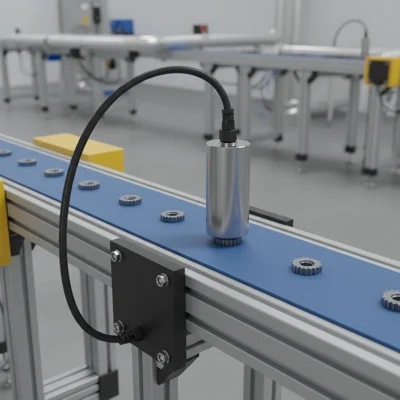
An inductive proximity sensor is a non-contact electronic device that detects only metallic objects. Its operation relies on two physical phenomena: a coil generating an alternating electromagnetic field and eddy currents (Foucault currents) induced in any conductive target that enters this field.
The coil embedded in the sensing face forms an LC oscillator circuit running at a fixed frequency. When a conductive object enters the sensing range, eddy currents absorb energy from the circuit and the oscillation amplitude drops. A comparator circuit detects this drop and switches the output transistor. No moving parts. No mechanical wear.
Important: inductive sensors do not detect plastic, glass, wood, or other non-conductive materials. Capacitive sensors are used for those applications.
Types of Inductive Sensors
Output Transistor Type: NPN vs PNP
This is the most critical classification when wiring to a programmable logic controller.
PNP (sourcing, p-type) — switches the positive supply (+) to the output on detection. Current flows from the sensor to the load. Used with sourcing (source-type) PLC inputs — the default for Schneider, Omron, and Siemens S7.
NPN (sinking, n-type) — switches the output to the negative supply (0 V) on detection. Current flows into the sensor from the load. Used with sinking (sink-type) PLC inputs — common in Japanese automation equipment and some Delta PLCs.
Choosing the wrong NPN/PNP type is the single most common reason a sensor "doesn't trigger." Always check your controller's input specification before ordering.
Output Logic: NO vs NC
NO (normally open) — output is open at rest; closes when metal is detected. Standard choice for part counting and position detection.
NC (normally closed) — output is closed at rest; opens when metal is detected. Used where a broken cable must trigger an emergency stop (fail-safe logic).
Number of Wires: 2-Wire vs 3-Wire
2-wire — wired in series with the load (like a limit switch). Simple installation, but limited output current and residual leakage current (~1 mA) that can falsely trigger some PLC inputs.
3-wire (Brown=+24 V, Blue=0 V, Black=output) — separate supply and output wires. Higher current capacity, compatible with all modern PLCs. Recommended for new installations.
Detection Range: Flush vs Non-Flush Mounting
The nominal sensing distance (Sn) is measured against a standard mild steel target (Fe37) under controlled conditions. Actual operating distance depends on the target material and mounting type.
Flush (shielded) — the sensor body is magnetically shielded on the sides. It can be mounted flush in a metal bracket with no clearance required. The detection zone is more directional, but Sn is approximately 30 % shorter than an equivalent non-flush sensor of the same diameter.
Non-flush (unshielded) — the lateral field is not suppressed; a metal-free zone of approximately 3× the sensor diameter is required around the body. Longer Sn, but stricter mounting requirements.
Correction factors relative to mild steel: stainless steel ≈ 0.9, aluminium ≈ 0.4, copper ≈ 0.35, brass ≈ 0.5. For non-ferrous targets, always select a sensor with a larger Sn or use a dedicated "factor 1" all-metal sensor.
Wiring Diagrams for PLC Connection
PNP NO → Sourcing (source-type) PLC Input (Schneider / Omron)
+24 V ──── Brown (1) ────[PNP Sensor]──── Black (4) ──── PLC INPUT │ 0 V ───── Blue (3) ──────────────────────────────────── PLC COM
Current flows from the sensor to the PLC input. The input sees +24 V when the sensor triggers.
NPN NO → Sinking (sink-type) PLC Input (Delta DVP / Mitsubishi FX)
+24 V ──── Brown (1) ────[NPN Sensor] 0 V ───── Blue (3) Black (4) ──── PLC INPUT │ +24 V ──────────────────────────────── PLC COM
The input sees 0 V when the sensor triggers. PLC COM connects to +24 V.
If your variable frequency drive has onboard discrete inputs or a built-in logic controller, check the manual for input type. Most modern drives support both types via a parameter or jumper.
How to Select the Right Inductive Sensor
1. Target Material
Mild steel is the reference material. For aluminium, copper, or stainless steel targets, apply the correction factors above or select a factor-1 sensor rated for non-ferrous metals.
2. Required Sensing Distance
Always set the actual operating gap to 50–70 % of the rated Sn. This margin compensates for manufacturing tolerance, temperature drift, and mechanical vibration.
3. Housing Size
- M8 — Sn 1–2 mm. Tight spaces, small stops, compact mechanisms.
- M12 — Sn 2–4 mm. Most common. Conveyors, fixture positioning.
- M18 — Sn 5–8 mm. Heavy industry, press units, stamping operations.
- M30 — Sn 10–15 mm. Large steel structures, gates, hoists.
4. Environmental Conditions
Check the IP rating (IP67 — submersion to 1 m is standard), operating temperature range (typically −25…+70 °C), and vibration/shock resistance (IK06 or higher).
5. Switching Frequency
For high-speed conveyors or pulse counters, select sensors rated ≥ 1 kHz. Standard sensors switch at 100–500 Hz.
Leading Sensor Brands Available in Ukraine
- Schneider Electric (Osiris XS series) — full range M8–M30, flush/non-flush, IO-Link versions, local service support in Ukraine.
- Omron (E2E, E2EW series) — Japanese precision, All-Metal versions for non-ferrous targets, standard cable length up to 5 m.
- SICK (IME/IMB series) — premium segment, IO-Link, weld-field immunity, ECOLAB/FDA versions for food and pharmaceutical industries.
- All three brands are stocked in the sensors catalogue on chastotnik.ua. Use the category filters to narrow down by parameter.
Where to Buy an Inductive Sensor in Ukraine
At chastotnik.ua you will find inductive sensors from Schneider Electric, Omron, and SICK in stock in Ukraine. Nationwide delivery via Nova Poshta or courier. Free technical consultation — call us or use the live chat.
For a complete automation system, browse our industrial controllers and variable frequency drives catalogue.