Why a Variable Frequency Drive Is Essential for Compressors
Compressor equipment is one of the largest electricity consumers in industrial facilities: by various estimates, compressed air accounts for 20 to 40% of total production energy consumption. The traditional approach to compressor control involves running the motor at a fixed speed and regulating output through loading/unloading or on/off cycling. This leads to significant losses: during idle mode, a screw compressor consumes approximately 25% of its rated power, while frequent starts of a piston compressor reduce motor lifespan.
A variable frequency drive (VFD, also known as a frequency converter or inverter) fundamentally changes this situation. It converts fixed-frequency 50 Hz mains voltage into variable-frequency output, enabling smooth adjustment of the compressor motor speed according to actual demand. Instead of operating in an "on at 100% — off" mode, the compressor produces exactly the amount of compressed air needed at any given moment.
How a VFD Works in a Compressor System
A variable frequency drive consists of three main functional blocks:
- Rectifier — converts AC mains power to DC.
- DC Bus — smooths ripple and stabilizes voltage using capacitors.
- Inverter — generates AC output at the desired frequency and amplitude using IGBT transistors and pulse-width modulation (PWM).
The compressor controller sends a pressure sensor signal to the VFD. When system pressure drops below the setpoint, the VFD increases motor speed. When pressure reaches the upper limit, the frequency decreases. Pressure regulation accuracy reaches ±0.1 bar, significantly exceeding the 1–2 bar variation typical of conventional control.
For proper VFD setup on a compressor, it is important to correctly configure motor parameters, frequency range, acceleration and deceleration ramps, and pressure limits.
Key Benefits of a VFD for Compressors
Energy Savings of 20–50%
The primary advantage of a VFD is substantial energy consumption reduction. Since the power consumed by fan-type loads (which includes compressors) is proportional to the cube of rotational speed, reducing speed by 20% yields approximately 50% power savings. In practice, depending on the load profile, implementing a VFD delivers energy savings of 20 to 50%.
Soft Start Without Shock Loads
During direct-on-line (DOL) starting, an electric motor draws starting current 5–8 times the rated value. This creates significant stress on the electrical network, contactors, and mechanical components. A VFD provides smooth speed ramping, limiting starting current to 100–150% of the rated value. This also enables practically unlimited starts without motor overheating — a critically important feature for piston compressors.
An alternative is a soft starter, but it only reduces starting current and does not provide speed control during operation. A detailed comparison of these solutions is described in the article Top Questions About VFDs and Soft Starters.
Stable System Pressure
Without frequency control, system pressure fluctuates between the compressor start and stop thresholds (for example, 6–8 bar). With a VFD, pressure is maintained at the setpoint with ±0.1 bar accuracy. This improves process quality, reduces air leaks (every 0.1 bar of excess pressure means ~1% extra consumption), and extends pneumatic equipment life.
Extended Equipment Lifespan
Soft starting and the absence of abrupt switching reduce mechanical stress on screw block bearings, couplings, valves, and the motor itself. According to manufacturers, compressor bearing life with VFD control increases by 30–50%, and maintenance intervals extend by 20–30%.
Reduced Noise Levels
When a compressor operates at reduced speed, the noise level decreases. This is particularly important for installations located near work areas or in facilities with noise restrictions.
Compressor Types and VFD Application Specifics
Screw Compressors with VFD Control
A screw compressor is the ideal candidate for variable frequency control. It is designed for extended continuous operation and has a smooth load characteristic. The speed regulation range for screw compressors is typically 25–100% of rated speed, enabling wide output adjustment without starting additional compressors.
A typical scheme for large systems is to have one VFD-equipped screw compressor serving as the trim unit (covering the variable portion of demand), while one or more fixed-speed compressors handle the base load.
Piston Compressors with VFD Control
For piston compressors, VFD application has specific considerations. The regulation range is limited: reducing speed below 30–40% of rated may cause lubrication and cooling problems. Nevertheless, even within this range, a VFD delivers significant savings, especially under variable loads.
The main benefit for piston compressors is eliminating shock starting loads. Each DOL start of a powerful piston compressor creates significant mechanical impact that shortens the life of connecting rods, piston rings, and valves. A VFD completely eliminates this phenomenon.
Scroll and Rotary Compressors
Scroll and rotary compressors are widely used in refrigeration and air conditioning systems. VFD application allows precise temperature maintenance, avoiding on/off cycling, which improves comfort and efficiency.
Comparison: Compressor with VFD, Soft Starter, and No Control
| Parameter | No Control (DOL) | Soft Starter | Variable Frequency Drive |
|---|---|---|---|
| Starting current | 500–800% of rated | 200–350% of rated | 100–150% of rated |
| Speed regulation | No | No | Yes, 0–100% |
| Pressure regulation accuracy | ±1–2 bar | ±1–2 bar | ±0.1 bar |
| Energy savings | Baseline | 5–10% | 20–50% |
| Starts per hour | 6–10 | 10–15 | Unlimited |
| Motor lifespan | Baseline | +15–20% | +30–50% |
| Noise at partial load | 100% (runs at full speed) | 100% | Reduced proportionally to speed |
| Solution cost | Minimum | Medium | Higher, payback 1–3 years |
How to Select a VFD for Your Compressor
When selecting a variable frequency drive for a compressor, several key factors must be considered:
- Motor power — the VFD must match the compressor motor rated power with a 10–20% margin for piston models (due to higher starting loads).
- Load type — for screw compressors, standard fan/pump duty drives are suitable; for piston compressors, models with high starting torque are required.
- Supply voltage — single-phase 220 V or three-phase 380 V. For power ratings above 4 kW, three-phase supply is recommended.
- Protection rating (IP) — for installation in dusty or humid environments, a minimum of IP54 is required.
- EMC filter — a built-in or external electromagnetic compatibility filter prevents interference in the power network.
- Built-in PID controller — an integrated PID controller allows connecting a pressure sensor directly to the VFD and implementing automatic pressure regulation without an external controller.
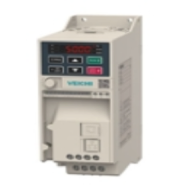
A good example of a cost-effective solution is the VEICHI AC10 drive, which features a built-in PID controller and is suitable for compressors up to 15 kW. For more powerful systems, vector control series are used.
Real-World Example: VFD Payback on a Screw Compressor
Consider a typical scenario: a 22 kW screw compressor operates in two shifts (16 hours per day, 250 working days). Average load is 65% of rated capacity.
- Without VFD: annual consumption ≈ 22 kW x 16 h x 250 days x 0.85 (accounting for idle time) = 74,800 kWh. At a rate of UAH 4/kWh — UAH 299,200/year.
- With VFD: annual consumption ≈ 22 kW x 16 h x 250 days x 0.55 (effective load) = 48,400 kWh. Cost — UAH 193,600/year.
- Savings: UAH 105,600/year (35%). VFD cost for 22 kW — approximately UAH 25,000–45,000. Payback period — 3–5 months.
For smaller compressors (5.5–11 kW), payback typically takes 6–12 months; for larger units (37–75 kW) — 2–4 months due to greater absolute savings.
Installation and Configuration Guidelines
When installing a VFD on a compressor, the following rules should be observed:
- Ventilation — a VFD generates heat (2–3% of rated power). Ensure adequate airflow or install an external cooling fan.
- Cables — use shielded cables between the VFD and motor to minimize electromagnetic interference. Cable length should not exceed manufacturer recommendations (typically 50–100 m).
- Pressure sensor — install an analog pressure transducer (4–20 mA or 0–10 V) on the receiver or in the compressed air main line.
- Minimum frequency — for screw compressors, the minimum frequency is typically limited to 25–30 Hz (50–60% speed) to ensure adequate lubrication. For piston compressors — 20–25 Hz.
- Ramp time — set an acceleration ramp of 5–15 seconds for screw and 3–10 seconds for piston compressors.
A detailed setup guide for specific VFD models can be found in the article VFD Setup for Compressor Operation.
Application in Ventilation and Related Systems
In addition to compressors, variable frequency drives are widely used in ventilation systems, where the operating principle is similar: adjusting fan or pump speed according to actual demand. The experience of implementing VFDs in ventilation systems confirms the effectiveness of this solution for compressor equipment as well.