What are motor efficiency classes
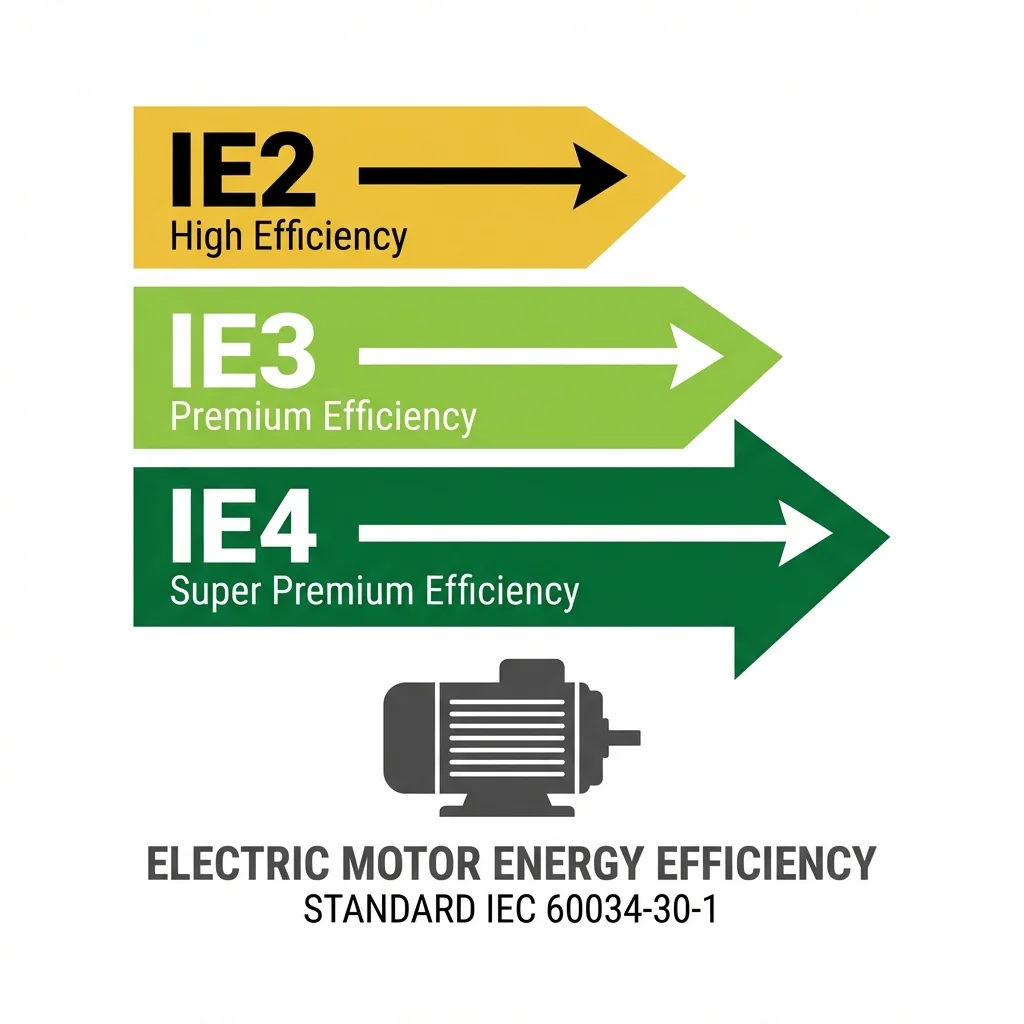
Electric motors consume approximately 70% of all electricity in industry. Even a modest 1–2% improvement in motor efficiency translates into tens of thousands of kilowatt-hours saved annually at the plant level. This is precisely why the International Electrotechnical Commission (IEC) developed the IEC 60034-30-1 standard, which classifies induction motors by energy efficiency levels from IE1 to IE5.
The standard covers three-phase induction motors rated from 0.12 to 1000 kW, up to 1000 V, operating in duty cycle S1 (continuous). Each successive class represents higher efficiency — and consequently, lower energy losses.
IE1–IE5 classification: what each class means
IE1 (Standard Efficiency) — the baseline level, gradually being phased out in the EU. IE1 motors have the lowest efficiency and highest losses. In most industrialized countries, the sale of new IE1 motors for general industrial applications is already prohibited.
IE2 (High Efficiency) — improved efficiency. Until recently, IE2 was considered the industry standard, but since 2015 in the EU it has remained permissible only for low-power motors (0.75–7.5 kW) or when controlled by a variable frequency drive.
IE3 (Premium Efficiency) — premium efficiency. This is currently the mandatory minimum for motors from 0.75 to 1000 kW in the EU (since July 2023). The IE3 class provides the optimal balance between cost and energy savings and is the most popular choice for new projects.
IE4 (Super Premium Efficiency) — super premium efficiency. IE4 motors have 15–20% lower losses compared to IE3. They are economically justified for continuous operation, high energy costs, and ESG/sustainability programs.
IE5 (Ultra Premium Efficiency) — ultra efficiency. The standard defines IE5 as a class with losses 20% lower than IE4. The market offers primarily permanent magnet motors (PMSM) and synchronous reluctance motors (SynRM), which require control from a variable frequency drive.
Efficiency comparison table by class
Below are the minimum efficiency values (%) for 4-pole motors (1500 rpm, 50 Hz) per IEC 60034-30-1:
| Power rating | IE1 | IE2 | IE3 | IE4 |
|---|---|---|---|---|
| 0.75 kW | 72.1% | 77.4% | 80.7% | 83.5% |
| 1.5 kW | 77.2% | 81.4% | 84.2% | 86.7% |
| 3 kW | 81.5% | 84.6% | 87.0% | 89.1% |
| 7.5 kW | 85.7% | 88.1% | 90.4% | 92.0% |
| 15 kW | 88.0% | 90.3% | 92.1% | 93.3% |
| 37 kW | 90.5% | 92.2% | 93.7% | 94.7% |
| 75 kW | 92.0% | 93.6% | 94.7% | 95.4% |
| 160 kW | 93.3% | 94.6% | 95.4% | 96.0% |
Note that the difference between IE2 and IE3 for a 7.5 kW motor is 2.3 percentage points. This may seem small, but at 6,000 hours of operation per year it saves approximately 1,400 kWh annually on a single motor.
EU regulations and international requirements
The European Union has been progressively tightening motor efficiency requirements:
- 2011 — IE2 became mandatory for motors 0.75–375 kW (EU Regulation 640/2009).
- 2015 — IE3 became mandatory for motors 7.5–375 kW (or IE2 + variable frequency drive).
- 2017 — IE3 became mandatory for motors 0.75–375 kW (or IE2 + VFD).
- July 2021 — EU Regulation 2019/1781 expanded requirements: IE3 for single-phase motors 0.12 kW+, IE2 for explosion-proof motors.
- July 2023 — IE4 became mandatory for motors 75–200 kW (under Regulation 2019/1781, second stage).
Ukraine, as an EU candidate country, is gradually adopting European standards. Many Ukrainian enterprises are already choosing IE3 and IE4 motors during modernization to comply with future requirements and reduce electricity costs.
Price differences: IE2 vs IE3 vs IE4
Higher efficiency requires better materials: more copper in windings, thinner electrical steel laminations with lower losses, and more precise machining. This increases manufacturing costs.
| Parameter | IE2 | IE3 | IE4 |
|---|---|---|---|
| Price premium (vs IE1) | +10–15% | +15–30% | +40–60% |
| Loss reduction (vs IE2) | — | 15–25% | 30–40% |
| Typical payback period | — | 1–3 years | 2–5 years |
| Annual savings at 7.5 kW (6,000 h) | — | ~700–1,400 kWh | ~1,500–2,500 kWh |
The exact difference depends on the brand, power rating, and supplier. For example, on chastotnik.ua you can compare prices for ABB M3AA series (IE3) and WEG W22 series (IE3) motors.
IE3 motor payback calculation
Let's consider a real-world example. A plant replaces a 7.5 kW IE2 motor with IE3:
- IE2 efficiency at 7.5 kW: 88.1%
- IE3 efficiency at 7.5 kW: 90.4%
- Operating hours: 6,000 hours per year (two shifts)
- Average load: 75%
- Electricity rate: UAH 4/kWh (industrial)
Annual savings calculation:
- IE2 consumption = (7.5 x 0.75) / 0.881 x 6,000 = 38,297 kWh/year
- IE3 consumption = (7.5 x 0.75) / 0.904 x 6,000 = 37,334 kWh/year
- Savings = 38,297 - 37,334 = 963 kWh/year
- Monetary savings = 963 x 4 = UAH 3,852/year
If the price difference between IE2 and IE3 motors at 7.5 kW is approximately UAH 5,000–8,000, the payback period is 1.3–2.1 years. After that, the plant saves nearly UAH 4,000 per motor annually.
With 24/7 operation (8,760 hours), savings increase to UAH 5,600/year, and payback shortens to 1–1.5 years.
When to choose IE4
IE4 motors cost significantly more, so their selection must be justified:
- Continuous operation (24/7) — pumps, compressors, ventilation. At 8,760 hours/year, the additional savings of IE4 over IE3 become substantial.
- High electricity rates — the more expensive energy is, the faster the price premium pays for itself.
- ESG and sustainability — many companies include energy efficiency in their ESG reports. IE4 motors demonstrate concrete investments in carbon footprint reduction.
- New projects with long horizons — when designing a new facility for 15–20 years of operation, IE4 pays for itself many times over.
- Regulatory requirements — in the EU since 2023, IE4 is already mandatory for 75–200 kW motors.
The "VFD + IE3 motor" combination — maximum efficiency
The greatest savings come from combining an energy-efficient motor with a variable frequency drive (VFD). The VFD adjusts rotational speed according to actual load demand, avoiding full-speed operation during partial loading.
The typical effect of VFD implementation on pumps and fans is 20–50% electricity savings. Combined with an IE3 motor instead of IE1, total savings can reach 30–60%.
For example, a "frequency converter + IE3 motor" system for a 15 kW pumping station with variable load can save 25,000–40,000 kWh per year — that is UAH 100,000–160,000 at industrial rates.
Real brands on chastotnik.ua
The chastotnik.ua catalog features motors from leading global manufacturers with IE3 and IE4 ratings:
- ABB M3AA / M3BP series — among the most widely used IE3 motors worldwide. Aluminum (M3AA) and cast iron (M3BP) frames, power ratings from 0.18 to 355 kW. ABB also produces a range of SynRM motors at IE5 class.
- WEG W22 series — the Brazilian powerhouse, the world's third-largest motor manufacturer. The W22 series is available in IE2, IE3, and IE4 classes. Excellent value for money.
- Siemens 1LE1 series — German engineering and a wide power range. The SIMOTICS GP (1LE1) series is manufactured in IE3 and IE4 classes.
All listed motors can be browsed in the catalog with filtering by power, brand, and efficiency class.
How to choose an efficiency class: step-by-step guide
- Determine the operating schedule — hours per year. Below 2,000 hours — IE3 is sufficient. Above 6,000 — consider IE4.
- Calculate lifecycle energy cost — a motor operates for 15–20 years. The cost of electricity over this period is 10–50 times the purchase price of the motor itself.
- Assess the load profile — for variable loads (pumps, fans), add a variable frequency drive.
- Consider future requirements — European standards tighten every 2–3 years.
- Compare offerings — the chastotnik.ua catalog lets you compare motors from different brands and classes.
Frequently Asked Questions (FAQ)
Can I replace an IE2 motor with IE3 without modifying the drive system?
Yes. IE3 motors have standard mounting dimensions per IEC (matching their power rating and frame size). In most cases, an IE3 motor is a direct drop-in replacement for IE2 — same dimensions, mounting, and shaft. The only consideration: IE3 may be slightly heavier due to the increased volume of active materials.
Does an IE3/IE4 motor work with a variable frequency drive?
Yes, and it is the recommended combination. Standard IE3 and IE4 induction motors are fully compatible with variable frequency drives. Moreover, EU Regulation 2019/1781 allows using an IE2 motor instead of IE3 if it is operated with a VFD — but in practice, IE3 + VFD delivers the best savings.
What is the real consumption difference between IE2 and IE3?
For a 7.5 kW motor at 6,000 hours per year, the difference is approximately 960 kWh — about UAH 3,800/year at industrial rates. For higher-power motors (37–75 kW), savings increase to 3,000–6,000 kWh per year.
Is IE4 worth buying if the motor runs less than 4,000 hours per year?
With limited operating hours, IE4 payback may exceed 5–7 years. In this case, the optimal choice is IE3. It is better to invest the price difference in a variable frequency drive, which will deliver significantly greater savings under variable load conditions.
Does the efficiency class affect motor lifespan?
Yes, positively. Lower losses mean less winding heat. According to the Arrhenius rule, a 10°C reduction in winding temperature doubles insulation life. IE3 and IE4 motors typically run cooler, extending their service life.