Wireless VFD Control: Technologies, Benefits and Practical Applications
Modern industrial automation has long moved beyond simple on-off equipment control. Variable frequency drives that just a few years ago required an operator to be physically present at the control panel now support wireless connectivity through WiFi, Bluetooth and cloud platforms. This opens up new possibilities for remote monitoring, diagnostics and configuration of electric drives without the need to run additional cables or stand right next to the equipment.
In this article, we will explore how wireless control of frequency converters works, what technologies are used, with a focus on the Siemens Sinamics V20 Smart Access and other solutions, and compare wired versus wireless connectivity for various industrial scenarios.
How the Siemens Sinamics V20 Smart Access Wireless Module Works
Siemens was the first major industrial drive manufacturer to offer a production-ready solution for wireless access to compact variable frequency drives. The Smart Access module for the Sinamics V20 series embeds a web server directly into the drive, creating a secure WiFi access point.
How the module operates
Once the Smart Access module is installed in the slot on the VFD housing, the drive creates its own WiFi network. The operator connects to it from a smartphone, tablet or laptop and gains access to the web interface through a standard browser. No additional software installation is required.
Key functions of the wireless module:
- Reading and modifying all VFD parameters through the web interface
- Real-time monitoring of drive status: frequency, current, voltage, temperature
- Starting and stopping the motor from a mobile device, including jog mode
- Fault diagnostics and error log review
- Copying parameter sets between multiple drives via a mobile device
- Backup and restore of configuration settings
The WiFi connection range is up to 20 meters in line of sight, which is sufficient for servicing equipment within a single room or production line. The password-protected connection prevents unauthorized access to drive parameters.
Wireless Communication Technologies for Variable Frequency Drives
Beyond the Siemens WiFi module, industrial drive manufacturers use several technologies to provide wireless access. Each has its own advantages depending on the application.
WiFi (802.11 b/g/n)
The most common option for local wireless access. The VFD creates its own access point or connects to the existing plant network. The advantage is compatibility with any device that has a WiFi module and browser. The drawback is limited range and potential interference from industrial equipment.
Bluetooth and BLE
Some compact variable frequency drives use Bluetooth Low Energy to connect with the manufacturer's mobile app. The range is shorter (up to 10 meters), but the module's power consumption is minimal. It is well suited for commissioning work and periodic diagnostics.
Industrial IoT platforms
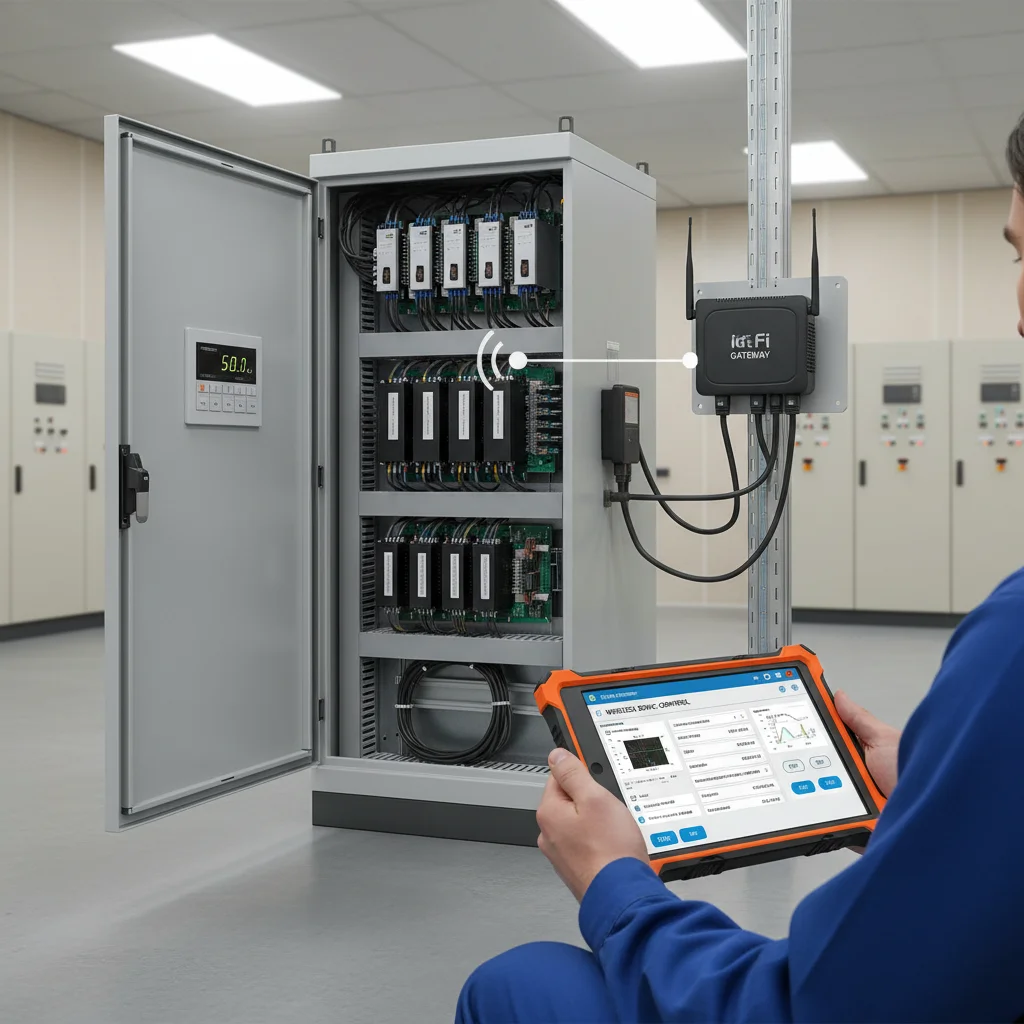
A current trend is integrating VFDs into cloud platforms through IoT gateways. The drive connects to a local gateway via Modbus RTU or Profinet, and the gateway transmits data to the cloud over Ethernet or mobile connectivity (4G/5G). This allows equipment monitoring from anywhere in the world, automatic fault notifications and analysis of motor operation trends.
Mobile connectivity (4G/LTE)
For remote sites without fixed internet access, such as pump stations, rooftop ventilation units and compressor installations, modules with a SIM card are used. The VFD transmits telemetry over the mobile network, and the operator receives data on a smartphone or in a SCADA system.
Wired vs Wireless VFD Control: A Detailed Comparison
Choosing between wired and wireless connectivity depends on the specific task, reliability requirements and project budget. Below is a comparison table of both approaches.
| Parameter | Wired control | Wireless control |
| Communication reliability | High, not affected by interference | Depends on RF environment |
| Installation cost | Significant: cables, trays, labor | Minimal: module into drive slot |
| Range | Up to several hundred meters (RS-485) | WiFi: up to 20 m, IoT gateway: unlimited |
| Commissioning speed | Hours to days for cable installation | Minutes to connect the module |
| Scalability | Requires running new cables | Add new devices without cables |
| Security | Physical access to cable | WPA2/WPA3 encryption, authorization |
| Suitability for real-time control | Yes, minimal latency | Limited for critical processes |
| Common protocols | Modbus RTU, Profibus, Profinet | HTTP/REST API, MQTT, OPC UA |
| Cable infrastructure maintenance | Required: inspection, replacement, labeling | Not required |
For critical production processes that require minimal response latency (for example, synchronizing multiple drives on a conveyor), a wired connection via Profinet or Profibus remains optimal. Wireless communication is best suited for commissioning, condition monitoring, diagnostics and control of auxiliary equipment: ventilation systems, pumps and compressors.
Practical Use Cases for Wireless VFD Access
Commissioning multiple drives
Consider this scenario: a facility has 15 variable frequency drives installed for supply and exhaust ventilation. The traditional approach means an engineer at each cabinet with a laptop and cable. With a wireless module, they connect to each drive from a smartphone, copy the base configuration and adapt individual parameters. Commissioning time is reduced by a factor of 3 to 5.
Servicing equipment in hard-to-reach locations
VFDs are often mounted at height, in tight electrical cabinets or in rooms with restricted access. A wireless module allows reading parameters and performing diagnostics without opening the cabinet or using a ladder. This is not only more convenient but also safer for maintenance personnel.
Remote monitoring through an IoT platform
For distributed facilities such as pump station networks, shopping centers and warehouse complexes, integrating VFDs with an IoT platform enables:
- Receiving emergency stop and overload notifications on a smartphone
- Analyzing energy consumption graphs and optimizing operating modes
- Planning preventive maintenance based on actual wear data
- Comparing equipment performance across different sites
Automatic restart after power supply failures
Modern VFDs with wireless modules support automatic restart after voltage recovery. Combined with remote monitoring, the operator receives a failure notification, sees that the drive has successfully restarted, and can confirm normal operation without traveling to the site.
Security Requirements for Wireless VFD Connections
Connecting industrial equipment to wireless networks demands a serious approach to cybersecurity. Unauthorized access to drive parameters can lead to motor damage, production downtime or even personnel injury.
Key security recommendations:
- Change the default WiFi module password immediately after installation
- Use WPA2 or WPA3 encryption for wireless connections
- Limit the number of simultaneous connections to the module
- Separate the industrial WiFi network from the corporate enterprise network
- Regularly update the wireless module firmware
- Use the function to lock critical parameters from modification through the wireless interface
Most manufacturers, including Siemens, implement multi-layer protection: a WiFi network password, web interface authorization and access rights differentiation for parameters (read-only or full access).
What to Consider When Choosing a VFD with Wireless Control
When selecting a frequency converter with wireless connectivity support, consider the following factors:
Wireless module compatibility with the drive model. Not all modules fit all series. Check compatibility in the manufacturer's catalog before ordering.
Type of wireless technology. WiFi provides the broadest compatibility, Bluetooth offers minimal power consumption, IoT gateways provide unlimited range.
Web interface functionality. Does it allow monitoring only, or also full control and parameter changes?
Integration capability with existing systems. Check support for MQTT, OPC UA or REST API protocols for connecting to SCADA or cloud platforms.
Protection against unauthorized access. Availability of encryption, authorization and access rights differentiation.
If your application requires smooth motor speed regulation without a complex variable frequency drive, also consider soft starters. A comparison of both solutions is covered in the article about differences between VFDs and soft starters.
Future Trends in Wireless Electric Drive Technology
The industrial IoT market is growing at 15-20% annually, and VFD manufacturers are actively integrating new wireless technologies. Key trends include:
Predictive maintenance. Analysis of vibration, temperature and current characteristics of the motor through a cloud platform enables predicting failures well before they occur.
Digital twins. Creating a virtual drive model to simulate operating modes and optimize parameters without stopping real equipment.
Edge computing. Processing data directly at the drive level without transmitting large volumes of information to the cloud, reducing latency and network load.
5G standard for industry. Private 5G networks at industrial facilities will provide reliable wireless communication with minimal latency, suitable even for real-time drive control.
Wireless VFD control is no longer an experimental technology but a practical tool that simplifies commissioning, reduces downtime and improves industrial equipment maintenance efficiency. Choose the solution that matches your requirements and start leveraging the benefits of remote access today.