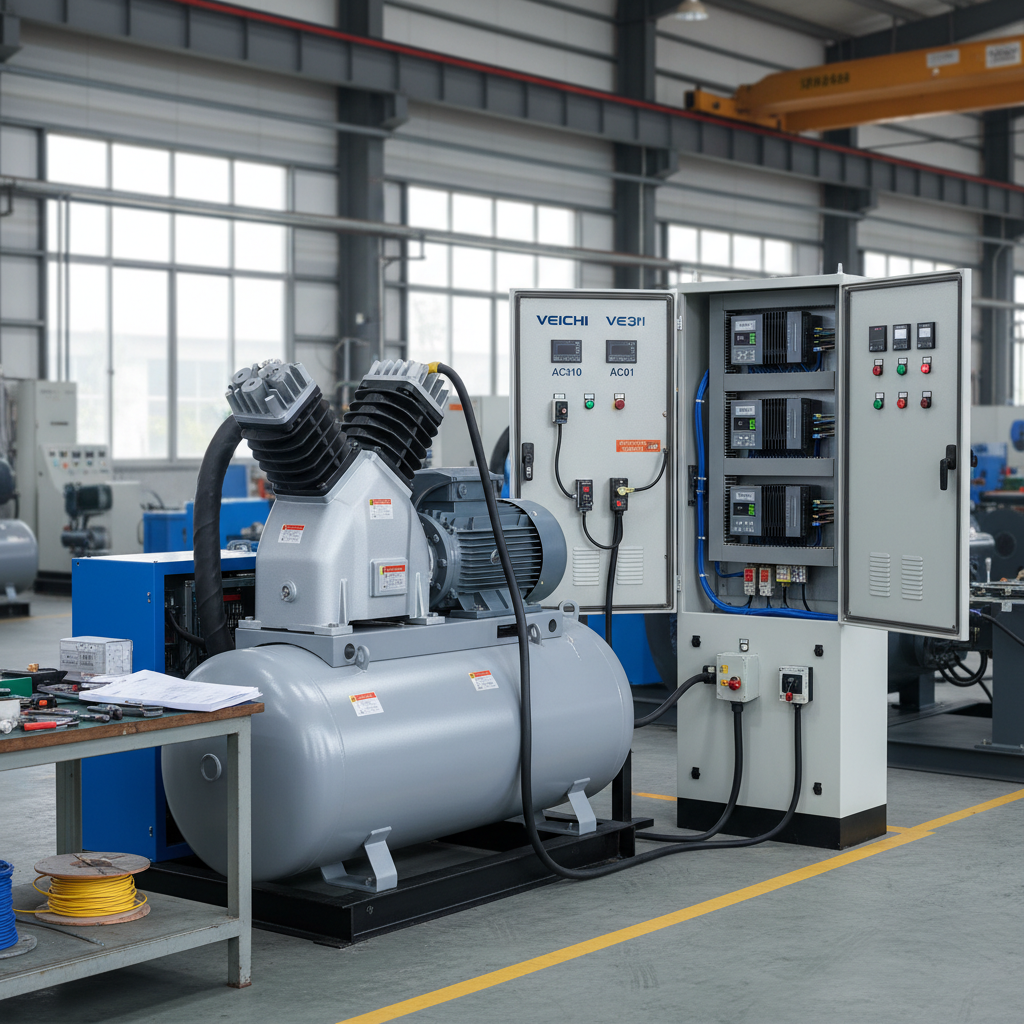
The use of frequency converters for industrial mechanisms such as compressors has become very popular due to systemic power supply interruptions. Unfortunately, shutdown schedules primarily affect industry first. To ensure power supply, solar power plants, cogeneration units, and generators (gasoline or diesel) are usually used. But all these power generation units have a significant drawback – they cannot provide a high starting current for compressor installations, which can be 15-20 times higher than the nominal current of the motor. To address this, you either need to increase the capacity of the solar power system or the generator unit several times, which leads to a significant increase in project costs just for a starting current that lasts very briefly. But there is a solution. The frequency converter. It is not expensive compared to increasing the project size and provides an effect that limits and smooths the starting current almost to the nominal rating of the electric motor.
The idea of integrating a frequency converter into the compressor control system is that the entire compressor automation algorithm and all its protections remain unchanged. The frequency converter can work with the compressor constantly, as it provides the motor with additional protections. Let's consider the necessary set of parameters for configuring VEICHI frequency converters to operate with a compressor.
| Parameter | Description | Value |
| F00.03 | Reset to factory settings | Value 22. |
| F02.01 | Number of motor poles | We take it from the motor nameplate or calculate using the formula 120*f/n where f is the motor's rated frequency, and n is the synchronous speed, for example, for a "three-thousand" this is 2 poles (120*50/3000), for a "one-and-a-half-thousand" it is 4 poles 120*50/1500, etc. |
| F02.02 | Rated motor power, kW | We take it from the motor nameplate |
| F02.03 | Rated motor frequency, Hz | We take it from the motor nameplate |
| F02.04 | Rated motor voltage, V | We take it from the motor nameplate |
| F02.05 | Rated motor speed, rpm | We take it from the motor nameplate |
| F02.06 | Rated motor current, A | We take it from the motor nameplate |
| F02.07 | Motor autotuning | 1. Dynamic tuning (with disconnected load) 2. Static tuning (if disconnecting the load is impossible). After selection, press the run button. r00-r01-r02-r03-frequency 50.00 or it will show an error code. Usually, we use this option |
| F01.00 | Control type | 0. Asynchronous motor, scalar control |
| F01.01 | Frequency converter start method | 1. Start from terminals |
| F01.02 | Frequency setting channel | 0. Frequency setting from buttons on the control panel. Usually set to 50 Hz – motor rated frequency |
| F01.21 | Acceleration time setting | Acceleration time of the motor in seconds (usually not less than 10-15 s) |
| F01.22 | Deceleration time setting | Motor stop time in seconds (usually not less than 20 s) |
| F07.03 | Start protection | 0000 – it is recommended to set all zeros to disable the start blocking when the power is supplied (so that the compressor can start if the pressure relay had operated before the voltage appeared) |
| F07.06 | Auto start after power loss/power supply | 0. Disabled 1. Auto-catch with speed search (recommended) |
| F07.07 | Auto start delay after power restoration | Set the auto start delay after voltage appears. (recommended 1 second or more) |
| F07.10 | Stop mode | 0. Smooth stop (by parameter F01.22) 1. Coast stop (recommended) the F01.22 parameter does not apply. The compressor will stop by inertia, as when working from a starter |
| F04.00 | U/F curve selection | 0 – linear dependence 1 – power 1.1 2 - power 1.2 3 - power 1.3 4 - power 1.4 5 - power 1.5 6 - power 1.6 7 - power 1.7 8 - power 1.8 9 - power 1.9 10 - power 2 (quadratic) 11 – custom via 5 points (parameters F04.10 – F04.19) Recommendation: we try these so that the current consumption is minimal. This will be the optimal curve. But usually, value 0 fits. |
Let's stop for a moment on connecting the frequency converter to the compressor automation. The idea of such a connection is to completely preserve the operation algorithm laid down by the manufacturer. Usually, powerful compressors are started through a star-delta contactor assembly or directly through a pressure relay. We need to remove the power wires that go to the switching device (starter or pressure relay), disconnect them, and connect them to the input of the frequency converter (for VEICHI frequency converters these are terminals R S T). The wires coming from the switching device to the motor are connected to terminals U V W (for VEICHI frequency converters). This way, we get three free potential-free pairs of normally open power contacts. On one of them, we hang a 2-core cable that will give a start signal to the frequency converter upon operation.
Terminals for starting VEICHI frequency converters:
- COM and X1 – for AC310 and AC10 series with power 7.5 kW and above;
- GND and X1 – for AC01 and AC10 series up to 5.5 kW inclusive.
- Thus, the frequency converter becomes a starter that receives a start signal from the standard automation system.
- If you encounter difficulties or have questions about this integration, contact us at the Chastotnik.ua team. We will explain. Select. Help.