Cobots in 2026: when a robot works shoulder to shoulder with a human
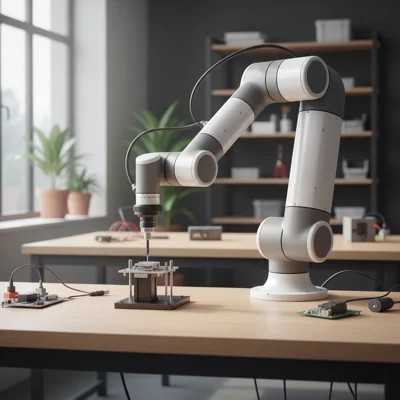
A cobot (collaborative robot) is an industrial robot that works next to a human without a safety fence, thanks to built-in joint torque sensors on every axis and speed and power limits defined by ISO 10218-1/-2 and ISO/TS 15066. Plainly: if you push a cobot with your hand, it stops in 80-150 milliseconds instead of continuing and breaking your wrist.
In our cobot catalogue we have seen the reaction of people who enter a cobot-equipped shop for the first time. The senior technologist walks up, carefully places a palm on the arm - the robot freezes. The engineer slaps the arm harder - the robot slowly retreats and shows the stop reason on the panel. After that, talk about "robots will replace humans" gets quieter. This is a coworker, not a competitor.
Below is a practical snapshot of the Ukrainian cobot market in 2026. Prices, brands, real tasks, payback, safety and the boundaries beyond which a cobot stops being the right answer.
How a cobot differs from a classic industrial robot
The main difference is that a cobot is designed to work next to an operator, while a classic industrial robot is designed for an isolated cell with a fence and a laser scanner at the entrance. Everything else follows from that: speed, payload, price, deployment time.
| Criterion | Cobot | Traditional industrial robot |
|---|---|---|
| Works next to a human | Yes, no fence | No, fence required |
| Max speed | up to 250 mm/s in collaborative mode | up to 6000 mm/s |
| Payload | 0.5-25 kg | 3-2300 kg |
| Hardware price | 250,000 - 1,200,000 UAH | 500,000 - 5,000,000 UAH and up |
| Integration time | from a few days | weeks to months |
| Reconfiguration | drag and drop, hand guiding | programming, safety system review |
| Primary safety standard | ISO/TS 15066, ISO 10218 | ISO 10218 + physical fence |
Simple test: if the robot stands in a cage with yellow mesh and a laser scanner at the gate, it is a classic industrial robot. If you can walk up to it with a mop, calmly sweep away chips and the robot just slows down, it is a cobot.
A cobot is not always the right answer. For a stamping shop with 100 kg workpieces, fast car-body welding or truck cabin painting, a classic robot beats a cobot on speed and payload several times over. We are honest about this with customers: if your task is to lift 50 kg and toss it on a conveyor in 1.2 seconds, a cobot is not the tool - look at classic six-axis industrial robots.
How cobots work: force sensors, PFL and teach by demonstration
A cobot is a normal six-axis manipulator, except every joint carries a torque sensor. The controller reads torques 500-1000 times per second and compares them to expected values. If actual torque exceeds expected by a threshold, the robot decides: something external is blocking motion. And stops.
Torque sensors on every axis
This is what separates a cobot from a classic robot with a laser scanner bolted on. The scanner sees the human before contact, the cobot senses contact itself. Typical sensitivity is 5-15 N depending on the model and tuning. That is roughly the force of pressing an elevator button. Reaction time is 80-150 ms - the robot freezes before you consciously register that you touched it.
Power and Force Limiting (PFL)
The most common collaboration mode. The robot continuously caps both force and speed so that even during an impact the energy stays below the safe threshold from ISO/TS 15066. That standard provides a table of maximum permissible forces and pressures for every body region - separately for face, chest, forearm. The integrator calculates from this table which speed and payload are allowed.
Four collaboration modes under ISO/TS 15066
- Safety Monitored Stop - the robot stops automatically when a human enters the working zone and resumes motion when the person leaves. Simple logic, fits machine tending.
- Hand Guiding - the operator physically grabs the robot and guides it through waypoints. The robot memorises the trajectory.
- Speed and Separation Monitoring - a laser scanner or 3D camera tracks distance to the human. Closer means slower motion. 1.5 m - full speed, 0.5 m - sharp slowdown, contact - stop.
- Power and Force Limiting - the baseline cobot mode, no external scanners. All control runs through joint torque sensing.
Teach by demonstration
The best feature of cobots for small businesses is hand-guided teaching. You do not write code, you do not twiddle a joystick. You release the brakes, grab the arm by the wrist and walk it: "point A - point B - grip - point C - release". The robot remembers. A new cycle is ready in 20-30 minutes. For a classic industrial robot the same cycle is 2-3 shifts of an engineer with a teach pendant and a program editor.
Cobot brands in Ukraine 2026: who is who
Several global vendors sell and service cobots on the Ukrainian market in 2026. Prices below are "starting from" figures, without end-effector or commissioning. For a real project add 30-50% to the bare arm price.
| Brand | Series | Payload | Reach | Price from (UAH) |
|---|---|---|---|---|
| Veichi | VCC | 10 kg | 1310 mm | 350,000 |
| KUKA | LBR iiwa 7/14 | 7 / 14 kg | 820 / 800 mm | 900,000 |
| Universal Robots | UR3e / UR5e / UR10e / UR16e / UR20 | 3-20 kg | 500-1750 mm | 600,000 |
| FANUC | CRX-5 / 10 / 25 | 5-25 kg | 731-1889 mm | 750,000 |
| ABB | GoFa / YuMi / SWIFTI | 1-15 kg | 500-1200 mm | 800,000 |
| Doosan Robotics | H / M / A series | 5-25 kg | 900-1700 mm | 650,000 |
A separate word about Veichi. Veichi VCC cobots in our catalogue are a Chinese manufacturer long known in variable frequency drives and servo drives. For the "first cobot in a mid-size shop" segment, Veichi VCC covers 80% of tasks at the UR10e level but at half the price. No magic here: servo motors and sensors are their own, not European, and support comes through the integrator. If you need a robot for a Pfizer lab, take KUKA iiwa. If you need one for a cosmetics packaging line in Brovary, look at VCC first.
KUKA LBR iiwa is the premium class. Seven torque sensors, German precision school, medical certifications. Priced accordingly. On our installations we specify iiwa where sub-millimetre repeatability or lab-grade protocol cleanliness is required.
Universal Robots is the de facto European standard. UR5e - packaging classic, UR10e - machine tending classic, UR20 - 2023 arrival with 1750 mm reach. Largest library of ready-made programs (UR+) and the longest track record. If the customer says "we want it like Audi assembly", odds are Audi runs UR.
FANUC CRX is an odd combination: a cobot arm, but behind it stands one of the world's largest classic robot makers. Strong advantage - shared R-30iB Plus controller with the rest of the FANUC fleet on the floor. If you already run five FANUC R-2000s, the sixth CRX joins the existing system in a couple of days.
What a cobot really costs: TCO 2026
The bare arm is 60-70% of the project budget. The other 30-40% is everything else. Here is a typical breakdown of a full "cobot on a packaging line at a Kyiv plant" project, using a Veichi VCC at 350,000 UAH bare.
- Arm with controller and teach pendant - 350,000 UAH (≈70%)
- End-effector (pneumatic Schunk-style gripper, vacuum suction or custom tooling) - 40,000-90,000 UAH (≈10-18%)
- Installation, wiring, cable tray, control cabinet - 30,000-50,000 UAH (≈8%)
- Commissioning and cycle programming - 60,000-120,000 UAH (≈15-25%)
- Training two operators - 15,000-30,000 UAH (≈5%)
- Risk Assessment and CE documentation - 20,000-40,000 UAH
Total: a minimum cobot cell turnkey in Ukraine 2026 lands at 450,000 - 750,000 UAH. Large ABB/KUKA projects with 3D vision and complex tooling easily cross 1.5 million.
A separate and often forgotten item is remote monitoring and service for the cobot. On older installations it is bolted on after the fact for an extra 50,000-80,000 UAH, but on new ones it pays to plan it in from day one. It saves several service-engineer callouts per year.
Typical cobot tasks: five real cases
A cobot is not a universal answer to every automation question. Some tasks are a perfect fit, others should not use a cobot at all. Here are five scenarios where a cobot pays off quickly.
1. Small-item packaging
Cosmetics, electronics, dietary supplements, pharmaceuticals. Typical cycle: pick an item from the conveyor, place it in a blister or box, repeat 1200 times per shift. Cobot speed (20-40 cycles per minute) is plenty here, and the monotony is openly harmful to humans. We saw a case in Odesa: a cosmetics line, one operator packed 900 bottles a day. We installed a Veichi VCC - 1600 bottles a day, and the operator moved to QC and intake.
2. Machine tending
Loading a blank into a CNC machine, unloading the finished part, stacking it in a cassette. The most rewarding cobot scenario: the cycle is deterministic, parts are uniform, the machine dictates tempo. The cobot grabs a blank from the pallet, drops it in the spindle, closes the door, waits 3 minutes, pulls it out, drops it in the bin. 150-200 parts per shift without fatigue. For this scenario a PLC and an HMI panel are almost mandatory - you need to synchronise the cobot with the machine.
3. Machine vision quality control
The cobot picks a part, rotates it under a camera through 3-5 angles, the image goes into a machine-vision system, rejects go to a separate bin. A Veichi VCC plus an industrial camera is a working minimum at 600,000-700,000 UAH. Cobot advantage: reconfigurable to a new SKU in 40 minutes. Classic robot advantage: none - here a classic robot loses on flexibility.
4. Glue, sealant or silicone dispensing
Perimeter bead on a housing, droplet dispensing on a PCB, thermal paste application. Cobot accuracy (±0.1 mm on UR10e, ±0.2 mm on Veichi VCC) is adequate. Humans should not do this job long-term - adhesive solvents are toxic and tempo is monotonous. The cobot sits in a fume hood and does not complain.
5. Lab sample preparation
Dispensing reagents from a pipette into tubes, moving 96-well plates from the incubator to the centrifuge and back. Classic KUKA LBR iiwa scenario in pharma. The cobot works sterilely, does not cough into a tube, the protocol auto-documents. Here we recommend only LBR iiwa because of its medical certification.
Cobot payback for small and mid-size business
A cobot in a small business pays back in 2-4 years if the task is to displace monotonous manual work across two shifts. This is not theory, it is arithmetic we run with every customer before the deal.
Simple model. A plant in Cherkasy, a fastener packaging line. Two operators in two shifts doing pick-and-place from a bin to a blister. Salary is 20,000 UAH gross per month each plus 22% social tax = 24,400 UAH. Two operators per year - 585,600 UAH. Cobot with integration - 650,000 UAH one-off capex, maintenance 15,000 UAH per year.
- Turnkey cobot cost: 650,000 UAH
- Payroll for the two displaced operators: 585,600 UAH/year
- Cobot operation: 15,000 UAH/year (electricity, maintenance, spares)
- Net annual saving: 570,600 UAH
- Payback point: 650,000 / 570,600 ≈ 1.14 years
That is the ideal case. Real life adds transition costs, downtime during training, product redesign for the cobot. A realistic payback is 2-3 years. Extra upside beyond pure savings: stable quality, round-the-clock tempo, no sick leave and no turnover.
The honest downside. A small business often does not have a single dedicated operator you can simply displace. The person packs in the morning, then loads trucks and keeps the books after lunch. A cobot only covers part of that role. Then payback stretches to 5-7 years, and the cobot becomes more of an image item than a business tool.
How to deploy a cobot safely
A cobot is safe in itself, but a collaborative cell is not. Safety comes from a proper ISO 12100 Risk Assessment plus a correctly designed end-effector, not from the robot. Integrators keep seeing plants buy a UR10e, mount a homemade gripper with sharp edges on it and then call it "the cobot that cuts hands".
- ISO 12100 Risk Assessment. Before installation. Assess every human-robot interaction scenario including maintenance and abnormal situations.
- Safety category PL d per ISO 13849 for the emergency stop control chain. Sufficient for most collaborative scenarios.
- End-effector without sharp edges or pinch points. If you have them, cover with a soft buffer or redesign.
- Speed in the collaborative zone limited to 250 mm/s. ISO 10218 requirement, not negotiable even for throughput.
- Two emergency stop buttons - on the operator pendant and on the cell frame. Within reach from any position where a human stands next to the robot.
- Regular PFL parameter validation. Force and speed parameters can slowly drift as gearboxes wear. Test every six months.
A separate topic is integration with other equipment on the floor. A cobot rarely works alone. Around it sit variable frequency drives, sensors, pneumatics, conveyors. The emergency stop must cut all of them, not just the robot. A standard beginner mistake.
Will the cobot replace the human?
Short answer: no, not in the next decade. Long answer below.
A cobot displaces monotonous repetitive work in a predictable environment: pick-and-place, machine tending, dispensing, packaging. For tasks that require nuanced "what if" judgement, the cobot still loses to the human. If the spindle breaks mid-cycle, the cobot does not call maintenance or open a ticket. The operator does.
From our experience the right pattern reads like this: one operator plus two or three cobots. The human handles prioritisation, incident resolution, start/stop, acceptance checks. The cobots handle cycle repetition between incidents. More productive than three operators without cobots, but nowhere near "lay everyone off".
And separately - creative work. Welding a complex 3D seam on a prototype, commissioning a new product, repair - here the human stays ahead for a long time. A cobot earns its place when the task is known and repeats a thousand times. For a one-off, pick a human with the right tool.
For a wider view, see our article on intelligent robotics in the factories of the future - we sketch what a shop with cobots, an AI dispatcher and human operators will look like in the 2030s.
Frequently Asked Questions
How much does a cobot cost in Ukraine in 2026?
A bare arm starts at 350,000 UAH (Veichi VCC 10 kg) and reaches 1.2 million for a KUKA LBR iiwa 14. Turnkey projects start at 450,000 UAH, typically 650,000-900,000 UAH including end-effector, commissioning and training.
How does a cobot differ from a classic industrial robot?
A cobot works next to a human without a safety fence thanks to joint torque sensors on every axis. A classic industrial robot is 10-20 times faster and more powerful but requires a fence, laser scanner and bars humans from the working zone during a cycle.
Is it safe to work next to a cobot?
Yes, provided an ISO 12100 Risk Assessment is done correctly and the end-effector has no sharp edges. A cobot stops within 80-150 ms of contact, and speed in the collaborative zone is capped at 250 mm/s by ISO 10218.
Which cobot should a small business pick?
For 80% of small and mid-size production tasks in Ukraine 2026 we recommend Veichi VCC (10 kg, 1310 mm, from 350,000 UAH). If European build quality and a full integration library matter, take Universal Robots UR10e. For a lab or pharma line, go with KUKA LBR iiwa.
Do I need an ISO certificate to run a cobot in a shop?
The cobot arrives with CE marking and verified ISO 10218-1 conformity. The finished cell (cobot + tool + guarding + control logic) is a separate machine for which the integrator must issue a separate CE declaration after an ISO 12100 Risk Assessment.
Summary and next step
A cobot is not hype, it is a mature industrial tool with understandable economics. For pick-and-place, machine tending, dispensing and packaging a cobot pays back in 2-3 years and stabilises quality. For heavy welding, cabin painting and 100 kg part handling a classic robot is the right call - a cobot does not fit.
If you made it this far, you probably already have a specific task in mind. Browse the cobot catalogue on chastotnik.ua, send us a short task description (part mass, cycle time, what the robot should do) and within 2 days we will estimate whether a cobot makes sense, which one, and what it costs turnkey. If it does not make sense, we will tell you honestly and point you towards classic industrial robots or other automation based on PLCs and servo drives.
---