


Delta Electronics: where this manufacturer sits between INVT and Schneider
Delta Electronics is a Taiwanese company founded in 1971. It is a large power-electronics maker: power supplies, UPS, PV inverters, servo drives, CNC controllers, industrial automation. Delta has been building frequency inverters since the 1990s as a separate large product line. This is not a no-name from an unbranded OEM plant: own components, own IGBT modules on the higher series, proper English documentation, serviceable hardware.
Delta sits a notch above budget Chinese brands (INVT, Veichi) and below the big European trio (ABB, Danfoss, Siemens). In day-to-day behaviour it is closer to the Europeans: stable firmware, predictable parameters, good thermal handling. On price it is usually 15-30 % cheaper than a Schneider ATV or Danfoss FC, but 15-25 % more expensive than an INVT GD-series of the same class. So it is a mid-to-upper workhorse. We pick it when a budget drive no longer holds up on reliability, but the project never budgeted for a European brand.
Which Delta VFD series are actually in the catalogue
We keep around 95 active Delta models in stock for drives from 0.2 to 400+ kW. Below are the series we actually sell, tied to what they do.
VFD-E: general-purpose industrial series
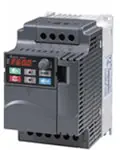
VFD-E is the best-selling Delta we have (more than half of all Delta sales over the past year). Sensorless vector control, built-in PID, RS-485 Modbus, 150 % overload for 60 s. Single-phase 230 V up to ~2.2 kW, three-phase 400 V above that. We use it for pumps, fans, conveyors, machine tools, crushers. A set-and-forget drive. Discontinued at the factory but still shipping from stock with spares available; for new projects we usually offer MS300 instead.
VFD-EL and VFD-EL-W: compact basic series
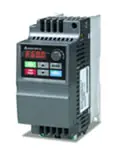
VFD-EL is the smallest-footprint drive for simple low-power machinery, typically 0.2-2.2 kW. U/f control plus basic sensorless, PID present, Modbus present. VFD-EL-W is a variant with improved heat dissipation and a wider supply range. We fit it to extractor fans, small pumps, conveyors, small machinery where exact torque is not needed. Just soft start and speed control.
MS300: modern compact vector series
MS300 is the current replacement for the old VFD-E/EL up to ~22 kW. Sensorless vector with better low-speed torque, built-in PLC (internal logic without an external controller), STO functional safety on higher trims, detachable keypad, two communication ports. In G/P mode one frame size handles either a larger motor in light duty (P, 110 %) or a smaller one in heavy duty (G, 150 %/60 s). We use it for pressure-controlled pumps, fans, conveyors, dosing units, packaging equipment. Anything where you want modern logic without paying for a large series.
VFD-C200: basic compact drive with vector control
VFD-C200 is a small series between EL and C2000. Vector control, built-in PLC, braking transistor already inside on small ratings. It fits where VFD-EL is too limited but C2000 is overkill.
VFD-C2000: heavy industrial vector series
VFD-C2000 is the top line for serious drives. Full vector control with encoder (closed-loop), torque control, 150 % overload for 60 s (more on the heavy trim), range up to hundreds of kW. A drive for cranes, hoists, extruders, heavy-start mixers, winders, CNC machines. If the customer says "it has to hold torque at zero speed" or "needs a synchronous motor", this is C2000.
VFD-CP2000 and CFP2000: pump, fan and HVAC series
VFD-CP2000 is a dedicated pump-and-fan line. Cascade control of a pump group, sleep/wake, PID on pressure or flow, fire mode for smoke-extraction systems, energy saving on quadratic load. CFP2000 is a close variant tuned for ventilation. We use it for water-supply pumping stations, boiler rooms, supply-and-exhaust ventilation, cooling towers.
VFD-ED: elevator and lifting series
VFD-ED is a narrowly specialised elevator drive. Closed loop with encoder, smooth start/stop for cabin weight, brake control, emergency power from a UPS. Outside elevator work it is rarely used.
Which Delta series for which job
A short selection map. By task, not by price. If you are torn between adjacent series, the rule is simple: a heavier start and a need to hold torque mean you take the higher series.
| Task | Delta series | Why |
|---|---|---|
| Pump or fan with pressure/flow control | MS300 or VFD-CP2000 | Built-in PID; for a pump group, cascade on CP2000 |
| Small pump, extractor fan, conveyor up to ~2.2 kW | VFD-EL / VFD-EL-W | Compact, cheap, soft start and speed control — nothing more needed |
| General-purpose set-and-forget drive (machine tool, crusher, conveyor) | VFD-E (or MS300 for a new project) | Sensorless vector, proven reliable logic |
| Conveyor, mixer, extruder with a heavy start | VFD-C2000 | 150 %+ overload, torque control |
| Crane, hoist, winder — torque needed at zero speed | VFD-C2000 (closed-loop with encoder) | Closed vector loop, load holding |
| HVAC: supply-and-exhaust ventilation, cooling towers, boiler room | VFD-CP2000 / CFP2000 | Energy saving on quadratic load, fire mode, sleep/wake |
| Elevator, lift | VFD-ED | Dedicated logic: brake, encoder, emergency power |
Overload class, phases and voltage, derating: what it means in practice
Three things that make people buy the "wrong" Delta even though the model looks right.
Overload class G/P. One drive frame has two rated modes. G (heavy duty) is constant torque, 150 % overload for 60 s. Conveyors, crushers, cranes, compressors that start under load. P (light/normal duty) is variable torque, 110-120 % overload for 60 s. Pumps and fans where torque rises with the square of speed and there is no starting jolt. For the same frame, P mode lets you hang a larger motor. Typical mistake: someone took an "oversized" G-mode drive for a pump and overpaid; or fitted a P-rated unit on a conveyor and it trips on overload at startup.
Single-phase 230 V vs three-phase 400 V. Delta with a single-phase 230 V input genuinely exists up to ~2.2 kW (VFD-EL21, VFD-E21, single-phase MS300 trims). Their output is still three-phase, so the motor must be three-phase 230 V (delta connection) or rewired accordingly. Above 2.2-3 kW on a domestic or small grid the options are: run three phases, or agree a specific model with us. A "single-phase 5 kW VFD" is almost always a compromise on input current. The three-phase 380-480 V line is the main one, from ~0.75 kW up.
Derating. Delta holds rated current under normal conditions: up to 1000 m above sea level, cabinet air up to +40…50 °C (depending on series), typical PWM frequency. Above that, reduce load: roughly minus 1 % current per 100 m of altitude over 1000 m, plus a noticeable drop if the cabinet runs hot or you raised the carrier frequency for a quieter motor. In practice, in an unventilated metal cabinet under sun you take the next frame size or add ventilation. That is cheaper than replacing a burnt module.
Delta reliability without the gloss, and what to check before buying in Ukraine
Honestly: Delta is one of the most reliable brands in our catalogue under normal operating conditions, closer to European drives than to budget on return statistics. But "under normal conditions" is the key part. The weak spots are the same as on any VFD, Delta just forgives less than it looks:
- Thermal regime. The most common cause of death is not a defect but overheating: a dust-clogged heatsink, a dead cooling fan, a cabinet with no ventilation. Blow out the heatsink once a year and check the fan spins, and the drive runs for years.
- DC-bus capacitors. Electrolytic DC-bus capacitors are a consumable rated for 7-10 years at normal temperature, less if the drive ran hot. Ageing signs: longer startup, sag under load, humming. On older VFD-B/VFD-F this is already relevant, worth rebuilding rather than waiting.
- Parameters and firmware. Most Delta "faults" are corrupted or wrongly set parameters: wrong load type, wrong ramp time, auto-start left enabled, mismatched Modbus. Before writing "the VFD failed", reset to factory and configure from scratch using the manual for your series. We have them posted.
- Braking. If the load is inertial (a large-diameter fan, a flywheel, lowering a weight), the VFD needs a braking resistor or module, otherwise it trips on DC-bus overvoltage during braking. On small C200/C2000 the braking transistor is already inside, you just add a resistor. On large C2000 you add a separate braking module.
Before ordering Delta in Ukraine it makes sense to check:
- The series for the task, not for the price. A cheaper VFD-EL on a heavy-start conveyor ends up costlier than a proper MS300 or C2000 because of downtime.
- Overload class G/P for your load type (see the section above).
- Braking resistor or module: whether it is needed and whether it is included.
- Single-phase supply: genuinely available up to ~2.2 kW, above that agree the model.
- Service and spares. Delta is officially represented in Ukraine, 24-month warranty, replacement modules for the popular series (VFD-E, VFD-EL, MS300) are in stock.
- Documentation. Check there is a manual and parameter list for your series. We have them posted on the relevant series pages.
Delta, INVT or Schneider: short and honest
All three make working VFDs; the question is only what the project is and how much money rides on it.
INVT is the sensible budget. GD20/GD200A are 20-30 % cheaper than a Delta of the same class and do their job honestly on pumps, fans and medium-duty conveyors. We pick it when you need a working drive without overpaying and without hard brand requirements. If you are comparing in detail, there is an INVT frequency inverters page with the same series breakdown.
Delta is the reliable mid-to-upper segment. More expensive than INVT, cheaper than Schneider, closer to the Europeans in behaviour: stable firmware, predictable parameters, good thermal handling, proper service in Ukraine. We pick it when a budget drive no longer holds up on reliability, or when dedicated logic matters (CP2000 for pumping stations, ED for elevators, C2000 for cranes).
Schneider Electric (Altivar) and Danfoss are the premium. The most expensive, the best integration into European control systems, the longest official support, often specified in the project by default. We pick them when the project documentation or the customer's corporate standard requires it, or when you need maximum compatibility with their ecosystem (PLC, SCADA, fieldbuses).
In short: a working drive with no brand requirement is INVT; a reliable drive for years or a dedicated task is Delta; a project requirement or corporate standard is Schneider or Danfoss. Not sure what fits your job? Send us the motor current, load type, phases, whether there is an encoder and the desired power, and we will pick a specific model.