What a welding robot is and why production needs one
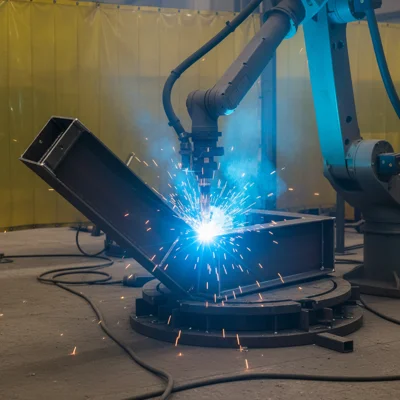
A welding robot is a 6-axis articulated manipulator paired with a welding current source (MIG/MAG, TIG, spot or laser) and automatic wire feed that lays beads at ±0.05 mm repeatability and 5–40 mm/s travel speed. In short, it welds identical seams day after day — night shift, weekends, holidays. A human cannot match that.
Why Ukrainian plants need this. In 2026, skilled welders are a disaster: a class-6 welder costs from 45,000 UAH a month and simply is not available on the market. A robot closes the problem in 12–24 months of payback and welds more consistently than people do. We have installed such cells at agricultural machinery plants, food industry factories, metal furniture workshops — and we will share honestly what works and what does not.
Types of robotic welding — which seam does what
The welding type depends on metal thickness, material and seam quality requirements. Do not mix types — switching a robot from spot welding to TIG is almost impossible without replacing the gear.
MIG/MAG — most common, 70% of our orders
MIG (metal inert gas) and MAG (metal active gas) are semi-automatic welding with a consumable electrode in shielding gas. MIG runs on argon or helium (stainless, aluminium), MAG on CO₂ or mixtures (carbon steel). Travel speed is high: 10–40 mm/s. This type goes into 70% of our client sites — frames, car bodies, metal structures, greenhouse frames.
TIG — thin beads, food industry, aerospace
TIG (tungsten inert gas) welds with a non-consumable tungsten electrode and external filler. Delivers a perfect spatter-free bead on stainless, titanium, aluminium from 0.5 mm thickness. Travel speed is low — 2–8 mm/s. Pricey, but mandatory for food-grade pipelines, pharma, aviation.
Spot welding — car bodies
Spot welding squeezes two copper electrodes and passes 5–15 kA current through a stack of sheets. One contact takes 0.2–0.5 s. Used where many thin sheets need welding fast: car doors, home appliance housings, radiators.
Laser — premium for thin metals
A laser head (2–6 kW fibre laser) delivers a 0.2–1 mm wide bead with almost no heat-affected zone. Works with 0.5–6 mm sheet. Cell price starts at 4M UAH. Justified for electrochemistry, medical devices, battery packs — anywhere precision matters.
Plasma cutting + welding in one cell
A combined cell: plasma first cuts the workpiece to a CAD file, then MIG welds along the same contour. Saves logistics between shops — but demands powerful extraction and special nozzles.
Components of a robotic welding cell
A cell is not just a robot. It is 7 interconnected subsystems, and saving on any of them kills the whole project.
- 6-axis robot — KUKA KR 16 arc, Veichi VCSG, FANUC ARC Mate or MOTOMAN AR. Payload 6–16 kg, reach 900–2016 mm.
- Welding current source — Fronius TPS/i, EWM Phoenix, Lorch MicorMIG. Synergic modes, digital bus to the robot.
- Wire feeder — 4-roll, speed 0.5–24 m/min, buffer for aluminium.
- Liquid-cooled torch — Binzel Abirob, Fronius Robacta. Automatic nozzle cleaner (Reamer).
- Part positioner — 1–3 extra axes on Veichi SD7 servo drives or KUKA KP. Without it half the seams are unreachable.
- Safety system — fence with light curtain, forced extraction of welding fumes, ABS cut-off on operator intrusion.
- Robot controller + PLC — synchronises motion, current, gas, positioner. Usually Delta DVP-SX2 or KUKA mxAutomation.
Skip the positioner and the robot will fail to reach 40% of seams on a 3D frame. Save on the power source and you get floating current and full lack of fusion. That is how first production batches worth 2M UAH go to scrap.
Robot brands for welding — what actually sells in Ukraine
Our welding robot catalogue is dominated by two brands: KUKA (premium, German standard) and Veichi (budget China with acceptable quality). FANUC and MOTOMAN are usually bought for specific contracts with Japanese or US partners. Here is a comparison of current models as of April 2026.
| Brand | Model | Payload | Reach | Price from, UAH |
|---|---|---|---|---|
| KUKA | KR 6 R900 arc | 6 kg | 901 mm | 1,100,000 |
| KUKA | KR 16 arc HW | 16 kg | 2016 mm | 1,450,000 |
| Veichi | VCSG10 | 10 kg | 1786 mm | 650,000 |
| FANUC | ARC Mate 100iD | 12 kg | 1441 mm | 1,300,000 |
| MOTOMAN | AR1440 | 12 kg | 1440 mm | 1,200,000 |
Veichi VCSG10 is the cheapest entry into robotic welding. We have seen it running on metal shelving and greenhouse frame lines where saving money matters more than 2% repeatability. KUKA KR 16 arc HW is the pick when you weld thick (up to 12 mm), in volume, fast, and right first time. More on specific models is on the brand pages KUKA and Veichi.
Cost of a full turnkey cell
A typical welding cell budget in Ukraine in 2026 runs 1.3–2.5M UAH. Here is the real line-item breakdown we show clients before the contract is signed:
- Robot — 650,000 UAH (Veichi VCSG10) to 1,500,000 UAH (KUKA KR 16 arc HW)
- Welding source Fronius TPS 400i / EWM Phoenix 421 — 250,000 – 400,000 UAH
- 1–2 axis positioner with servo drive — 150,000 – 350,000 UAH
- Liquid-cooled torch + Reamer — 80,000 – 150,000 UAH
- Fencing, light curtain, fume extraction — 120,000 – 250,000 UAH
- Commissioning + trajectory programming (3–6 welded parts) — 200,000 – 400,000 UAH
- Integration with shop-floor PLC and HMI — 50,000 – 120,000 UAH
Total: 1,500,000 – 3,170,000 UAH depending on equipment class. A typical mid-range Veichi + Fronius cell lands around 1.6M UAH. Premium KUKA + EWM + 2-axis positioner reaches 2.4–2.8M UAH. Payback is 14–22 months on two-shift operation.
How to pick a welding robot — 6 steps
We have run this loop more than 30 times. The order is strict — skip a step and you end up either short on functionality or overpaying by half a million.
- Define the welding type. MIG/MAG for frames, bodies, carbon steel. TIG for stainless and thin pipes. Spot for body panels. This single choice drives everything that follows.
- Measure the workpiece. Seam length, part envelope, farthest point from the robot base. Add 15% headroom. That sets your required reach (900, 1400, 2000 mm).
- Weigh the torch with cable. Fronius Robacta weighs 4–6 kg, liquid-cooled 6–8 kg. Add 2 kg for fixtures. That is your minimum payload.
- Judge seam geometry. A straight linear bead — 6 axes is enough. A 3D frame with corner seams — you must add a 2-axis positioner. Complex geometry — tool changer or a 7th axis on a rail.
- Count volume. Under 30 parts per shift — one robot covers it. More — go twin cell or rail-mounted robot moving between zones.
- Choose the source brand. Fronius CMT for thin steel without spatter, EWM Phoenix Pulse for thick, Lorch MicorMIG for budget. Verify protocol compatibility with the robot controller — DeviceNet, EtherCAT, ProfiNet.
If any step feels uncertain, contact us before you buy the hardware, not after. Reworking a finished cell costs 30–40% of its original price.
Common mistakes — how not to lose a million
Eight years of robotic welding deployment have taught us that different companies repeat the same failures. Here are the top 5 mistakes that cost clients from 500,000 to 3,000,000 UAH.
- Weak safety zone. A light curtain without ABS disconnect and a Pilz safety relay. One incident — 150k fine from labour inspection, production halt, potential injuries. Do not skimp.
- Poor part preparation. The robot welds straight but does not compensate for a crooked edge. If plasma-cut blanks arrive at ±1 mm tolerance — slag and lack of fusion is what you get. CNC-mill or laser-cut first, then weld.
- Saving on the positioner. A client from Poltava bought a KUKA without a positioner to save 280k. Within a month he realised 40% of seams on a car-body bracket were unreachable. Positioner bought separately later, reprogramming another 180k. Net overspend 50k — plus 2 months of downtime.
- Cheap current source. An unbranded Chinese inverter at 80k instead of a 350k Fronius. Four months in — ±12% current drift, full scrap on aluminium, no service centre will touch it. Entire door batch of 320 units went to metal recycling.
- No welding-fume extraction. Ukrainian health regulators tightened limits in 2025. Without extraction in the welding zone — fines up to 500k plus complaints from shift foremen. Install filtration from day one, not later.
Real cases from Ukrainian plants
Three deployment stories from our practice — no polish, with concrete numbers and the mistakes we made.
Case 1: Agricultural frames, Cherkasy region
Manufacturer of tractor trailers. They welded 4×2×1.2 m frames manually, two class-6 welders delivering 14 frames a week. We installed a KUKA KR 16 arc HW with a 2-axis Veichi SD7 positioner and an EWM Phoenix 421 Progress source. Frame welding cycle dropped from 3.5 hours to 48 minutes. Output grew to 38 frames per week without hiring. Payback — 17 months, counting payroll savings and revenue growth.
Case 2: Food-industry stainless pipelines, Vinnytsia
Producer of tanks and piping for dairy plants. TIG bead on 304 stainless, 2 mm thick, the requirement was mirror-finish with no tint discoloration. We installed a Veichi VCSG10 with a Lorch TIG 300 source, protecting the bead root with argon through an internal forming tube. Welding speed on a ⌀50 mm tube dropped from 6 minutes (human) to 2.5 minutes (robot). FDA food-grade inspection reject rate went from 14% to 0.8%.
Case 3: Metal furniture, Kyiv region
Family business making cabinets and shelving from 1.2–2 mm carbon steel. They ordered a FANUC ARC Mate 100iD with a Fronius TPS 270i CMT source (cold transfer). CMT is critical — without it thin steel burns through. Capacity rose to 180 cabinets per shift from 65 by hand. Paid back in 13 months. They also started taking subcontract welding for other manufacturers — the cell now runs two shifts instead of one.
Integration with our automation ecosystem
A robot without peripherals is dead iron. In 90% of our projects the welding cell is wired into the rest of the shop automation. Here is what we add.
- Delta DVP-SX2 PLC or Siemens S7-1200 — synchronises robot, source, positioner, part-feed conveyor, signalling.
- Veichi HMV HMI panel, 10" — operator sees cycle, coolant temperature, wire remaining, extractor load. Uses it for Start/Stop, recipes, calibration.
- AC310 frequency drive — runs the fume extractor fan and auxiliary fixture axes (tilters, hoists).
- Wire-touch sensors — find the seam start using the welding wire itself. Compensates for ±2 mm blank tolerance. Saves 15 min per series changeover.
- Nozzle blow-off + Reamer — cleans the torch from spatter every minute automatically. Without it, the bead degrades after 30 min of continuous work.
See adjacent equipment in the servo drives, PLCs and operator panels catalogues. We spec everything for a single project rather than selling off-the-shelf.
Frequently Asked Questions
How much does a welding cell cost in Ukraine?
A budget cell with Veichi VCSG10 + Lorch MicorMIG source + simple positioner starts at 1.3M UAH turnkey with commissioning. A mid-range KUKA + Fronius build runs 1.8–2.2M. Premium with a 2-axis positioner and a laser source is 3.5–4.5M.
Which robot to choose for stainless steel welding?
For TIG on 1–6 mm stainless, any 6-axis robot with 6–10 kg payload works (KUKA KR 6, Veichi VCSG10, FANUC ARC Mate 100iD). The source matters more — Lorch TIG 300 or Fronius MagicWave — along with root-side argon shielding inside the pipe.
Can a welding robot be repurposed for other tasks?
Technically yes — robots are universal, you swap the end-of-arm tool. In practice, building a tool changer costs 40–80k and the source plus positioner will not transfer to packaging or palletising. Plan one task per robot.
Is forced ventilation required in the welding zone?
Yes, mandatory. Ukrainian 2025 health standards cap welding fume concentration in the operator breathing zone at 4 mg/m³. For an autonomous robot cell — a Donaldson Torit or Kemper MaxiFil filter at 1500–3000 m³/h. Budget it from day one.
Who handles commissioning and trajectory programming?
We do. Our application engineer visits for 3–10 days depending on complexity, trains 2 operators, writes 3–6 base welding programs and leaves a video guide. After that your technologist adds new parts themselves from the robot teach pendant.
Bottom line
A welding robot in 2026 is not a luxury — it is cold arithmetic. A class-6 welder costs 45k/month and is not on the market anyway. A Veichi + Fronius cell starting at 650k and totalling 1.6M pays back in 14–22 months and welds 24/7 with no sick days. The main rule — do not cut corners on the source, positioner or extraction. Full model catalogue and configurations for your parts is in the welding robots section. Send us a photo of your part and seam specs — we will calculate the budget and delivery window in 2 days. More on brands in the KUKA, Veichi collections or in the general industrial robots catalogue. More robotic welding cases in the articles about unique capabilities of welding robots, how a robot replaces a welding crew and capabilities of modern welding robots.
---