Calculating solar panel count for your home
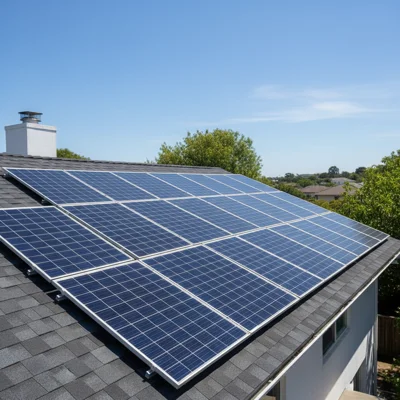
A home consuming 500 kWh per month needs roughly 10-12 panels rated at 500 W. That is a 5-6 kW system covering 22-28 m² of roof. But your home is not average, so you need to calculate specifically for your situation.
The calculation boils down to a simple formula: your consumption divided by the output of one kilowatt of panels in your region. Then adjustments for roof orientation, tilt, and shading. Let us walk through it step by step.
Step 1: determine your consumption
The most accurate method is to look at electricity bills for the past 12 months. Take the total kWh for the year and divide by 12. That is your average monthly consumption.
- Apartment, 2 people — 150-250 kWh/month
- House 80-120 m², 3-4 people — 300-500 kWh/month
- House 150-200 m² with air conditioning — 500-800 kWh/month
- House with electric heating — 1,000-2,000 kWh/month (a heat pump cuts this to 400-700)
No bills? Count appliances: refrigerator ~40 kWh/month, washing machine ~25, water heater ~150, air conditioner ~120, lighting ~30. Add them up and tack on 20% for what you missed.
Step 2: solar irradiance in your region
1 kW of solar panels generates different amounts depending on where you live. Here are average figures for Ukraine (kWh per 1 kW of panels per month, at optimal tilt):
| Region | Annual average | June | December |
|---|---|---|---|
| Odesa, Kherson, Mykolaiv | 115-125 | 165-175 | 35-45 |
| Dnipro, Zaporizhzhia, Poltava | 105-115 | 155-165 | 30-40 |
| Kyiv, Vinnytsia, Cherkasy | 95-110 | 145-160 | 25-35 |
| Lviv, Rivne, Lutsk | 85-100 | 135-150 | 20-30 |
| Chernihiv, Sumy | 90-105 | 140-155 | 22-32 |
The gap between south and west Ukraine is nearly 30%. A 5 kW system in Odesa produces the same as 6.5 kW in Lviv.
Step 3: the calculation formula
Here is the formula we use for preliminary sizing:
- Average monthly consumption (kWh) x 1.2 (margin for system losses) = target generation
- Target generation / output of 1 kW in your region = required capacity (kW)
- Capacity (W) / wattage of one panel = number of panels
Example for Kyiv: consumption 450 kWh/month x 1.2 = 540 kWh. Output of 1 kW in Kyiv ~ 100 kWh/month. Need 540 / 100 = 5.4 kW. That is 11 panels at 500 W or 14 panels at 400 W.
Example for Odesa: same consumption 450 kWh x 1.2 = 540 kWh. Output of 1 kW ~ 120 kWh/month. Need 540 / 120 = 4.5 kW. That is 9 panels at 500 W — two fewer than in Kyiv.
Adjustments that change the result
The formula gives a baseline. Reality adjusts it — sometimes significantly.
Roof orientation
- South — 100% output (reference)
- South-east / south-west — 95% (minimal loss)
- East or west — 80-85%
- North — 55-65% (not recommended)
If the roof faces east, add 15-20% to the calculated capacity. Or split panels across two slopes — east + west — for more even generation throughout the day.
Tilt angle
The optimal angle for Ukraine is 30-35° from horizontal. A flat roof (0°) loses ~10% of annual output but allows mounting panels on frames at the right angle. A vertical facade (90°) loses 30-40% — only as a supplementary option.
Shading
Even partial shade from a tree, antenna, or neighbouring building can cut output by 20-50%. Shade on one cell drags down the entire string. The fix is microinverters or power optimisers that isolate the shaded panel from the rest.
What it costs: budget examples
| System | Panel count | Budget (panels) | Full budget |
|---|---|---|---|
| 3 kW (small) | 6 x 500 W | 18,000-22,000 UAH | 80,000-120,000 UAH |
| 5 kW (standard) | 10 x 500 W | 30,000-38,000 UAH | 130,000-180,000 UAH |
| 10 kW (large home) | 20 x 500 W | 60,000-75,000 UAH | 250,000-350,000 UAH |
| 15 kW (with electric heating) | 30 x 500 W | 90,000-112,000 UAH | 400,000-550,000 UAH |
Full budget includes a hybrid inverter, LiFePO4 batteries, cabling, protection, and installation. Panels are 25-35% of the total.
Frequently Asked Questions
How many panels does a 100 m² house need?
House area alone tells you little — what matters is consumption. A typical 100 m² house uses 300-500 kWh/month, requiring 8-12 panels at 500 W (a 4-6 kW system).
Can I add panels later?
Yes, if the inverter has headroom. We recommend getting an inverter with 20-30% spare capacity from the start — for example, an 8 kW inverter for an initial 5 kW of panels.
How much roof area does a 5 kW system take?
10 panels at 500 W occupy about 24 m² of usable roof area. Accounting for edge offsets and row spacing, plan for 28-32 m².
Should I base calculations on winter consumption?
Depends on the goal. For 100% annual coverage, use the annual average. For winter autonomy, use December consumption — but the system will be 2-3 times larger and costlier. The usual compromise is covering 70-80% of annual usage.
More panels or a bigger battery?
More panels generate more energy during the day. A bigger battery stores more for the night. For maximum value, start with panels — they produce electricity, while the battery only stores it. A good ratio is 1 kWh of battery per 1-1.5 kW of panels.
What comes next
After calculating panel count, pick specific models. Browse our solar panels for home catalog — filter by wattage, technology, and price. Choosing between 400, 500, and 600 W? We have a detailed comparison. And for a general selection guide, see our article on choosing solar panels.