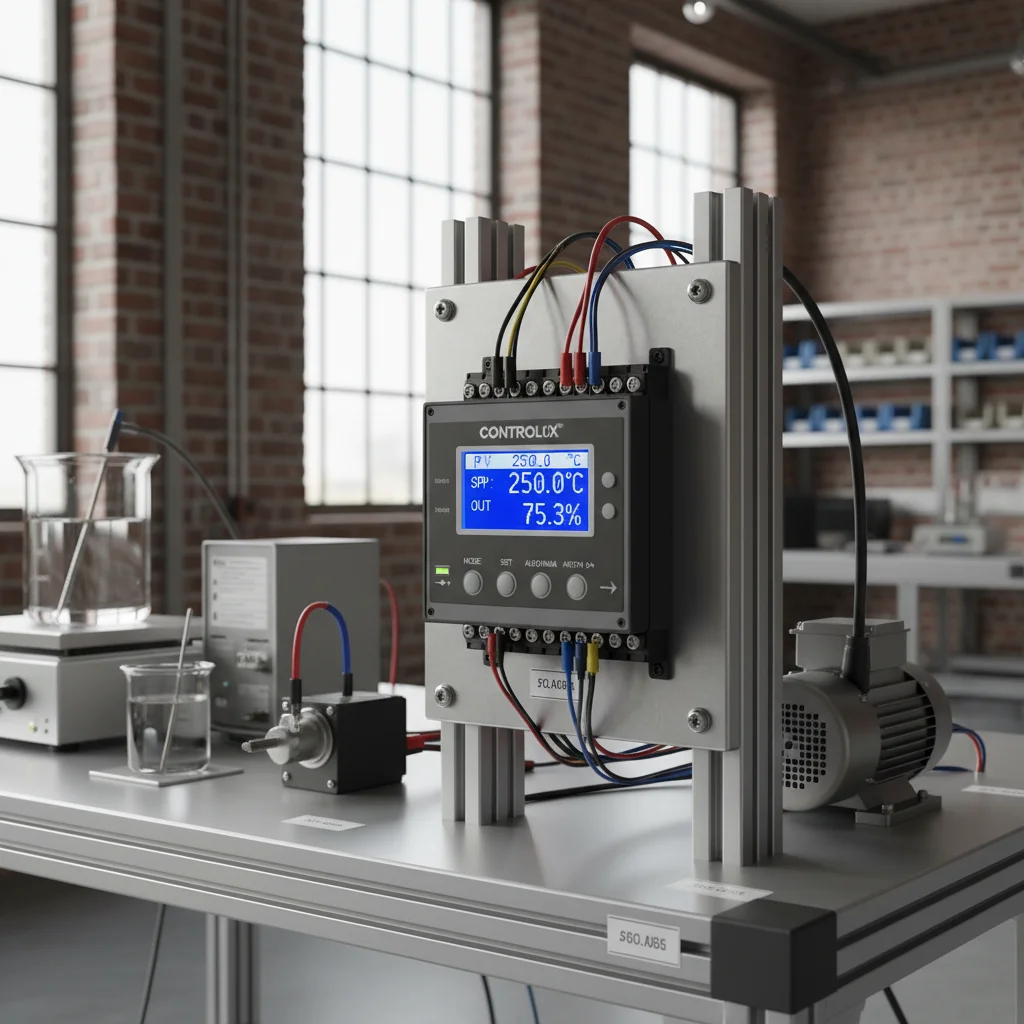
In the world of modern automation and process control, there is one universal tool that is applied almost everywhere — from home coffee makers to complex industrial installations. Its name is the PID controller. This abbreviation stands for Proportional-Integral-Derivative controller. Despite its complex name, its principle of operation is logical and extremely effective. Its main goal is to maintain a given system parameter (e.g., temperature, speed, pressure) at a stable level, quickly and accurately responding to any deviations.
This article is a detailed guide to the world of PID controllers. We will break down each of its components, learn the basics of tuning, and look at real-world examples of its application so that you can not only understand the theory but also see how it works in practice.
Anatomy of a PID Controller: The Three Pillars of Control
The strength of a PID controller lies in the combination of three components, each performing its unique function. They work together to ensure the optimal response of the system to an error — the difference between the desired value (setpoint) and the actual current value.
P — Proportional Component: The Force of Reaction
The proportional component (P) is the foundation of the controller. Its logic is very simple: the larger the current error, the stronger the corrective action. It reacts to the present. Imagine you are controlling a heater to maintain a temperature of 100°C. If the current temperature is 80°C, the error is 20°C. The proportional controller will output power to the heater proportional to these 20 degrees. If the temperature drops to 70°C, the error will increase to 30°C, and the controller will output even more power.
The main parameter of this component is the gain coefficient Kp. A large Kp means a very aggressive reaction to the error, which speeds up the system but can cause strong oscillations and instability. A small Kp makes the system slow and sluggish. The main drawback of a purely proportional controller is the presence of steady-state error. The system almost never reaches the setpoint perfectly, stopping slightly below or above it.
I — Integral Component: Memory of the Past
The integral component (I) is designed to solve the main problem of the P-controller — steady-state error. It works by analyzing the past. The integrator accumulates (sums up) the error over time. If the system has stabilized slightly below the setpoint, the P-component no longer changes its influence, but the I-component sees that the error still exists and begins to gradually increase the control signal.
Let's continue the heater example. The system stabilized at 98°C instead of 100°C. An error of 2°C is small, and the P-controller is satisfied. But the integrator sees these 2°C and begins to "accumulate" this error over time, slowly adding power to the heater. This process will continue until the temperature reaches exactly 100°C, and the error becomes zero. The parameter responsible for this component is the coefficient Ki. A too large Ki can lead to significant overshoot, where the system exceeds the setpoint, and cause oscillations.
D — Derivative Component: A Look into the Future
The derivative component (D) is the most "intelligent" of the trio. It reacts neither to the current error magnitude nor its accumulation, but to its rate of change. Its main goal is to predict future system behavior and prevent undesirable effects such as overshoot and oscillations. It acts as a damper, stabilizing the system.
Imagine the temperature rapidly approaching the set 100°C. The P and I components are still actively supplying power to the heater. But the D-component sees that the error is decreasing very quickly and "predicts" that if nothing is done, the temperature will overshoot the 100°C mark and go higher. Therefore, it creates a counteracting signal, temporarily reducing the total power to "slow down" the system before reaching the target. Its parameter is the coefficient Kd. It is important to note that the D-component is very sensitive to noise in the measurement signal, as any sharp jump will be perceived as a very rapid change in error, which can lead to chaotic controller actions.
Impact of Coefficients on System Behavior
The correct balance between the coefficients Kp, Ki, and Kd is the key to successful tuning. Changing each of them affects the key characteristics of the control process. Let's summarize this impact in a table.
| Parameter | Impact of increasing the coefficient | Effect |
| Kp (Proportional) | Reduces rise time | Speeds up system response, but increases overshoot and can cause oscillations. Reduces, but does not eliminate, steady-state error. |
| Ki (Integral) | Eliminates steady-state error | Completely removes steady-state error, but increases overshoot and settling time. Can lead to integral wind-up. |
| Kd (Derivative) | Reduces overshoot and settling time | Damps the system, making it more stable, allowing for a larger Kp. Improves response to rapid changes. Very sensitive to noise. |
Practical PID Controller Tuning: Trial and Error Method
Tuning a PID controller is the process of selecting optimal Kp, Ki, Kd coefficients for a specific process. Many methods exist, but one of the most common for manual tuning is the Ziegler-Nichols method. This is an empirical method that provides good starting values for further refinement.
Ziegler-Nichols Tuning Algorithm:
Zero out the integral (Ki) and derivative (Kd) components. Set them to zero, leaving only the proportional component.
Find the critical gain (Ku). Gradually increase the Kp coefficient until the controlled system enters a mode of stable, undamped oscillations around the setpoint. The Kp value at which this occurs is the critical gain Ku.
Measure the oscillation period (Tu). Using a graph or a stopwatch, measure the time of one complete oscillation (from one peak to the next). This will be the oscillation period Tu.
Calculate the coefficients. Use the obtained Ku and Tu to calculate the starting values of the coefficients according to the table below.
Ziegler-Nichols Coefficient Calculation Table
| Controller Type | Kp | Ki (via Ti) | Kd (via Td) |
| P | 0.5 * Ku | - | - |
| PI | 0.45 * Ku | Kp / (Tu / 1.2) | - |
| PID | 0.6 * Ku | 0.6 * Ku / (Tu / 2) | 0.6 * Ku * (Tu / 8) |
Important: the obtained values are only a starting point. After setting them, it is necessary to observe the system's behavior and, if necessary, manually adjust the coefficients to achieve an ideal response — a quick transition to the desired state without significant overshoot and oscillations.
Real-world Examples of PID Controller Applications
To better understand the power of this tool, let's look at a few real-life examples.
Cruise control in a car. Task — maintain a speed of 90 km/h. Process — car speed. Control action — throttle position. If the car starts going uphill (disturbance), the speed drops. The PID controller instantly registers the error (90 - 88 = 2 km/h), the P-component opens the throttle, the I-component prevents the speed from "hanging" at 89 km/h, and the D-component smooths out jerks when driving onto a flat road.
Temperature maintenance in a furnace. Task — 800°C. Process — temperature measured by a thermocouple. Control action — power of heating elements. When the furnace door is opened, the temperature drops sharply. The PID controller increases power to quickly return the temperature to normal but does so smoothly thanks to the D-component, so as not to overheat the furnace to 850°C.
Drone stabilization system. Task — maintain a horizontal position. Process — tilt angle measured by a gyroscope and accelerometer. Control action — motor rotation speed. A gust of wind tilts the drone. The PID controller instantly calculates the tilt angle error and its rate, and adjusts the rotation speed of the corresponding motors to level the device. This happens hundreds of times per second.
Conclusion
The PID controller is an amazingly flexible and powerful tool that forms the basis of most modern automated systems. Understanding the operating principles of its three components — proportional, integral, and derivative — allows for effective control of a wide variety of processes. Although its tuning may seem like a complex task, methods such as Ziegler-Nichols, and modern auto-tuning functions significantly simplify this process. By mastering PID control, you gain the key to stability, accuracy, and efficiency in any automation task.