LiFePO4 battery — what it is and why it became the standard
LiFePO4 (lithium iron phosphate battery) is a type of lithium battery with an iron phosphate cathode. It differs from regular lithium-ion batteries by thermal stability, longevity, and predictable discharge behavior. In short: it does not catch fire, works for 10-15 years, and holds voltage steady until the very end of discharge.
We have been selling and installing LiFePO4 batteries since 2021. Over that time, more than 400 systems have passed through us — from apartments with a 3 kW hybrid inverter to industrial facilities with a 100 kWh battery bank. This article is practical experience, not textbook theory.
LiFePO4 advantages over other technologies
The main advantage is cycle life. LiFePO4 withstands 4,000-6,000 charge-discharge cycles at 80% depth. Lead-acid AGM manages 400-600 cycles. A tenfold difference. And if you calculate cost per cycle, LiFePO4 becomes cheaper by year three.
- Safety: iron phosphate does not release oxygen when overheated — ignition is physically impossible even with a damaged case
- Stable voltage: the discharge curve is nearly flat from 90% to 10% charge. The inverter receives a steady 51.2 V throughout the cycle
- Low weight: a 5.12 kWh battery weighs 40-45 kg versus 150+ kg for lead-acid equivalents of the same capacity
- Wide temperature range: operates from -20°C to +60°C (discharge), charging from 0°C
- Built-in BMS: the management system balances cells and protects against overcharge, over-discharge, and short circuits
There are downsides too — let us be honest. The entry price is higher: one 5.12 kWh module costs 18,000-28,000 UAH depending on brand. An AGM equivalent is 8,000-12,000 UAH. But after 3 years the AGM needs replacing, while the LiFePO4 battery keeps working.
How to choose LiFePO4 battery capacity
Selection starts with a simple question: how many hours of autonomy do you need and what is the load? The formula is straightforward — multiply average consumption (kW) by hours and add 20% reserve.
Example calculation for a house
Typical load during an outage: refrigerator (150 W), router (15 W), lighting (100 W), chargers (50 W) — about 315 W total. For 10 hours of autonomy you need 3.15 kWh. With 20% reserve — that is 3.8 kWh. A single 5.12 kWh module covers this with comfortable margin.
| Load | Battery 5 kWh | Battery 10 kWh | Battery 15 kWh |
|---|---|---|---|
| 300 W (minimum) | ~14 hrs | ~28 hrs | ~42 hrs |
| 500 W (basic) | ~8.5 hrs | ~17 hrs | ~25 hrs |
| 1000 W (comfort) | ~4 hrs | ~8.5 hrs | ~13 hrs |
| 2000 W (full) | ~2 hrs | ~4 hrs | ~6.5 hrs |
Note: actual battery output is 85-95% of nominal. Inverter losses take another 5-10%. So a "5 kWh" module actually delivers 4.0-4.5 kWh of usable energy.
48V vs 51.2V — which to choose
Short answer: 51.2 V is the "48-volt" system. The confusion arises from the difference between nominal and working voltage. Nominal voltage of a LiFePO4 cell is 3.2 V. One module has 16 cells in series: 16 × 3.2 = 51.2 V. Inverter manufacturers write "48V input" meaning the 44-58 V range.
So a 51.2 V battery is fully compatible with any hybrid inverter marked 48V. Deye, Veichi, Growatt, Victron — they all work in this range.
When you need 24V or other voltages
24-volt LiFePO4 units (8 cells, 25.6 V) are less common and typically used in small systems — campers, boats, alarm systems. For home autonomy with an inverter from 3 kW and up — only 48V (51.2 V). It is the industry standard.
What to look for when buying
Not all LiFePO4 batteries are equal. The difference lies in cell quality, BMS, and assembly. Here are the main criteria we recommend checking.
- Cell type: Grade A from CATL, EVE, BYD, Hithium — proven manufacturers. Avoid batteries with unmarked cells
- BMS: should support balancing, overcharge/over-discharge protection, temperature monitoring. Bluetooth or CAN/RS485 communication with the inverter is a plus
- Communication: protocol between battery and inverter (CAN, RS485). Without it, the inverter cannot see the charge level
- Expandability: can you connect a second module in parallel? What is the maximum?
- Warranty: 5 years is the minimum. Serious manufacturers offer 10 years
We work with batteries for inverters from Deye, Veichi, and Felicity Solar.
Typical connection diagrams
LiFePO4 batteries connect to a hybrid inverter directly via a DC cable of appropriate cross-section. A standard home setup looks like this:
- Solar panels → MPPT input of inverter
- Battery → DC battery input of inverter
- Grid 220V → AC input of inverter
- Load → AC output of inverter
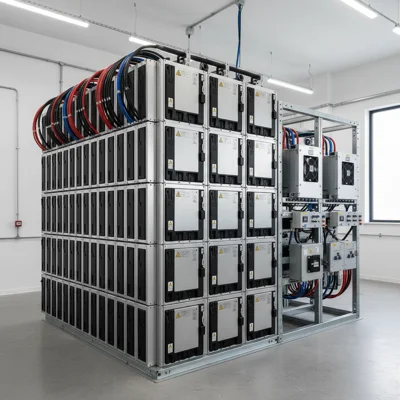
For systems with two or more modules, batteries are connected in parallel. This doubles capacity while keeping voltage at 51.2 V. The maximum number of parallel modules depends on the model — usually up to 16 units.
If you are planning batteries for solar panels, it is important to match the MPPT controller capacity with the panel array. The inverter should be able to charge the battery during daylight hours.
Frequently Asked Questions
How many years will a LiFePO4 battery last?
Under normal conditions (depth of discharge up to 80%, temperature 0-45°C) — 10 to 15 years. That is 4,000-6,000 cycles. Even with a full daily charge-discharge cycle, the resource lasts 10+ years.
Can LiFePO4 be left in freezing conditions?
Discharging is possible down to -20°C, but charging only above 0°C. If the battery is in an unheated space, you need a BMS with heating function or a separate heating element.
What is the difference between 5 kWh and 10 kWh modules?
Double the capacity means double the autonomy time at the same load. A 5 kWh module is the minimum for an apartment. 10 kWh suits a house with a pump and air conditioner.
Do I need a special inverter for LiFePO4?
You need a hybrid inverter with lithium battery support and CAN/RS485 communication protocol. Most modern hybrid inverters (Deye, Veichi, Growatt) support LiFePO4 out of the box.
How much does a LiFePO4 home system cost?
A minimum kit (5 kW inverter + 5.12 kWh battery) starts from 45,000 UAH. A system with 10 kWh storage starts from 70,000 UAH.
Bottom line: who should choose LiFePO4
The LiFePO4 battery is the best choice for home autonomy with a hybrid inverter. More expensive upfront, but considerably more cost-effective after 3-5 years compared to AGM or GEL. If you are building a backup power system or a solar power plant — this is the only technology we recommend without reservations.
Browse the LiFePO4 battery catalog or contact our engineers for a configuration tailored to your home.