LiFePO4 batteries for hybrid inverters: complete selection guide
Lithium iron phosphate (LiFePO4) batteries have become the standard for autonomous and backup power systems based on hybrid inverters. Their chemical stability, a lifespan exceeding 6,000 cycles, and depth of discharge up to 90% make LiFePO4 the most cost-effective solution in the long run. This guide covers battery types, technical specifications, and selection criteria for residential and commercial solar power systems.
What is LiFePO4 and how does it differ from other chemistries
LiFePO4 (lithium iron phosphate) is a subtype of lithium-ion technology where the cathode is made of iron phosphate. Unlike NMC (nickel-manganese-cobalt) or LTO (lithium titanate), phosphate chemistry provides thermal stability even at temperatures exceeding 270 C. This means the battery will not catch fire or explode even during a short circuit or mechanical damage to the casing.
The nominal voltage of a single LiFePO4 cell is 3.2 V, compared to 3.7 V for NMC. To achieve the standard 48 V (actually 51.2 V), 16 cells are connected in series. The 48-volt architecture is the primary configuration for modern hybrid inverters rated at 5 kW and above.
Battery type comparison: LiFePO4, Li-ion NMC, and lead-acid AGM
Before purchasing a battery, it is important to understand the fundamental differences between the three most common technologies. The comparison table below presents real-world parameters.
| Parameter | LiFePO4 | Li-ion NMC | Lead-acid AGM |
|---|---|---|---|
| Nominal cell voltage | 3.2 V | 3.6 — 3.7 V | 2.0 V |
| Cycle count (80% DoD) | 3,000 — 6,000+ | 1,000 — 2,000 | 300 — 700 |
| Allowable depth of discharge (DoD) | 80 — 95% | 80 — 90% | 50% |
| Charge/discharge efficiency | 95 — 98% | 90 — 95% | 70 — 80% |
| Service life | 10 — 15 years | 5 — 8 years | 3 — 5 years |
| Monthly self-discharge | less than 3% | 5 — 10% | 3 — 5% |
| Weight (per 1 kWh) | 9 — 12 kg | 7 — 10 kg | 25 — 35 kg |
| Thermal stability | High (up to 270 C) | Medium (up to 210 C) | Low (gas emission) |
| Maintenance required | None | None | Electrolyte level check |
| Cost per kWh (per cycle) | Lowest | Medium | Highest |
Although the initial cost of AGM batteries is lower, the cost per energy storage cycle for LiFePO4 turns out to be 5-8 times less due to the enormous difference in cycle life and depth of discharge. A 100 Ah LiFePO4 battery at 90% DoD delivers 90 Ah of usable energy, while an AGM battery of the same capacity provides only 50 Ah.
Key specifications when choosing a LiFePO4 battery
Capacity and voltage
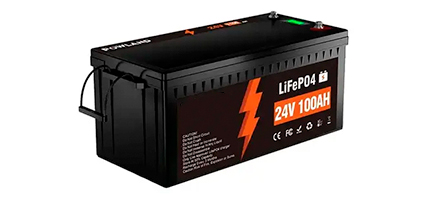
For residential systems based on hybrid inverters, the standard is 48 V (51.2 V) modules with capacity ranging from 100 Ah (5.12 kWh) to 500 Ah (25 kWh). For example, the Felicity LPBA48100 has a capacity of 5.12 kWh and is suitable for apartment backup power, while the Felicity LPBA48500 at 25 kWh serves fully autonomous homes or commercial facilities. Veichi VCLB series batteries operate at 51.2 V and are available in 5 kWh and 10 kWh configurations.
Battery Management System (BMS)
A BMS (Battery Management System) is a mandatory component of any LiFePO4 battery. It protects against overcharge, over-discharge, overcurrent, and overheating. A quality BMS features CAN and RS485 communication interfaces for data exchange with the hybrid inverter. For instance, Rosen batteries at 51.2 V are equipped with a BMS supporting CAN and RS485, allowing the inverter to precisely monitor state of charge (SoC), individual cell temperatures, and voltage balance.
Maximum charge and discharge current
This parameter determines how quickly the battery can be charged from solar panels and what peak current draw it can handle. Veichi VCLB-5K batteries support a continuous charge current of 50 A (0.5C) and peak loads up to 50 A at 15-45 C. The Veichi VCLB-10K at 10 kWh provides up to 100 A continuous current. Rosen batteries support 100 A nominal charge and up to 200 A peak, making them compatible with powerful inverters rated at 8 kW and above.
Cycle count
LiFePO4 battery lifespan is measured in charge-discharge cycles at a specified depth of discharge (DoD). Felicity batteries are rated for over 6,000 cycles, and Veichi VCLB guarantees 6,000 cycles at 80% DoD. With one full cycle per day, this translates to over 16 years of operation. In practice, if the battery serves as a backup source and is not discharged daily, the service life can exceed 20 years.
LiFePO4 battery form factors
Wall-mounted
Wall-mounted batteries are compact and do not occupy floor space. The Rosen BAT-51.2V-200AH-WALL with 10.24 kWh capacity measures 810x500x225 mm and mounts directly to the wall. Similarly, the Veichi VCLB-5K-W01 (5.12 kWh, 520x470x142 mm, weighing 47.2 kg) is designed specifically for residential wall installation.
Rack-mounted
Rack-mounted batteries fit standard 19-inch server cabinets and are ideal for scalable systems. The Rosen BAT-51.2V-100AH-RACK (5.12 kWh, 483x680x178 mm, 87 kg) and Rosen BAT-51.2V-200AH-RACK (10.24 kWh) allow capacity expansion by installing multiple modules in a single rack. The floor-standing Veichi VCLB-5K-D01 (550x440x130 mm) is also suitable for rack placement.
Modular cascade systems
Most modern LiFePO4 batteries support parallel connection for expanding total capacity. For example, four Veichi VCLB-5K modules at 5 kWh each create a 20 kWh system, while combining Felicity LPBF48350 units (17.5 kWh each) enables building a 35-70 kWh storage facility for commercial use.
How to size a battery for your hybrid inverter
Proper battery capacity calculation depends on three factors: daily electricity consumption, desired autonomy duration, and hybrid inverter power rating.
Step 1: Determine daily consumption
An average Ukrainian household consumes 10-15 kWh per day. For an apartment with basic needs (lighting, refrigerator, router, device charging), 5-8 kWh is sufficient. A private home with electric heating may consume 20-30 kWh.
Step 2: Determine desired autonomy
For backup power during outages, 4-8 hours of autonomy is usually sufficient. For a fully autonomous system with solar panels, plan for 1-2 days of reserve, accounting for cloudy weather.
Step 3: Calculate the required capacity
Formula: Capacity (kWh) = Daily consumption x Days of autonomy / DoD. For example, for a home consuming 15 kWh with 1 day of autonomy at 90% DoD: 15 x 1 / 0.9 = 16.7 kWh. In this case, the Felicity LPBF48350 at 17.5 kWh or a combination of two Veichi VCLB-10K units totaling 20.48 kWh would be suitable.
LiFePO4 battery compatibility with hybrid inverters
Not every battery is compatible with every inverter. Critical compatibility parameters include:
- Inverter battery input voltage range — must match LiFePO4 operating voltage (44-58 V for 48V systems)
- Communication protocol — CAN, RS485, or RS232 for data exchange between BMS and inverter
- Maximum charge current — the inverter must not supply more current than the battery BMS allows
- Lithium battery support — the inverter must have an appropriate charging mode (CC-CV with correct thresholds)
Veichi hybrid inverters in the SI and VH series are fully compatible with Veichi VCLB batteries and support direct data exchange via the CAN bus. Veichi SI inverters rated at 4.2-10.2 kW work with both 24 V and 48 V batteries, while three-phase VH models operate exclusively with 48 V systems. For more details on inverter types, see our article Difference between hybrid and grid-tied inverters.
LiFePO4 battery operation and maintenance
Temperature range
The optimal operating temperature for LiFePO4 batteries is 10 C to 35 C. At sub-zero temperatures, capacity decreases by 10-20%, and charging below 0 C can damage the cells. Veichi VCLB batteries limit charge current to 40 A at 0-15 C (instead of 100 A at 15-45 C), automatically protecting cells from degradation.
Cell balancing
The BMS automatically equalizes voltage across 16 cells (for a 48V battery) during each charge cycle. This is critical: even a 50 mV difference between cells can lead to premature wear of the weakest cell. Quality BMS units perform both passive balancing (dissipating excess through resistors) and active balancing (redistributing charge between cells).
Storage
If a LiFePO4 battery will not be used for an extended period (for example, at a country house during winter), charge it to 50-60% and disconnect it from the system. LiFePO4 self-discharge is less than 3% per month, so over 6 months of storage, the battery will lose only 15-18% of its charge.
Economic analysis: LiFePO4 versus AGM
Consider a specific example for a system requiring 10 kWh of usable capacity:
- AGM option: requires 20 kWh nominal capacity (50% DoD), cost approximately UAH 40,000, replacement every 3-4 years, over 15 years that means 4 sets = UAH 160,000
- LiFePO4 option: requires 11 kWh nominal capacity (90% DoD), cost approximately UAH 100,000, service life 15+ years, over 15 years that means 1 set = UAH 100,000
LiFePO4 saves UAH 60,000 over a 15-year period, not counting the higher charge efficiency (95% versus 75% for AGM), which additionally saves 15-20% of electricity from solar panels. Learn more about building solar power systems in our article Evolution of solar panels.
LiFePO4 batteries in the Chastotnik catalog
Our battery catalog features LiFePO4 solutions from three manufacturers with capacities ranging from 5 to 25 kWh:
- Felicity — range from 5.12 kWh (LPBA48100) to 25 kWh (LPBA48500), over 6,000 cycle life, 48 V voltage
- Veichi — VCLB-5K (5.12 kWh) and VCLB-10K (10.24 kWh) models, 51.2 V, BMS with protection, wall and floor mounting
- Rosen — 5.12 and 10.24 kWh batteries in Rack and Wall form factors, BMS with CAN/RS485, maximum current up to 200 A
For help selecting the optimal battery and hybrid inverter combination, contact our specialists. For additional technical information on choosing LiFePO4 batteries, see our article What you need to know when selecting a LiFePO4 battery.