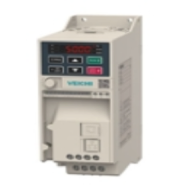
Selecting Veichi SD710 equivalents for Delta ASD-A2 servo systems
Replacing an industrial servo system is not just a matter of choosing a drive with the same power rating. In real machinery, supply voltage, rated and peak current, motor inertia, encoder type, flange, shaft, cables, communication protocol and the old parameter logic all matter. That is why moving from Delta Electronics ASD-A2 to Veichi SD710 should be treated as a technical migration, not as a simple part-number substitution.
Delta ASD-A2 has been used for many years in packaging machines, machine tools, cutting lines, winding units and positioning mechanisms. It is valued for built-in positioning functions, E-CAM, stable operation with ECMA motors and a familiar parameter structure. Veichi SD710 belongs to a newer generation: it reacts faster to commands, uses compact V7E motors, modern absolute encoders and flexible control modes.
Architectural difference between Delta ASD-A2 and Veichi SD710
Delta ASD-A2 was designed as a precise servo system with 20-bit incremental encoders, good vibration suppression and internal positioning modes. For its generation, it was a strong solution because many applications could be implemented without a separate motion controller.
Veichi SD710 uses newer digital signal processing hardware. The control-loop bandwidth can reach 3 kHz compared with about 1 kHz for ASD-A2. In practice, this means faster command response, lower following error during sharp acceleration and better behavior on high-speed mechanisms.
| Criterion | Delta ASD-A2 | Veichi SD710 | Practical meaning |
| Loop response | About 1 kHz | Up to 3 kHz | Veichi is better suited to fast cycles and aggressive motion profiles |
| Typical resolution | 20-bit encoder | 17 or 23 bits | The electronic gear ratio must be checked after replacement |
| PC connection | Mini-USB or service cable | USB Type-C | Diagnostics and setup are simpler |
| Motor protection | Usually IP65 | Usually IP67, except shaft outlet | Better resistance to dust, moisture and oil mist |
Encoders and electronic gear recalculation
Many Delta ASD-A2 kits in Ukrainian warehouses use incremental ECMA motors. After every power loss, the machine often has to perform a homing cycle. Veichi SD710 is more commonly supplied with absolute encoders, including 17-bit and 23-bit versions.
A 23-bit encoder provides 8,388,608 counts per revolution. This is much higher than the 20-bit Delta system. Therefore, old electronic gear values should not be copied mechanically without verification. If this step is skipped, the machine may move the wrong distance even when direction, acceleration and speed look correct.
- Check the old E-Gear values in the Delta parameters.
- Identify the new encoder resolution for the exact Veichi V7E or V7U motor.
- Recalculate the pulse scale so that one millimeter, degree or mechanical revolution remains unchanged.
- Run a slow test move after startup and measure the real displacement.
Cluster 1: supply voltage and phase configuration
The first selection filter is voltage. Delta ASD-A2 has 220 V and 400 V models. Up to 1.5 kW, 220 V models are often used with either single-phase or three-phase input. Higher-power 220 V models normally require a three-phase supply.
| Delta ASD-A2 series | Power | Voltage and phase | Veichi SD710 reference |
| ASD-A2-xxxx-A | 100 W - 1.5 kW | 220 V, 1 or 3 phases | SD710-xxxA-PA, CA or EA |
| ASD-A2-xxxx-B | 2.0 kW - 15 kW | 220 V, 3 phases | SD710-xxxA-PA, CA or EA |
| ASD-A2-xxxx-D | 750 W - 7.5 kW | 400 V, 3 phases | SD710-xxxD-PA, CA or EA |
In Veichi marking, A refers to the 220 V class and D refers to the 400 V class. This is the basic compatibility condition. A voltage mismatch can damage the power module, so voltage is checked before torque, flange or protocol.
Cluster 2: current and overload capability
Delta drives are often identified by motor power: for example, 0421 means the 400 W class. Veichi selection is more closely tied to rated output current. For servo systems this is a professional approach because dynamic behavior depends not only on watts, but also on peak current during acceleration, braking and load compensation.
| Delta power | Delta rated current | Delta max current | Veichi model | Veichi rated current |
| 100 W | 0.9 A | 2.7 A | SD710-1R8A | 1.8 A |
| 400 W | 2.6 A | 7.8 A | SD710-3R3A | 3.3 A |
| 750 W | 5.1 A | 15.3 A | SD710-5R5A | 5.5 A |
| 1.0 kW | 7.3 A | 21.9 A | SD710-7R6A | 7.6 A |
| 1.5 kW | 8.3 A | 24.9 A | SD710-9R5A | 9.5 A |
| 750 W, 400 V | 3.07 A | 9.21 A | SD710-3R8D | 3.8 A |
In most typical replacements, Veichi provides a small current reserve. This helps on packaging machines, feeders, cutting units and mechanisms with frequent acceleration. However, the reserve does not remove the need to check thermal behavior, braking resistor sizing and the real load profile.
Cluster 3: torque, inertia and motor type
The most common motor replacement mistake is looking only at rated torque. In a servo system, rotor inertia is just as important. Delta ECMA motors include low, medium and high inertia versions. Veichi V7E follows a similar logic, while optimized magnetic design can provide the same torque with a shorter motor body.
| Delta motor | Torque | Inertia | Veichi equivalent | Veichi torque |
| ECMA-CA0604, Low | 1.27 Nm | 0.277 x 10⁻⁴ kg m2 | V7E-L06A-R4030 | 1.27 Nm |
| ECMA-E11310, Medium | 4.77 Nm | 8.41 x 10⁻⁴ kg m2 | V7E-M13A-1R020 | 4.77 Nm |
| ECMA-F11830, High | 19.1 Nm | 54.95 x 10⁻⁴ kg m2 | V7E-M18A-2R915 | 19.1 Nm |
If a low-inertia motor is replaced with a medium-inertia motor only because the torque matches, the machine may develop vibration, overshoot or unstable positioning. Therefore, selection software must keep the motor family marker: C, E, F for Delta and L, M for Veichi.
Mechanical compatibility: flange, shaft and length
For a servo motor, mechanical fit is often more important than electronics. If the flange and shaft match, replacement can be fast. If even one dimension differs, an adapter plate, new coupling or mounting modification may be needed.
| Power | Delta flange | Delta shaft | Veichi flange | Veichi shaft |
| 100 W | 40 mm | 8 mm | 40 mm | 8 mm |
| 400 W | 60 mm | 14 mm | 60 mm | 14 mm |
| 750 W | 80 mm | 19 mm | 80 mm | 19 mm |
| 1.0 kW | 100 or 130 mm | 22 mm | 110 or 130 mm | 19 or 22 mm |
| 2.0 kW | 130 or 180 mm | 22 or 35 mm | 130 or 180 mm | 22 or 35 mm |
The 1.0 kW class needs special attention. A low-inertia Delta motor may use a 100 mm flange, while the closest Veichi version may use 110 mm. For new equipment this is a small difference, but on an existing machine it can require an adapter plate.
Cables and connectors: a mandatory part of the kit
Delta cables should not be treated as Veichi-compatible by default. Encoder connectors, power connectors, signal pinouts and service cables differ. If the customer orders only the drive and motor, installation may stop at the wiring stage.
- Motor power cable must match the Veichi series and route length.
- Encoder cable must match the feedback type and connector on the new motor.
- Brake cable is required for vertical axes, clamping units and mechanisms that hold load.
- CN1 or I/O connector should be included when the customer makes custom wiring for digital and analog signals.
PR, E-CAM and parameter logic
Many machines using Delta ASD-A2 rely on the internal PR positioning mode. It stores position records, speeds, acceleration values and motion sequences. Veichi SD710 also has internal positioning functions, but the parameter structure is different. Settings should therefore be transferred through a cross-reference table, not by copying parameter numbers.
| Function | Delta ASD-A2 | Veichi SD710 | What to check |
| Control mode | P1-01 | Pn000 | Position, speed or torque |
| E-Gear numerator | P1-44 | Pn204 | Pulse scaling |
| E-Gear denominator | P1-45 | Pn206 | Actual axis movement |
| JOG acceleration time | P4-05 | Pn500 | Safe test movement |
| DI1 setup | P2-10 | Pn600 | Input assignment |
For flying shear, rotary knife or master-axis synchronization, E-CAM is critical. Delta supports cam tables, and Veichi SD710 can also build high-resolution profiles with interpolation. Before replacement, extract the old cam table and check master pulse scaling, direction, start point and the reaction of Capture and Compare inputs.
How selection software should work
For a distributor or service company, an internal migration tool is useful. Its task is not just to show one equivalent, but to build a complete kit and warn about risks.
- Parse the Delta model code: identify power, voltage, protocol and drive class.
- Select the Veichi drive by current: the new drive rated current must not be lower than the old one.
- Match the motor: check torque, speed, inertia, flange, shaft and brake availability.
- Add cables: power, encoder, brake and I/O connector.
- Show a parameter table: what must be transferred from Delta to Veichi before the first startup.
- Display warnings: for example, a 100 mm Delta flange versus a 110 mm Veichi flange.
Example: for ASD-A2-0721-M, the tool reads 750 W, 220 V and CANopen. It then searches for a Veichi drive with rated current not lower than 5.1 A, 220 V class and the corresponding communication option. For the ECMA-C10807RS motor, it also checks the 80 mm flange, 19 mm shaft, 750 W power and low inertia.
Practical conclusion
Veichi SD710 can be a full replacement for Delta ASD-A2 when selection follows a systematic matrix: voltage, current, torque, inertia, flange, shaft, encoder, protocol, cables and parameters. The best result comes not from finding one similar part number, but from building a replacement kit with technical notes for the installer and commissioning engineer.
Before ordering, prepare photos of the servo drive and motor nameplates, cable lengths, control type, brake availability and a short description of the mechanism. With this data, compatibility can be assessed quickly and the risk of machine downtime is reduced.
FAQ
- Can Delta ASD-A2 be replaced with Veichi SD710 without changing the controller?
Yes, if the control type, protocol or pulse interface matches and the input logic and motion scale are transferred correctly.
- Will the old Delta cables fit?
Usually no. Veichi normally requires separate power, encoder and brake cables, or new wiring based on the Veichi pinout.
- What should be checked before the first startup?
Supply voltage, rated current, motion direction, E-Gear, limit switches, emergency stop and brake operation.
- Why is power rating alone not enough?
Two systems with the same power can have different inertia, shaft, flange, peak current and feedback type.
- Is an adapter plate required?
Usually not for standard sizes, but some 1.0 kW replacements may change from a 100 mm Delta flange to a 110 mm Veichi flange.
- How long does setup take after replacement?
If the old Delta parameter map and correct cables are available, a basic startup can often be completed in one working day.