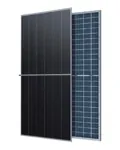
Solar panels: how many kW you actually need and which model we install
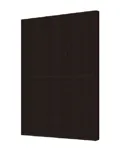
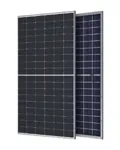
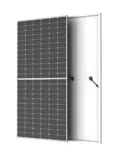
Customers buy solar panels for two scenarios. First: a standalone PV system to ride out blackouts (typical customer this year is a 100-150 m² homeowner in Kyiv, Dnipro or Odesa region who spent winter 2024-25 on a diesel generator and does not want a repeat). Second: cutting the electricity bill via a grid-tied hybrid system with net metering. Our warehouse stocks Veichi VCS-108H, VCS-144H, VCS-156H series – mono PERC+ at 20-22.5% efficiency (per the manufacturer datasheet).
Technically a panel is just a DC source. Without a hybrid inverter and a battery bank it powers nothing inside the house. That is why we always sell a kit, not panels alone. Baseline math for a residential house: 1 kW of installed capacity generates 1000-1200 kWh/year in Ukraine. A house consuming 6000 kWh/year covers 80% of demand with a 5-6 kW system (10-11 panels of 555 W or 9 panels of 600 W).
First question we ask: 400, 500 or 600 W
The answer depends on roof area. 400 W goes on small roofs of 15-25 m², balconies, garages, or where the structure cannot carry heavy modules. 500-555 W is the baseline for a typical private roof of 30-50 m² (the most ordered class in our shop). 600 W is for customers who want fewer joints or maximum watts per square meter, but the rafter capacity and the panel access route must be checked first.
What else we ask before placing the order. First: roof area and orientation (south gives the maximum, east or west cuts generation by 15-20%). Second: which inverter is installed or planned. Third: is a battery in the plan – without one, the PV system runs only when the grid is up, which negates half the point of the setup under rolling blackouts. Veichi warranty: 12 years on materials, 25 years linear performance (84.8% of nameplate after 25 years). We ship from Kyiv in 1-3 days. If you do not know where to start, call us – an engineer will size the kit in 10 minutes.
| Model | Power | Efficiency | Type | Application |
|---|---|---|---|---|
| VCS-108H-390-P | 390 W | 19.97% | Standard | Residential PV, limited roof area |
| VCS-144H-550-P | 550 W | 21.28% | Standard | Home PV system 5-10 kW |
| VCS-144H-580-D | 580 W | 22.44% | Bifacial | Ground mount, trackers |
| VCS-156H-600-P | 600 W | 21.46% | Standard | Industrial PV, large rooftops |
| VCS-156H-630-D | 630 W | 22.54% | Bifacial | Commercial and industrial generation |
Solar panel manufacturers
Veichi is a Chinese industrial equipment manufacturer specialising in variable frequency drives, hybrid inverters, and solar panels. The VCS series includes modules from 390 to 630 W based on monocrystalline silicon Half-Cell technology. Veichi panels carry IEC 61215 and IEC 61730 certifications, a 12-year warranty against manufacturing defects, and a 25-year performance warranty.
Solar panels by specifications
- 400W Solar Panel: compact modules for residential PV systems
- 500W Solar Panel: optimal choice for home power stations
- 600W Solar Panel: high-power modules for commercial systems
- Solar Panels for Home: selection tailored for household needs
Warranty and support
All solar panels come with an official manufacturer warranty: 12 years for manufacturing defects and 25 years for performance (minimum 80% of rated power). Our engineers will help calculate the required number of panels for your project. Payment by bank transfer for businesses or by card. Delivery across Ukraine with secure packaging.