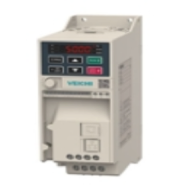
INVT: what kind of brand it is and where it fits in industrial automation
Shenzhen INVT Electric is a Chinese drive manufacturer headquartered in Shenzhen, on the market since the late 1990s. In the frequency-inverter segment this is the case where "Chinese" does not mean "no-name": INVT runs its own R&D, publishes full technical documentation for its series, has a service network and works to international standards (ISO 9001, IEC/EN, CE). In positioning terms it is the "honest mid-tier" — pricier than no-name marketplace drives, cheaper than Schneider Electric or ABB by roughly 25-40%, but with what no-name simply does not have: a manual, firmware, a warranty and a person you can solve a problem with.
Customers come to us for INVT when the project budget will not stretch to a European brand, but they also do not want to gamble on a marketplace unit. The typical reasoning: pump, fan, conveyor, mixer, extruder — a standard task, predictable torque, you need a working drive with support for 2-5 years, not maximum MTBF. On those applications INVT does the job. Where the drive runs three shifts on a crane or in an aggressive environment, we honestly recommend something more expensive and explain why.
What INVT we stock — the map of directions
In our catalogue INVT is represented by a single direction — GD-series frequency inverters. That is 138 SKUs from 0.4 kW to hundreds of kW, from simple scalar drives to vector drives with encoder feedback.
INVT GD frequency inverters
Series GD10, GD20, GD27, GD200A, GD350. The catalogue with prices, power/voltage filters, a comparison table and all common frame sizes is on the INVT frequency inverters page. From there it is easy to jump straight to the series you need: GD10 (compact, up to 2.2 kW), GD20 (general-purpose, pumps and fans), GD27 (sensorless vector + built-in PID), GD200A (universal vector), GD350 (heavy vector with encoder, crane and winding applications).
INVT's global portfolio also includes servo drives, hybrid inverters, UPS and PLCs — but we do not carry those INVT lines in our catalogue. If you need a servo motor, a hybrid solar system or a controller, we cover those categories with other brands: servo drives, hybrid inverters, PLCs. Tell the manager your task — we will say what is in stock and which brand to look at.
INVT GD frequency inverters: which series for which task
A short breakdown by series; in detail, with prices and filters, on the INVT frequency inverters page:
| Series | For | Control type | Power range guide |
|---|---|---|---|
| GD10 | Compact machines, small pumps and fans where panel space matters | Scalar V/F | 0.4-2.2 kW |
| GD20 | General-purpose drive: pumps, fans, conveyors, simple machine tools | V/F + basic sensorless vector | 0.4-110 kW |
| GD27 | Pumps with pressure control, ventilation, where a built-in regulator is needed | Sensorless vector + built-in PID, sleep mode | 0.75-450 kW |
| GD200A | Universal vector drive for machine building and conveyor lines | Sensorless vector, torque control | 0.75-500 kW |
| GD350 | Crane, winding, extrusion applications needing precision and overload | Vector with encoder, synchronous-motor support | 1.5 kW and up |
The selection rule we go through with the customer is simple. The mechanism just needs to turn at stable torque with speed control: GD10 or GD20. You need a built-in PID (pressure, level, temperature) and pump sleep mode: GD27. You need proper vector control with torque control: GD200A. You need positioning precision, encoder feedback or a firm start under load: GD350. Detailed parameter comparison and all frame sizes are on the INVT frequency inverters page.
Field notes: where INVT really fits, and where it does not
From what we see, INVT reliability comes down not to "Chinese origin" but to two things: the thermal regime and the chosen series. What we observe over years in service:
The thermal regime decides everything. Most budget-inverter failures come down to overheating: a clogged heatsink, insufficient panel ventilation, a drive with no current margin running in dust. INVT GD's thermal protection works correctly, but it only saves the drive if the drive can cool at all. On a dusty site, allow a one-frame-size power margin and clean the heatsink on schedule. That is the difference between "5 years without issues" and "died in year three".
DC-bus capacitors. The weak link of any budget drive. If the drive sat unpowered for a long time (warehouse, seasonal equipment), before starting let it sit energised with no load to reform the capacitor oxide layer. It is a standard procedure, but it is often forgotten and you get a pre-charge trip on the first start.
Firmware and revision. New GD20 and GD200A revisions ship with 50 Hz firmware and the EU voltage range 380±10%. If your plant side is 415 V, check the overvoltage protection parameters, or the drive will trip on overvoltage during braking. Parameters transfer between models of the same line via the keypad or USB. That saves hours of programming when replicating a setup.
Where INVT GD is a working solution: pumps (including with PID on GD27), ventilation, conveyors, mixers, crushers, simple machine tools. Anything with predictable torque and a normal thermal regime. Where we recommend something more expensive: a crane on three shifts, a centrifuge with frequent braking and no properly sized braking resistor, an aggressive environment, an object with a maximum-MTBF requirement in the spec. There Delta, Schneider or ABB are justified.
INVT, marketplace no-name and Delta: short and honest
The three tiers that actually exist on the market, and when each makes sense:
No-name marketplace drive. Cheapest, and a lottery. Documentation is a couple of pages or a "Google translation", no firmware, no service, a nominal warranty. It might run a year, it might die in a month, and you will troubleshoot it yourself. It makes sense only for a one-off non-critical task where downtime costs nothing.
INVT. A reasonable budget with support. A full manual, firmware, a warranty through official service in Ukraine, a person you can solve a problem with. Not "the most reliable hardware in the world", but predictable for its class. Bought by those who want to save against Europe but do not want to be left alone with the drive.
Delta, Schneider, ABB. 25-40% more expensive, dedicated series for narrow tasks (process drives for pumps, heavy vector drives for cranes), maximum MTBF, long line support. Bought by those who have it written in the spec, whose object is long-lived and critical, or who want a single drive + PLC + HMI ecosystem from one maker.
The honest answer to "what to buy": if the task is standard (pump, fan, conveyor), the budget is tight, and the spec does not require a specific brand — INVT GD will cover it cheaper than Delta and safer than no-name. If the spec says Schneider or the object is critical — get the European brand, the premium is justified. A no-name drive — only if downtime truly costs nothing.
What to check before buying INVT in Ukraine
The checklist we go through with the customer:
1. Series by task, not by price. Not "an INVT inverter" but specifically GD20 or GD350: different classes and a different selection logic. The cheapest series that formally "fits by kW" may not handle the duty on your application.
2. Overload class G/P. G (constant torque: conveyors, crushers, compressors) versus P (quadratic torque: pumps, fans). The same frame size in P mode gives more power but less overload capacity. For a conveyor with frequent starts, choose by class G.
3. Single-phase input ≠ a three-phase motor without limits. Models with 1×220 V supply exist in the smaller frame sizes, but they have lower permissible current and will not "spin up" just any three-phase motor. Clarify the motor and the mains before ordering.
4. Braking resistor or module for inertial loads. Centrifuges, winders, cranes, flywheels — anything that feeds energy back into the DC bus during braking. If the resistor is not sized and not in the spec, the drive will trip on overvoltage. It is a separate item, easy to forget.
5. Service and spares. For a budget brand this matters more than for a European one: clarify repair turnaround for your series and parts availability. For common GD10/GD20 frames spares are quick; for rare frame sizes the lead time is longer.
6. Documentation in Ukrainian. The GD series has full manuals; before installation pull the manual for your exact revision — there can be parameter differences between sub-versions of one line.
7. Stock availability. Common GD10, GD20, GD200A frame sizes are mostly in stock; rare GD350 items and heavy frame sizes are to order, allow 3-10 days for delivery.
Not sure which series fits your object — message the manager with the motor power, the load type (pump/fan/conveyor/crane) and the supply (1 or 3 phases). We will suggest a specific series and say what is in stock. Useful materials nearby: frequency inverter setup, frequency inverter repair, the INVT frequency inverters catalogue with prices and comparison.