How the Industrial Internet of Things (IIoT) reduces automation costs
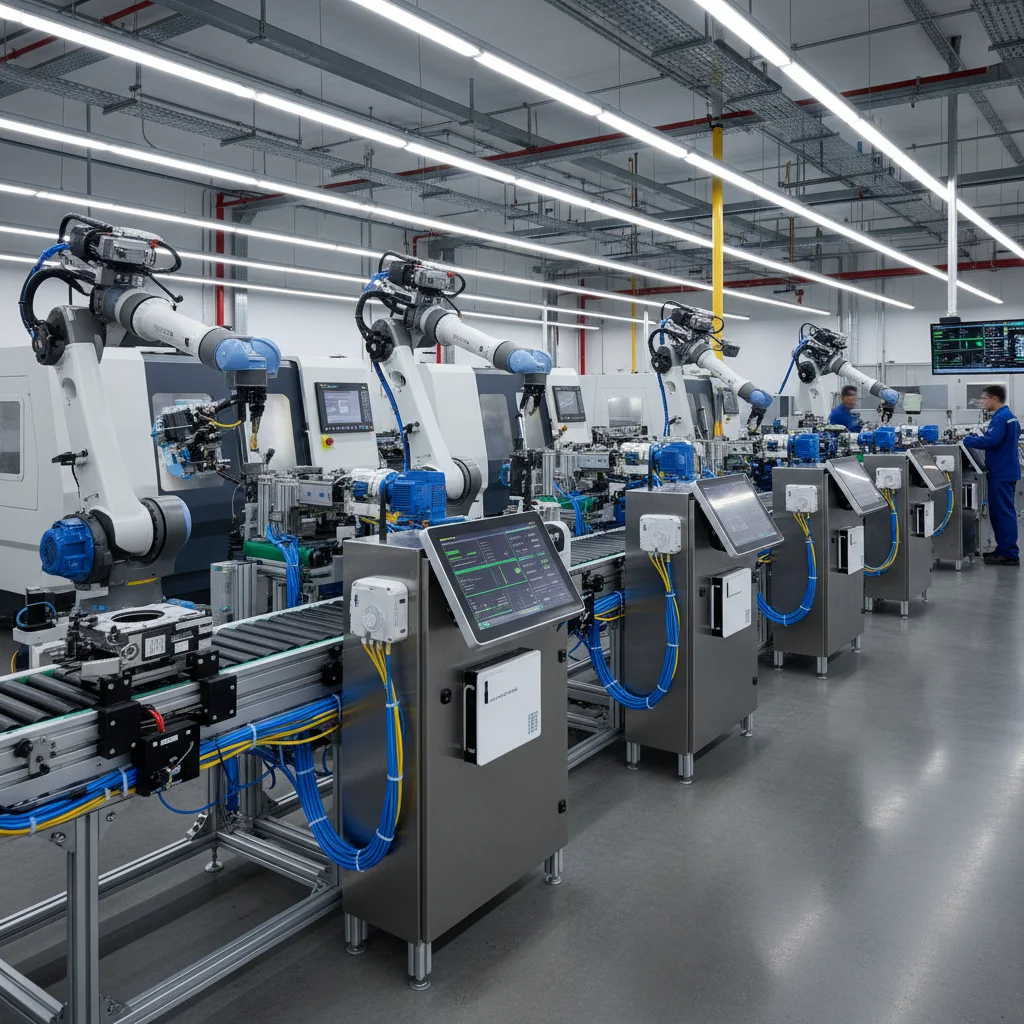
The Industrial Internet of Things (IIoT) has fundamentally changed how manufacturing facilities manage their production processes. Unlike traditional automation systems where equipment operates in isolation, IIoT connects sensors, controllers, variable frequency drives, and operator panels into a unified network. The result is a measurable reduction in maintenance costs, energy consumption, and downtime — often by tens of percentage points.
According to McKinsey Global Institute estimates, IIoT deployment across industrial enterprises generates an economic impact of $1.2–3.7 trillion annually. A significant share of this figure comes specifically from cutting operational costs — from predictive maintenance to energy consumption optimization.
What drives automation costs
Traditional industrial automation requires substantial upfront capital investment. A facility purchases equipment — programmable logic controllers (PLCs), variable frequency drives (VFDs), sensors, HMI operator panels — installs it, configures it, and commissions it. Then the annual costs begin:
- Scheduled maintenance — replacing filters, lubricants, and worn parts on a fixed timetable, regardless of actual equipment condition
- Emergency repairs — unplanned production stops due to failures detected too late
- Excessive energy consumption — motors and pumps running at full speed even when the load does not require it
- Manual data collection — operators walking through workshops with tablets, recording instrument readings
- Slow response to deviations — problems discovered hours or days after they first appear
IIoT eliminates or substantially reduces each of these cost categories. Connected sensors continuously transmit real-time equipment condition data. Algorithms analyze this data and generate recommendations before a problem becomes critical.
Cost comparison: traditional automation vs. IIoT
To understand the scale of savings, consider typical cost categories for a manufacturing facility with 50 pieces of primary equipment:
| Cost category | Traditional approach | With IIoT deployment | Savings |
|---|---|---|---|
| Maintenance | Scheduled preventive on fixed calendar | Predictive based on equipment condition | 25–40% |
| Unplanned downtime | 5–15% of operating hours | 1–3% of operating hours | up to 70% |
| Energy consumption | Constant load operation | Adaptive control | 15–30% |
| Data collection and analysis | Manual, 2–4 operators | Automatic, cloud analytics | 60–80% |
| Spare parts | Large safety stock inventory | Precise ordering by wear forecast | 20–35% |
| Product quality | End-of-line inspection, 3–5% scrap | In-process control, under 1% scrap | 50–80% scrap reduction |
Predictive maintenance: the largest savings category
The most significant financial impact of IIoT comes from the shift from scheduled preventive maintenance to predictive maintenance. Instead of shutting down a production line once a month for routine servicing, the facility installs smart sensors for vibration, temperature, and current on every critical piece of equipment.
These sensors continuously collect data and transmit it to an edge device or directly to the cloud. Machine learning algorithms analyze patterns and determine:
- Motor bearings have started vibrating 15% above normal — replacement needed in 2–3 weeks, not in 6 months per schedule
- VFD winding temperature has risen by 8°C — clogged ventilation filter, just clean it rather than replacing the entire assembly
- Pump current draw has increased 12% at the same pressure — worn impeller, schedule replacement for the next planned shutdown
According to Deloitte, predictive maintenance reduces unplanned downtime by 30–50% and repair costs by 20–40%. For an average Ukrainian manufacturing operation with an annual maintenance budget of 2–5 million hryvnias, this translates to savings of 400 thousand to 2 million hryvnias per year.
Energy efficiency through IoT-connected variable frequency drives
Electricity accounts for 30–60% of an industrial facility's operating costs. Variable frequency drives (VFDs) already reduce consumption by 20–50% on their own by adjusting motor speed to match the load. But connecting VFDs to an IIoT network unlocks additional savings potential.
Modern VFDs from Schneider Electric, Siemens, ABB, and other manufacturers have built-in communication protocols — Modbus TCP, PROFINET, EtherNet/IP, EtherCAT. Through these protocols, the VFD transmits dozens of parameters to the monitoring system: input and output voltage, current, frequency, module temperature, protection status, and operating hour counters.
How it works in practice:
- Pressure sensors in the pipeline measure actual system pressure
- A PLC or edge controller compares measured pressure against the setpoint
- The VFD automatically adjusts pump speed — reducing it during low demand, increasing it during peak consumption
- The system logs energy consumption every hour and generates reports with recommendations
- The operator sees real-time charts on the HMI panel and receives alerts for anomalies
Add-on VFD expansion boards enable connection to industrial networks even for VFD models that lack built-in Ethernet ports. This makes it possible to integrate previously installed equipment into an IIoT system without full replacement.
Edge computing: processing data on-site
One of the major challenges with early IoT implementations was the need to send the entire data stream to the cloud. For a facility with hundreds of sensors, this meant high bandwidth costs and processing delays. Edge computing technology solved this problem.
An edge device is installed directly on the factory floor, close to the equipment. It collects data from sensors and controllers, performs primary processing and analytics, and sends only aggregated results and anomalies to the cloud. This provides several advantages:
- Response time drops from seconds to milliseconds — critical for processes where latency is unacceptable
- Cloud traffic decreases by 90–95%, reducing communication costs
- The system continues operating even during temporary internet connectivity loss
- Confidential production data stays within the enterprise
Modern programmable logic controllers from Delta Electronics, Mitsubishi Electric, and Schneider Electric already combine classic PLC functions with edge gateway capabilities. They simultaneously control the technological process and transmit data to a cloud platform for long-term analytics.
Real-world savings examples from manufacturing
Theoretical calculations are confirmed by the experience of Ukrainian and global enterprises:
Water utility with IoT-monitored pumping stations
A water supply company installed pressure, flow rate, and vibration sensors at 12 pumping stations. VFDs regulate pump speed based on actual water demand. First-year results: electricity consumption dropped by 28%, emergency callouts decreased by 65%, and maintenance costs fell by 34%.
Food production with predictive maintenance
A dairy processing plant equipped conveyor lines and refrigeration compressors with vibration and temperature sensors. Over 8 months, the system identified 4 potential failures before they occurred, preventing shutdowns of 12–18 hours each. Total prevented losses exceeded 1.8 million hryvnias.
Metallurgical production with drive optimization
A steel plant connected 85 electric drives to a unified monitoring system. Optimizing operating modes for crane and rolling mill drives through the IoT platform reduced overall energy consumption by 19%, while bearing lifespan increased by 40% thanks to early detection of shaft misalignment.
Step-by-step IIoT implementation: from small to large
Transitioning to IIoT does not require replacing all equipment at once. A practical approach involves phased implementation:
Stage 1: Audit and pilot project (1–3 months)
Identify the 3–5 most critical pieces of equipment, install sensors on them, and connect to a basic cloud monitoring platform. Pilot cost ranges from 50 to 200 thousand hryvnias depending on the number of monitoring points.
Stage 2: Expansion to critical areas (3–6 months)
Based on pilot results, extend monitoring to all equipment whose downtime costs the facility the most. Integrate data from VFDs and PLCs already operating in production.
Stage 3: Full integration (6–12 months)
Unify all data sources into a single platform. Configure predictive analytics, automatic spare parts ordering, and energy efficiency KPI reporting.
The role of modern equipment in IoT transformation
An IIoT system's effectiveness directly depends on the capabilities of equipment at the field level. Modern industrial devices are already designed with IoT integration in mind:
- Variable frequency drives in the VEICHI AC series feature built-in Modbus RTU/TCP and an optional Ethernet module for direct connection to cloud platforms
- Delta Electronics DVP controllers support the MQTT protocol for direct data publishing to an IoT broker
- Kinco HMI panels can function as a local edge gateway, aggregating data from connected devices
- Industrial sensors with 4–20 mA analog output or IO-Link digital interface provide precise measurements for analytical algorithms
IIoT investment return
IIoT project payback periods depend on production scale and current automation level. Typical figures for Ukrainian enterprises:
| Enterprise scale | IIoT investment | Annual savings | Payback |
|---|---|---|---|
| Small (10–20 equipment units) | 100–300K UAH | 80–200K UAH | 12–18 months |
| Medium (50–100 equipment units) | 500K–1.5M UAH | 400K–1.2M UAH | 10–15 months |
| Large (200+ equipment units) | 2–5M UAH | 1.5–4M UAH | 8–14 months |
It is important to consider not only direct savings but also indirect benefits: reduced scrap rates, improved product quality, better working conditions (fewer emergency situations), and extended equipment lifespan. These factors combined can double the total economic impact.
Conclusions: IIoT as a modern manufacturing standard
The Industrial Internet of Things is no longer a futuristic concept — it is a proven cost-reduction tool accessible to enterprises of any scale. Key success factors for implementation include a phased approach, choosing equipment with industrial communication protocol support, and clearly understanding which costs to optimize first.
An IIoT investment is not a one-time expense but the creation of infrastructure that generates annual savings and scales with production growth. Enterprises implementing IIoT today gain a competitive advantage that will be difficult to overcome for those who postpone digital transformation.