How Industrial Robots Learned to Recognize and Grip Unfamiliar Objects
Just ten years ago, an industrial robot could only work with parts rigidly fixed in a predetermined position. Every object had to lie at a specific angle, in an exactly defined spot — otherwise the manipulator simply missed. Any change in product nomenclature required reprogramming, and engineers spent weeks configuring each new task.
The situation changed radically thanks to the convergence of three technologies: machine vision, artificial intelligence, and adaptive gripping devices. A robot equipped with this combination can see a previously unknown part, understand its geometry and physical properties, choose the optimal gripping strategy, and execute the task — without operator intervention.
From Dense Object Nets to Modern Solutions
One of the first breakthroughs was the Dense Object Nets (DON) system developed at MIT. DON decomposed an object into thousands of coordinate points, memorized their positions, and searched for analogies with previously studied items. If the robot saw a sneaker, it understood where the toe was, where the heel was, where the laces were, and picked up any shoe the same way. DON could grasp a mug of liquid by its handle regardless of orientation.
However, DON had a significant limitation: training on a single object took about 20 minutes, and the system only worked with objects similar to those already studied. For an industrial conveyor where dozens of different parts appear every minute, this was insufficient.
The next generation of systems — Dex-Net, GraspNet, and more recently Inbolt AI and B.AI by Blumenbecker — solved this problem through deep learning on millions of synthetic and real images. Instead of analyzing one object for 20 minutes, these systems generate a gripping strategy in under one second.
Bin Picking: The Robot Extracts Parts from a Container
The bin picking task (grasping objects from a container where they are randomly arranged) was considered the "Holy Grail" of robotics for decades. Parts lie chaotically, partially overlap each other, and have different sizes and materials. Humans solve this intuitively, but for a robot it was an insurmountable challenge.
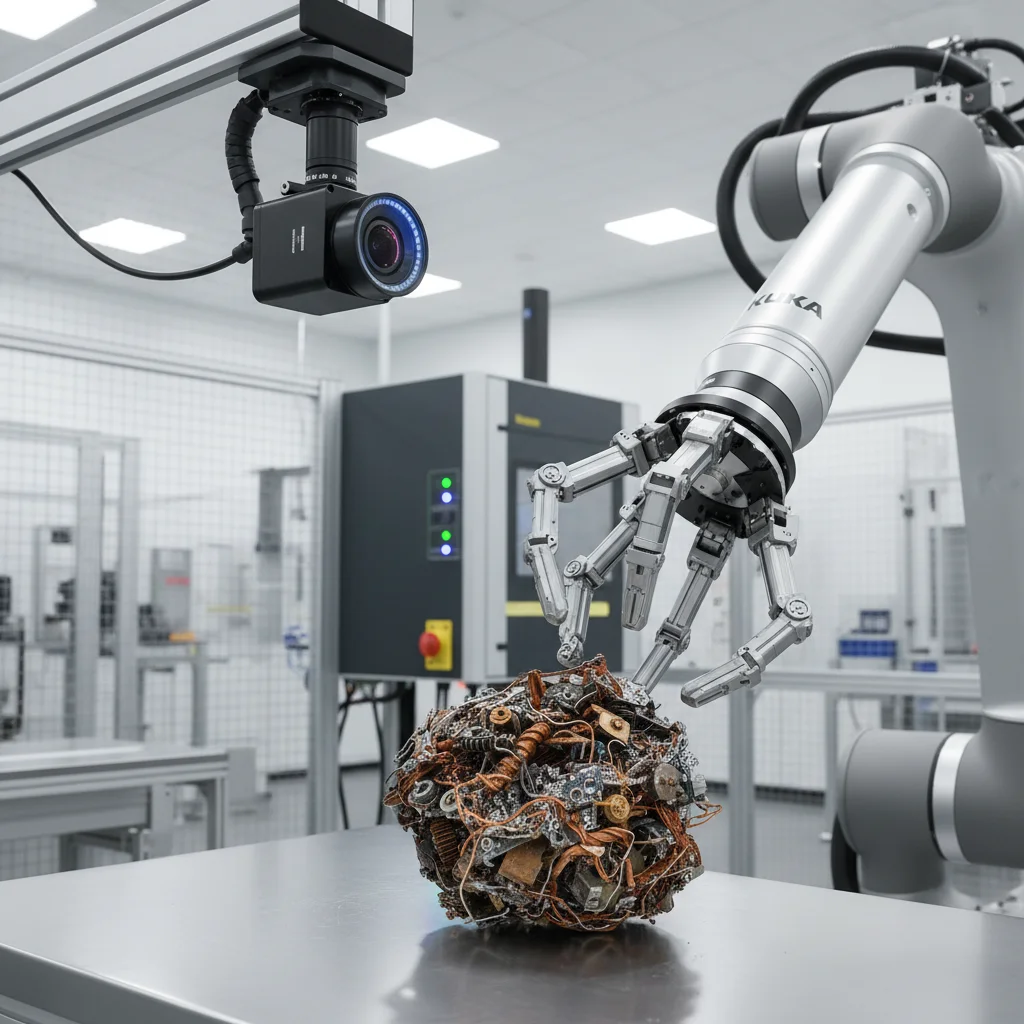
The solution was found in combining a 3D camera mounted directly on the manipulator with a neural network operating in real time. A modern bin picking cycle looks like this:
- Scanning: the 3D camera builds a point cloud of the container contents
- Segmentation: AI identifies individual objects, even when partially hidden under others
- Grasp planning: the neural network generates multiple grasp options and selects the optimal one based on reliability, speed, and safety criteria
- Execution: the manipulator grasps the part while AI continues refining the motion trajectory during transfer (in-hand localization)
- Placement: the object is precisely positioned in the target location
The Inbolt solution, launched in late 2025, achieves speeds of less than 1 second per pick with success rates up to 95%. The system is already operational at more than five manufacturing facilities.
Machine Vision: How the Robot "Sees" Unfamiliar Objects
The foundation of adaptive manipulation is machine vision. Modern systems use several types of sensors simultaneously:
- 2D cameras — for textures, markings, and colors
- 3D cameras and structured light — for precise object geometry
- Time-of-Flight (ToF) sensors — for rapid distance measurement
- Tactile sensors — for feedback during gripping (grip force, surface texture, slippage)
Data from all sensors is combined (sensor fusion) and fed into a neural network that classifies the object, determines its mass, material, and fragility. For industrial equipment based on servo drives and PLCs, this means seamless integration between the vision system and actuators.
Adaptive Gripping Devices
Even the best AI is helpless if the gripper physically cannot hold the part. That is why adaptive grippers — gripping devices that conform to the shape of the object — are developing in parallel:
- Soft grippers — made of elastic polymers or pneumatic chambers that wrap around objects of arbitrary shape. Ideal for fragile items: glass, electronics, food products
- Vacuum cups with adaptive zones — an array of suction cups of different diameters, activated depending on the object surface
- Multi-finger grippers — mechanical "fingers" with individual control of each one, allowing the grasping of objects from small screws to large housings
- Magnetic grippers — for metal parts, with adjustable magnetic field strength via electromagnets
The most advanced systems combine two or three gripper types in a single tool and automatically switch between them depending on the recognized object.
Traditional vs. Adaptive Robots: Comparison
| Parameter | Traditional Industrial Robot | Robot with Adaptive AI Gripping |
|---|---|---|
| Object recognition | Only pre-programmed parts | Any objects, including previously unknown ones |
| Changeover time | Hours or days (reprogramming) | Seconds (automatic adaptation) |
| Positioning accuracy | High, but only for fixed positions | High for arbitrary positions and orientations |
| Bin picking | Impossible without additional systems | Built-in capability with 90-95% success rate |
| Handling fragile objects | Damage risk (fixed force) | Adaptive grip force with tactile feedback |
| Integration cost | Lower initial, higher when changing products | Higher initial, significantly lower when changing products |
| Object range | Limited (typically 1-5 types) | Unlimited |
| System training | Manual point programming | Automatic via neural network or demonstration |
Collaborative Robots (Cobots) with Adaptive Gripping
Cobots are robots designed for safe operation alongside humans without protective barriers. Combining cobots with adaptive AI gripping has opened new scenarios: a robot can work on the same line as an operator, taking over heavy or monotonous tasks.
Market leaders in industrial robots — FANUC with the CRX series, ABB with YuMi cobots, KUKA with LBR iiwa, and Universal Robots — are actively integrating AI vision into their collaborative platforms. FANUC, for instance, partnered with Inbolt to implement precision operations on moving conveyors — General Motors became the first customer for this solution.
The collaborative robot market is growing from $1.42 billion in 2025 to a projected $3.38 billion in 2030 (CAGR 18.9%).
The Role of Variable Frequency Drives and PLCs in Adaptive Robotics
Behind the smooth movement of a robotic manipulator lies precise motor control. Variable frequency drives (VFDs) provide stepless speed regulation for motors, which is critical for adaptive gripping: the robot must smoothly position the gripper, decelerate when approaching the object, and instantly respond to signals from tactile sensors.
Programmable logic controllers (PLCs) coordinate all system components — from machine vision cameras to servo drives on the manipulator axes. In modern solutions, the PLC communicates with the AI module through industrial protocols (EtherCAT, PROFINET), transmitting commands with millisecond precision.
Systems based on servo drives provide positioning accuracy down to hundredths of a millimeter. For bin picking, this means the robot can extract a small screw from a pile of parts without touching adjacent ones.
Industrial Communication Protocols for AI Robots
Integrating a neural network with actuators requires fast industrial networks. Key protocols include:
- EtherCAT — update cycle under 100 microseconds, the standard for servo drives
- PROFINET IRT — synchronization with accuracy down to 1 microsecond
- OPC UA — data exchange between the AI server and PLC
- ROS 2 — a robot programming framework with AI module support
Practical Applications of Adaptive Robots
Logistics and Warehousing
Amazon, Walmart, and other e-commerce giants use adaptive robots to sort packages of varying sizes and shapes. A single robot processes thousands of unique product items per day — from cosmetics to household appliances.
Automotive Industry
Loading blanks into CNC machines, transferring parts between processing stages, final quality inspection — all these operations are being automated through adaptive bin picking. General Motors is already deploying the FANUC + Inbolt system at its plants.
Electronics Industry
Picking small components (microchips, capacitors, connectors) from feeder trays requires both high precision and delicacy. Expansion boards and modules for automation controllers demonstrate the level of miniaturization that modern robots must handle.
Pharmaceuticals and Food Industry
Soft grippers enable handling of fragile products: glass ampoules, medicine packages, confectionery. The robot adapts its grip force to each specific item.
Robot Training Technologies
How exactly does a neural network "understand" how to grasp an unfamiliar object? Several approaches exist:
Training on Synthetic Data (Sim-to-Real)
The AI trains in a 3D simulator (NVIDIA Isaac Sim, MuJoCo, PyBullet), where millions of random objects with different shapes, textures, and physical properties are generated. The robot in the virtual environment tries thousands of gripping strategies, and the trained model is then transferred to real hardware.
Learning from Demonstration
An operator manually guides the robot through the task several times, and the AI generalizes from these examples. This approach is used for rapid deployment of new tasks without deep programming knowledge.
Reinforcement Learning
The robot experiments on its own, receiving a "reward" for successful grasps and a "penalty" for failures. Through millions of attempts, the AI finds the optimal strategy. This method yields the best results but requires significant computational resources.
The Future: What Comes Next
The next step is foundation models for robotics. Just as GPT works with text and DALL-E with images, new models (Google RT-2, Open X-Embodiment) are learning to understand the physical world and generate robot actions based on text or visual instructions. A robot will be able to execute the command "pick up the red part and place it on the conveyor" without any programming.
For industrial automation, this means a shift from "configuring each task" to "explaining the task." And the components that provide motion and control — variable frequency drives, servo drives, controllers — will remain the foundation on which the next generation of intelligent robots operates. Learn more about practical applications of these components in our article on VFD applications and industrial automation concepts.