Palletizing Robot: What It Is and Why Your Warehouse Needs One
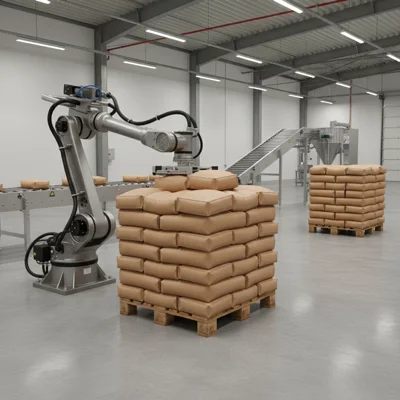
A palletizing robot is a 4- or 6-axis industrial manipulator that automatically stacks products (bags, boxes, drums, canisters) onto a transport pallet following a programmed pattern. Speed reaches 400–1500 cycles per hour, payload goes up to 450 kg per single grip, and the machine runs three shifts with no breaks or sick days. One robot replaces the work of 2–4 warehouse loaders, and you get a clean, stable stack that does not collapse during transport.
Read this guide sequentially. We start with robot types, move to brands and 2026 prices (the actual invoices we send to our clients), show a payback calculation on a grain packaging case, and give a 6-step procedure to pick the right unit for your plant. If you already know what you want, jump to the palletizing robot catalog.
Palletizing Robot Types: What Fits Your SKUs
Quick tip to start: if you have 1–3 package types and high volumes, take a 4-axis dedicated unit. If SKUs vary and pallets are mixed, pick a 6-axis universal arm. If boxes are light and you need flexibility in a small shop, go cobot. Details below.
4-Axis Dedicated Palletizers
These are the workhorses. Veichi VCP, KUKA KR PA, FANUC M-410 are tuned for one task and do it faster than universals. Four axes instead of six means simpler kinematics, fewer calculations for the controller, and higher repeatability on pattern moves.
- Where to use: production lines with 1–3 SKUs — flour, sugar, grains, cement, animal feed, beer crates.
- Speed: 800–1500 cycles per hour — the highest among all types.
- Payload: 120 to 700 kg in standard configurations, up to 1300 kg for the KUKA KR Titan PA for drums.
- Downside: rigid kinematics — not suitable for mixed pallets with varied goods.
6-Axis Universal Robots
KUKA KR 210, FANUC M-900, ABB IRB 6700 are the Swiss Army knife of palletizing. Six axes let you bypass obstacles, tilt loads, build complex multi-layer patterns, and switch between products in a couple of minutes through software. They run slower than dedicated units (400–700 cycles/hr vs. 1000+), but they handle jobs where a 4-axis arm fails.
Typical use cases: logistics centers with dozens of SKUs, pharma, mixed-SKU palletizing for retail chains. The kind of line where the robot stacks candy boxes today and beer crates tomorrow.
Cartesian Gantry Palletizers
A large frame with a moving carriage on X–Y–Z axes. They cover a whole warehouse section and serve 2–4 lines at once. Pros: big working envelope and high payload. Cons: expensive and complex steelwork, tricky maintenance. We do not import this category, but mention it for completeness — if your spec needs this scale, drop us a line and we will point to a partner.
Collaborative Palletizing Robots (Cobots)
Cobots — Universal Robots UR20, Veichi VCC-C series — handle up to 20 kg per grip, are safe near humans, and do not need a safety cage. This is the entry point into automation for small and mid-sized businesses: you place a cobot next to a packing line, teach it in half a day with a pendant, and it stacks 300–450 boxes per hour. Note: a cobot is not a replacement for a 4-axis KUKA on heavy tonnage. Its niche is up to 20 kg per cycle and up to 12 pallets per shift.
Brands and Models: 2026 Comparison Table
We compiled the models we actually sell and see on client invoices. Prices in the table are starting — a bare robot without the gripper, conveyor, and commissioning. With peripherals, add another UAH 600k to 1M.
| Brand | Model | Payload, kg | Reach, mm | Cycles/hr | Price from, UAH |
|---|---|---|---|---|---|
| Veichi | VCP120-3200 | 120 | 3200 | 800 | 1,100,000 |
| KUKA | KR 180 R3200 PA | 180 | 3200 | 1000 | 2,100,000 |
| KUKA | KR 240 R3200 PA | 240 | 3200 | 900 | 2,600,000 |
| KUKA | KR 1000 Titan PA | 1300 | 3100 | 350 | on request |
| FANUC | M-410iC/140 | 140 | 2850 | 900 | 1,900,000 |
| MOTOMAN | MPL160 | 160 | 3155 | 950 | 1,800,000 |
| UR + Robotiq | UR20 + PE20 kit | 20 | 1750 | 450 | 850,000 |
For brand details see the KUKA and Veichi pages, and the full industrial robot catalog.
Total Turnkey Cost of a Palletizing Robot in Ukraine, 2026
The robot itself is half the story. Turnkey always costs more because without the gripper, conveyor, and pallet feeder the robot just stands there. Here is the real breakdown of a mid-size 2026 project:
- Robot: UAH 850,000 – 2,600,000 depending on the model.
- End-of-arm gripper (vacuum / fork / clamps): UAH 150,000 – 400,000.
- Feed conveyor with a Veichi AC310 VFD: UAH 250,000 – 500,000.
- Pallet feeder/accumulator: UAH 150,000 – 300,000.
- Commissioning, pattern programming, operator training: UAH 250,000 – 400,000.
Total: UAH 1,650,000 – 4,200,000. So if someone offers you a turnkey robot for UAH 900,000, it is either a cobot for light goods or a deal without peripherals, and within a month you will buy the missing parts for the same money again.
Payback Calculation: Real Grain Packaging Case
A palletizing robot in food or chemical production pays back in about 2 years. From year 3 onward it delivers net gains of UAH 1–1.5M per year, and that excludes stack quality and lower transport damage. Numbers below are from a real 2024 project, updated to 2026 prices.
| Parameter | Value |
|---|---|
| Product | Grain, 50 kg bag |
| Packaging volume | 1,500,000 bags/year |
| Stack pattern | 6 layers, 8 bags per layer, EUR pallet |
| Manual labor: 4 loaders × UAH 15,000 × 12 months | 720,000 UAH/year |
| Turnover, sick leave, back injuries (avg.) | +300,000 UAH/year |
| Total manual labor cost | ~1,020,000 UAH/year |
| Investment: Veichi VCP120 + peripherals | 2,000,000 UAH |
| Payback | ~2 years |
| Net gain from year 3 | 1,000,000+ UAH/year |
Realistic note: the first year of payback is always a bit longer than the spreadsheet shows. Budget 2–3 months for commissioning and another 1–2 months until operators learn to quickly reprogram patterns for new products. After that the robot reaches its rated throughput and holds it for years.
How to Pick a Palletizer: 6 Steps
- Weigh a single package. 25 kg of cement? Veichi VCP120 or an entry-level cobot will do. A 200 L drum of chemicals? Only KUKA KR Titan or a 500+ kg analog.
- Measure the pallet. EUR 1200×800 and FIN 1200×1000 are the most common. The robot reach must cover the pallet diagonal plus a 300 mm approach margin.
- Count your SKUs. 1–3 product types on the line — go 4-axis dedicated. 4 and above — definitely 6-axis, otherwise you will burn out on reprogramming.
- Set target throughput. 400–700 cycles/hr is a mid-size plant. 800–1200 is a highly automated line. 1300+ is a large food complex, and there you always run two robots, not one.
- Check stack height. Standard is 2400 mm. If your ceiling is limited, pick a model with shorter vertical reach, otherwise you overpay.
- Align the ERP protocol. Most Ukrainian warehouses run on Modbus TCP. European plants use Profinet. EtherCAT is rarer. Make sure the robot speaks your language — protocol bridges cost another UAH 50–100k and add a failure point.
Typical Industries Where Palletizers Fit
- Food industry: grains, sugar, flour, salt, animal feed — 25–50 kg bags, 4-axis dedicated.
- Beverages: bottles in boxes, beer crates, PET in shrink wrap — 6-axis with vacuum gripper.
- Chemicals: 200 L drums, canisters, plastic containers with detergents — KUKA KR 500/Titan, clamp grippers.
- Building materials: cement, putty, dry mix — 25 kg bags, Veichi VCP or KUKA KR 180.
- Animal feed: 15–30 kg bags, up to 1000 cycles/hr, 4-axis.
- Cardboard packaging: polymer-wrapped boxes — vacuum gripper, fast cycle.
End-of-Arm Tools: What to Mount on the Flange
The gripper is a world of its own, and a mistake here costs as much as a mistake with the robot. The biggest issue is dusty bags, where vacuum cups lose grip pressure. In those cases we mount a fork gripper with auto-pickup from below, and clients forget about bag drops as a nightmare of the past.
- Vacuum gripper with suction cups: boxes, film, clean surfaces. Simple design, cheap to service.
- Fork gripper with auto-pickup: bags (grain, cement, feed). Handles dusty and uneven surfaces.
- Mechanical clamps: 200 L drums, large canisters. Reliable but slower than vacuum.
- Magnetic grippers: sheet metal, steel parts. Niche, but used.
- Combined tools: one flange with vacuum and forks simultaneously — for lines that alternate boxes and bags.
Integration with Our Automation Ecosystem
A palletizing robot does not stand alone. It needs a feed conveyor with controlled speed, a PLC for synchronization, weight and barcode sensors, and an HMI for the operator. Here is the standard signal chain we install:
- Delta or Siemens PLC — master controller, holds the logic of the whole line.
- PLC → robot over Profinet: cycle command, pattern, start/stop.
- PLC → Veichi AC310 VFD over Modbus: regulates belt speed to match robot rhythm.
- Servo drive on the pallet feeder — precise positioning of the new pallet under the robot.
- Weight and optical sensors — verify bag presence, weight, and geometry before the grab.
- Veichi or Weintek HMI panel — operator sees the pattern, current cycle, counters, alarms.
We have covered the philosophy of such a chain in our articles on packaging with industrial robots and intelligent robotics in tomorrow's factories. Read them if you are still planning the line.
When 4-Axis Is Not Enough and You Need 6-Axis
Many clients stumble here at the start. They buy the cheaper 4-axis unit, and six months in realize it cannot handle mixed patterns. Signs you need a 6-axis arm (6-axis robot catalog):
- Different box sizes on the same pallet.
- Stacking with angle or tilt — roof tiles, mattresses.
- Combined task: palletizing + weight check + conveyor-to-conveyor transfer.
- Frequent SKU changes (every 2–3 hours) — a 6-axis robot reconfigures in software.
If this sounds like your line, do not cut corners. The price gap is UAH 500k, but the 4-axis unit simply will not do the job.
Or Maybe a Cobot? When to Consider Collaborative Robots
A palletizing cobot (collaborative robot catalog) is a separate scenario for small business and pilot projects. Light boxes up to 20 kg, low cadence (up to 450/hr), ability to stand next to a person without a cage. A typical case is a bakery running 10 tons of output per day, or a craft brewery, or a small sunflower oil packer. Anything below industrial scale but where hand labor no longer makes sense.
Frequently Asked Questions
How much does a palletizing robot cost in Ukraine?
The robot alone ranges from UAH 850k (UR20 cobot) to UAH 2.6M (KUKA KR 240 PA). Turnkey with peripherals, gripper, conveyor, and commissioning — UAH 1.65M to 4.2M. We give the exact figure after a spec: package weight, SKU count, throughput, floor space.
How long does a palletizing robot take to pay back?
In food and chemical industries — about 2 years running 2–3 shifts. Net gain from year 3 onward is UAH 1M+ per year from replacing 2–4 loaders and reducing transport damage. At small volumes (below 500k cycles/year), payback stretches to 3–4 years, and a cobot often fits better there.
Can I palletize mixed SKUs on a single pallet?
Yes, but only with a 6-axis robot running programmable patterns. A 4-axis dedicated arm is not built for that — its kinematics are rigid for one template. For mixed-SKU palletizing look at the KUKA KR 210 R2700 or FANUC M-900iB.
Do I need special floor mounting?
Yes. A robot rated for 180 kg payload weighs 1000–1200 kg itself and creates dynamic loads during the cycle. Minimum — a 300 mm reinforced concrete foundation or an M20×8 anchor plate. We give the exact spec during commissioning, but plan 2–3 weeks for floor prep before the robot arrives.
Who handles commissioning and how long does it take?
Commissioning is done either by the manufacturer's integrator (KUKA, FANUC) or by our technical team for Veichi. Typical duration — 5–10 working days for installation, programming of 2–3 base patterns, and training of 2 operators. Another 2–4 weeks usually go into fine-tuning for the real line and peak load.
Summary: Which Palletizer for Which Job
If you pack grains, cement, feed, or flour in 25–50 kg bags and want a 2-year payback, pick the Veichi VCP120 or KUKA KR 180 PA. If your catalog is mixed with many SKUs and pallets going to retail chains — a 6-axis KUKA KR 210 or FANUC M-900. If you are a small shop with boxes under 20 kg — start with a UR20 and a Robotiq palletizing kit, that is a fast start without heavy capex. Send us a spec request through the form on the palletizing robot catalog page and we will build a configuration matching your volume and product.