The Digital Oilfield: The Role of Variable Frequency Drives and Automation
The oil extraction industry is undergoing a profound technological transformation. Just two decades ago, well management consisted of manual valve adjustments and periodic operator rounds. Today, oilfields are becoming complex cyber-physical systems. At the heart of this transformation lie three key technologies: variable frequency drives (VFDs), programmable logic controllers (PLCs), and SCADA platforms for real-time data collection and analysis.
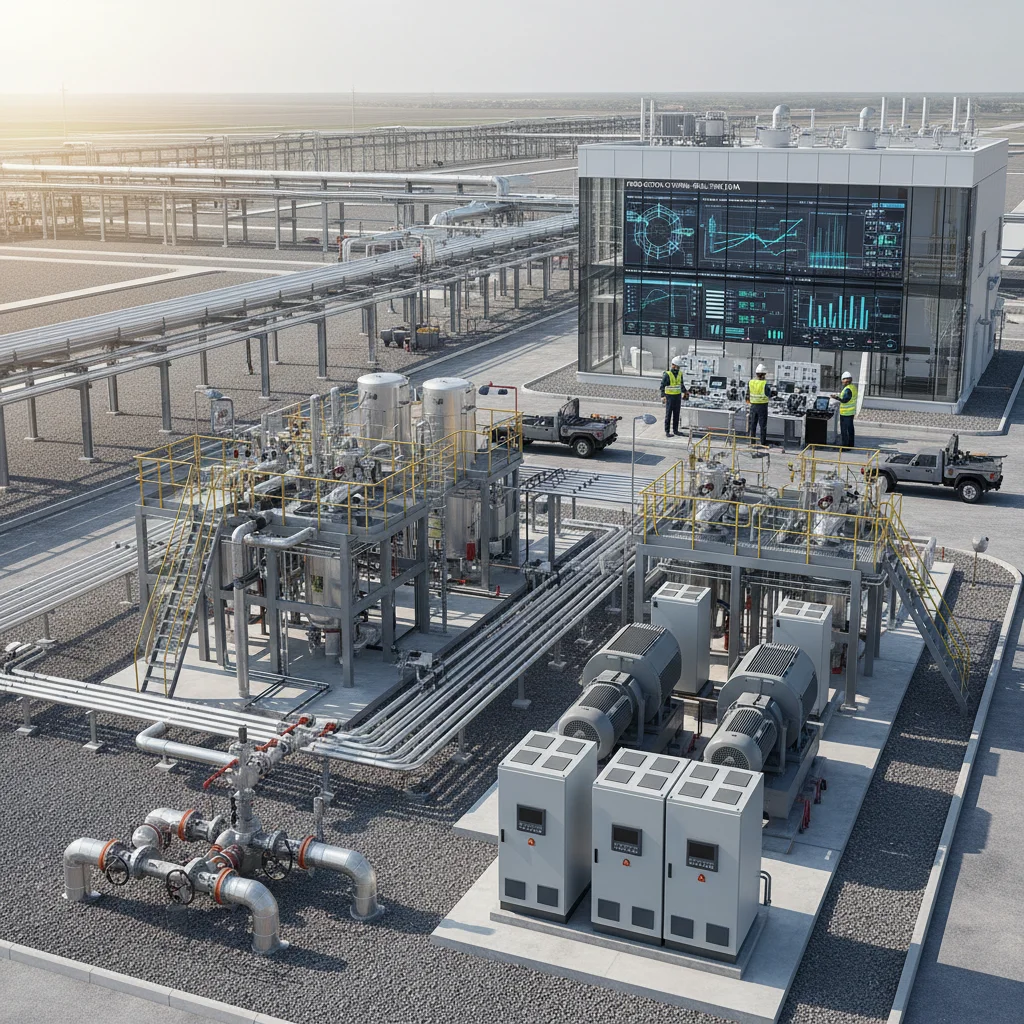
The Digital Oilfield concept involves connecting the entire well stock into a unified information network. Pressure, temperature, vibration, and flow rate sensors continuously transmit data to the central dispatch console. Based on this data, variable frequency drives automatically adjust pumping equipment operating modes, while controllers make decisions to stop or start individual units without human intervention.
Variable Frequency Drives for Electric Submersible Pumps (ESP)
Electric submersible centrifugal pumps (ESPs) remain the most productive mechanized method of oil extraction. However, their efficiency depends heavily on the stability and precision of the electrical power supply. This is precisely where the variable frequency drive plays a decisive role.
How a VFD Controls a Submersible Pump
The variable frequency drive powers the submersible motor through a long power cable lowered into the well to depths ranging from 500 to 3,000 meters. The drive varies the output frequency from 30 to 80 Hz, regulating the pump rotation speed. This enables operators to:
- Maintain optimal well flow rate as reservoir pressure changes
- Provide soft motor starting, reducing inrush currents by a factor of 5 to 7
- Prevent motor overheating through slip and load monitoring
- Automatically stop the pump when fluid level drops (pump-off mode)
- Adapt production capacity to current extraction requirements
Modern variable frequency drives for pumping equipment feature specialized sensorless control algorithms that monitor motor condition without additional downhole sensors. According to leading operators, implementing VFDs on ESP wells increases production by 8-12% and extends pump run life by 1.5 to 2 times.
VFD Requirements for ESP Applications
Working with submersible pumps imposes specific requirements on VFDs that distinguish them from standard industrial models:
- Power ratings from 30 to 800 kW for deep well motor operation
- Output voltage up to 4,000 V via step-up transformer or directly in medium-voltage configuration
- Sine-wave output filters to reduce dV/dt and protect cable insulation
- Extended frequency range (20-100 Hz) for flexible flow rate adjustment
- Built-in pump-off control algorithm without external sensors
- Overload tolerance up to 150% for 60 seconds
Sucker Rod Pump (SRP) Automation
Sucker rod pumping units (beam pumps) serve over 70% of mechanized wells worldwide. Traditionally, they operated at fixed speed, leading to excessive energy consumption and premature equipment wear.
Variable Frequency Control of Beam Pumps
A properly selected variable frequency drive on a rod pump unit performs several tasks simultaneously. First, it varies the beam stroke rate from 2 to 12 strokes per minute, matching pump output to the fluid inflow rate. Second, the VFD regenerates energy during the downstroke of the rod string, returning it to the power grid. Energy savings in this case reach 25-40% compared to fixed-speed operation.
Additionally, the variable frequency drive analyzes the dynamometer card (load versus position diagram) in real time. This plot, showing the forces on the rod string during each pumping cycle, carries information about valve condition, gas presence, fluid level, and rod integrity. A controller connected to the VFD recognizes characteristic fault patterns and adjusts the operating mode or sends an alarm to the operator.
SCADA Systems for Oilfield Operations
SCADA (Supervisory Control and Data Acquisition) represents the upper automation layer of oilfield operations. This system collects data from dozens or hundreds of wells, pumping stations, pipelines, and tank farms, displaying it all on a single operator screen.
SCADA Architecture on an Oilfield
A typical SCADA system for oil production consists of three levels:
- Field level — sensors, actuators, variable frequency drives, and controllers at each well. PLCs collect measurements and manage equipment locally.
- Communication level — radio modems, GSM/LTE channels, or fiber optic lines transmitting data from wells to the control center.
- Supervisory level — server software with visualization, trending, alarm management, and analytics modules.
Modern oilfield SCADA platforms integrate VFD data via Modbus RTU/TCP or Profinet protocols. This allows the dispatcher not only to view the current frequency, current, and power of each drive, but also to remotely change setpoints, switch a well to a different mode, or perform emergency shutdown.
Comparison of Mechanized Lift Technologies
| Parameter | ESP with VFD | Rod Pump with VFD | Progressive Cavity Pump with VFD |
|---|---|---|---|
| Typical flow rate, m3/day | 50 — 3,000 | 5 — 200 | 10 — 500 |
| Setting depth, m | 500 — 3,500 | 300 — 3,000 | 300 — 2,000 |
| VFD power, kW | 30 — 800 | 5 — 55 | 11 — 110 |
| System efficiency, % | 45 — 65 | 35 — 55 | 40 — 60 |
| Energy savings with VFD | 15 — 25% | 25 — 40% | 20 — 35% |
| Mean time between failures | 400 — 800 days | 600 — 1,200 days | 500 — 1,000 days |
| VFD role | Frequency control, soft start, pump-off | Stroke rate adjustment, regeneration, dynamometry | Speed regulation, dry-run protection |
Energy Efficiency and Economic Impact
Electricity accounts for 25-40% of operating costs in oil production. Implementing variable frequency drives across the well stock delivers a comprehensive economic impact that extends far beyond simple kilowatt-hour reduction.
Components of the Economic Impact from VFDs
- Reduced power consumption — 20-40% through matching drive output to actual load
- Increased production — 5-12% through optimal pumping regimes
- Reduced downtime — automatic restart after emergency shutdowns, fault diagnostics
- Extended equipment life — soft starting reduces mechanical shocks and electrical overloads
- Lower maintenance costs — predictive diagnostics enable planned rather than emergency repairs
According to estimates from leading oilfield service companies, the payback period for VFDs on oil wells ranges from 6 to 18 months depending on flow rate and depth.
The Role of PLCs and Sensors in the Digital Oilfield
A variable frequency drive alone is a powerful control tool, but its capabilities increase manifold when integrated with an industrial controller and a network of sensors. The controller serves as the well's "brain," processing signals from pressure, temperature, level, and flow sensors, and generating commands for the VFD based on this input.
A typical sensor suite on an automated oil well includes:
- Wellhead pressure sensor (0-25 MPa)
- Annular pressure sensor for fluid level monitoring
- Motor or bottomhole fluid temperature sensor
- Pump vibration sensor for predictive diagnostics
- Flow meter for produced fluid metering
- Moisture sensor for water cut determination
The PLC processes these signals according to a programmed algorithm and transmits the target rotation frequency to the variable frequency drive. For example, if annular pressure decreases (fluid level is dropping), the controller reduces the VFD frequency setpoint, lowering pump output. If pressure rises (fluid inflow is increasing), the controller increases the frequency, preventing well flooding.
Future Prospects: Machine Learning and Cloud Technologies
The next step in digital oilfield evolution involves applying machine learning algorithms to optimize production regimes. Neural networks trained on historical data from thousands of wells can predict optimal pump rotation speed weeks and months ahead, accounting for reservoir pressure changes, water cut variations, and seasonal factors.
Cloud-based SCADA platforms allow oil companies to eliminate expensive dedicated servers and access analytics through a standard web browser. Modern VFD product lines already support direct connection to cloud platforms via built-in IoT modules, transmitting telemetry without an intermediate controller.
Digitalization of oil production using variable frequency drives, controllers, and SCADA is not a distant future but current practice among progressive extraction companies. Technologies that were once available only to oil majors are becoming increasingly accessible to mid-size and small operators as equipment costs decline and cloud solutions proliferate.