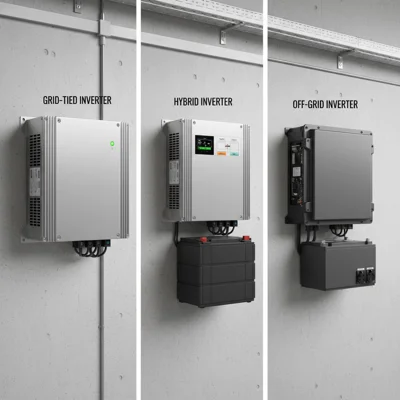
Grid-tied, hybrid, and off-grid inverter — what is the difference
Short answer: a grid-tied inverter works only with solar and the grid, an off-grid inverter works only with batteries, and a hybrid does everything at once. But the choice is not that simple because each type has its niche, its price, and its limitations. We sell and install all three types, and 70% of our customers in 2025-2026 chose the hybrid. Here is why.
The key point: the inverter type determines what your system can do. Panels and batteries are just energy sources — the inverter is the brain that decides how to use them.
Grid-tied inverter (on-grid)
A grid-tied inverter is connected to the utility grid and only works while the grid is available. This is its main limitation, which many people do not understand until the first blackout.
What it can do
- Converts DC from solar panels to AC 220V
- Synchronizes with grid frequency (50 Hz)
- Feeds surplus into the grid (feed-in tariff)
- Efficiency 97-98% — the highest among all types
What it cannot do
- Work without the grid — shuts down during a blackout (anti-islanding protection)
- Charge batteries — no charge controller
- Provide backup power — even with full sun, if the grid is down, the inverter is off
A grid-tied inverter is for those with stable grid power and a goal of reducing electricity bills through a feed-in tariff. In Ukraine since 2022-2023, this stopped making sense for most people because blackouts became routine. But if you are at an industrial site with dual feeds and a diesel backup, grid-tied is still justified.
Off-grid inverter
An off-grid inverter works completely independently from the grid. It takes DC from the battery (and/or from an MPPT controller for solar panels) and outputs AC 220V.
What it can do
- Work without the grid permanently
- Charge the battery from solar (if it has a built-in MPPT)
- Charge the battery from a generator
- Provide full autonomy
What it cannot do
- Synchronize with the grid — cannot feed surplus back
- Automatically switch between grid and battery (no ATS)
- Efficiently work with the grid as a primary source
An off-grid inverter is for cottages without electricity, remote sites, farms. If you have grid power (even unstable), an off-grid inverter will work but you cannot use the grid as backup.
Hybrid inverter — the best of both worlds
A hybrid is essentially a grid-tied + off-grid in one unit. It does everything: works with the grid, disconnects from it, charges the battery, uses solar. That is why the hybrid inverter has become the standard for private homes in Ukraine.
What it can do
- Everything a grid-tied can + everything an off-grid can
- Automatic grid/battery switchover in 10-20 ms
- Priority programming (solar → battery → grid)
- Battery charging from grid on night tariff
- Monitoring via Wi-Fi / mobile app
Main downside
Price. A 5 kW hybrid costs 30-50% more than a grid-tied of the same capacity. Plus you need a battery — another $800-1500 for a 10 kWh LiFePO4 battery. But compared to a generator + fuel + maintenance over 3 years, a hybrid often comes out cheaper.
Comparison table of three types
| Parameter | Grid-tied | Off-grid | Hybrid |
|---|---|---|---|
| Works with grid | Yes (only) | No | Yes |
| Works without grid | No | Yes (only) | Yes |
| Batteries | No | Required | Optional |
| Feed-in tariff | Yes | No | Yes (model-dependent) |
| Switchover time | — | — | 10-20 ms |
| Efficiency | 97-98% | 90-93% | 93-97% |
| Price (5 kW) | $400-700 | $300-600 | $700-1200 |
| Generator needed | Yes (for blackouts) | Advisable | No (with battery) |
Which type to choose — decision tree
Instead of general advice, here is a specific algorithm from our experience with hundreds of installations:
- Grid is stable, blackouts less than once a month? → Grid-tied inverter + feed-in tariff. Fastest payback
- No grid at all (cottage, farm, tower)? → Off-grid inverter + battery + panels. Only option
- Grid exists but blackouts are regular? → Hybrid inverter. For a 100 m² house — 5 kW model, for 150-200 m² — 10 kW
- Want feed-in tariff + backup? → Hybrid only. Grid-tied gives no backup, off-grid gives no feed-in
Most of our customers fall into point 3. If you are unsure, see the guide to choosing a hybrid inverter for your home.
Real cases: what our customers chose
Case 1: Private house, Kyiv region
Area 130 m², blackouts 2-3 times per week. Chose Deye SUN-5K-SG03LP1-EU + 10 kWh LiFePO4 + 6 panels at 550 W. Result: house runs autonomously for up to 12 hours, electricity bill dropped by 60%.
Case 2: Farm, Poltava region
No grid. Off-grid inverter 8 kW + 20 kWh battery + 10 panels + 6 kVA generator as backup. Generator runs roughly 3-4 times per month in winter, summer — almost never.
Case 3: Office in central Kyiv
Grid relatively stable, installed a 10 kW grid-tied inverter + 20 rooftop panels. Feed-in tariff. Payback about 4 years. But added a small UPS for servers in case of blackout.
Can you convert a grid-tied inverter to a hybrid?
No. These are different architectures. A grid-tied inverter lacks a charge controller, ATS, and battery input. Adding these is impossible — it is simpler and cheaper to buy a hybrid. The only option is adding a separate battery inverter in parallel with the grid-tied one, but that is more complex and costly than a hybrid.
If you are choosing now and there is even a small chance you will want a battery in the future — get a hybrid right away. The price difference is 30-50%, but retrofitting later will cost 2-3 times more.
Frequently Asked Questions
Can I use a grid-tied inverter during a blackout?
No. A grid-tied inverter has anti-islanding protection — it shuts down when the grid fails. This is a safety requirement to avoid feeding current into a dead grid and endangering utility workers repairing the line.
How much does it cost to switch from grid-tied to hybrid?
Essentially the cost of a new hybrid inverter plus batteries. You can keep your existing panels. Roughly $1500-2500 for a 5 kW system with a 10 kWh battery. The old grid-tied inverter can be sold on the secondary market.
Does an off-grid inverter only run on battery?
On battery and/or solar panels via an MPPT controller. Some models can also charge the battery from a generator. But an off-grid inverter does not work with the utility grid.
Is it worth installing a hybrid without a battery?
Yes, as a temporary solution. A hybrid without a battery works like a grid-tied — uses solar and feeds surplus to the grid. You can add a battery later when budget allows. That is one of the advantages of hybrid architecture.
Which inverter is better for a feed-in tariff?
Grid-tied offers 97-98% efficiency — maximum energy goes to the grid. Hybrid has 93-97% efficiency, so slightly less output. But a hybrid provides backup power. If a feed-in tariff is the only goal and blackouts are not a concern, grid-tied is more efficient.
What to choose — our recommendation
For 80% of Ukrainian households in 2026, the answer is hybrid. Grid-tied makes sense only with stable power and a feed-in tariff. Off-grid only when there is no grid at all. A hybrid covers both scenarios and lets you scale without replacing equipment. Browse models in our hybrid inverter catalog, and select solar panels in the relevant section.