Skip to content
Selection by parameters
Series
current, A

Softstart Siemens SIRIUS 3RW40

Found 15 products
SIRIUS 3RW40 ×
Скинути фільтри

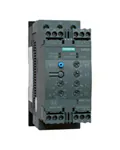
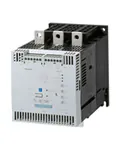
SIRIUS 3RW40 — Siemens Soft Starters

The SIRIUS 3RW40 series from Siemens is a range of soft starters designed for standard starting and stopping of three-phase asynchronous motors. Featuring thyristor control technology and an integrated bypass contactor, the 3RW40 series delivers a compact design with minimal heat dissipation in the control cabinet. The rated current range from 12 to 432 A at 400 V covers motors from 5.5 to 250 kW.

Key advantages of the SIRIUS 3RW40: simple parameterization via potentiometer (no programming required), intelligent overheating and motor overload protection, adjustable starting current limitation, and two-phase control with polarity balancing.

SIRIUS 3RW40 Product Lineup

Part NumberRated Current, AVoltage, V
3RW4024-1BB1412400
3RW4026-1BB1425400
3RW4028-1BB1438400
3RW4046-1BB1480400
3RW4055-6BB44134400
3RW4074-6BB44280400
3RW4076-6BB44432400

The complete catalogue includes 15 models with intermediate ratings of 32, 45, 63, 72, 106, 162, 230, and 356 A.

How to Choose a SIRIUS 3RW40

Selecting the right 3RW40 soft starter is based on the motor's rated current at operating temperature. For standard conditions (up to 40 °C), use catalogue values. At elevated ambient temperatures (50-60 °C), the permissible current derating must be considered. It is recommended to select a model with a 10-15 % margin above the motor's rated current.

The 3RW40 series is designed for direct starting with a smooth voltage ramp-up. For heavy-duty starting, reversing applications, or advanced diagnostics requirements, consider the Siemens SIRIUS 3RW44 — a series with extended functionality.

Other Soft Starter Series

In addition to Siemens, we offer soft starters from other manufacturers: Schneider Electric ATS48 for demanding starting applications, Danfoss MCD500 with a comprehensive protection set, and Siemens SIRIUS 3RW30 for compact solutions.

Warranty and Support

All Siemens SIRIUS 3RW40 soft starters come with the manufacturer's official warranty. Our engineers can assist with selection, configuration, and commissioning of the soft starter for your equipment.

Frequently Asked Questions

How is Altistart 22 different from ATS48 and the new ATS480?

ATS22 is the universal base Altistart series with internal bypass; it controls voltage during ramp-up and offers a plain stop ramp. ATS48 adds torque control (TQ-Control) and a full pump stop function for centrifugal pumps, but its bypass is external (a separate contactor in the panel). ATS480 is the new generation and effectively replaces ATS48: TQ-Control, pump stop, plus internal bypass and richer comms (Modbus, optional Profinet / Ethernet IP). For a new pump or conveyor project with torque control, pick ATS480; on new builds the ATS48 no longer makes sense.

How many starts per hour can a soft starter handle?

It depends on whether the unit has an internal bypass. Series with bypass (ATS22, ATS480, Danfoss MCD500, ABB PSR / PSE / PSTX, Veichi SS70) typically take 10-30 starts per hour, because the thyristors switch off after ramp-up and stop heating. Series without bypass (Schneider ATS01, Siemens SIRIUS 3RW30) tolerate 6-10 starts per hour. The exact figure is on the nameplate as AC-53a or AC-53b. If you need over 20 starts per hour with heavy torque, a VFD is more economical than paying for a premium soft starter.

Soft starter or VFD for a pump?

Driven by start frequency and the need to vary flow. If the pump runs in on / off mode by a pressure or level sensor, at up to 10-12 starts per hour, and does not need to hold constant pressure — a soft starter with pump stop (Schneider ATS48 / ATS480, Danfoss MCD500) is two to three times cheaper and fully removes water hammer. If the pump needs to hold network pressure, runs with frequent starts (drainage, sewage), or you need energy savings — pick a VFD with PID. A soft starter gives no savings under steady-state load.

Does a soft starter save energy?

Only on starting losses and through reduced mechanical wear. Under steady-state load the motor is fed straight from the mains via bypass, so consumption matches direct-on-line. Some series (Schneider ATS22, ABB PSTX) offer Inside Delta or Energy Saver, lowering voltage on underloaded motors — but real-world savings are 1-3% and only meaningful on motors permanently running below 50% load. If energy saving is the main goal, the right tool is a VFD with PID, not a soft starter.

What is pump stop and why use it?

Pump stop is a smooth pump-motor stopping function where the soft starter lowers voltage over 10-30 seconds so that pump speed and water-column speed in the pipeline decrease in step. Without pump stop the water column behind the check valve keeps moving by inertia, the valve slams shut and pressure spikes by 5-10 bar — that is water hammer, which breaks valves and welds. The function exists on Schneider ATS48, ATS480, ATS490, ATS430, Danfoss MCD500, ABB PSTX. It does not exist on ATS01, ATS22, MCD200, SIRIUS 3RW30 — these series should not be picked for pump applications.

Do I need an external bypass contactor?

It depends on the series and on start frequency. Series without internal bypass (Schneider ATS01, ATS48, Siemens SIRIUS 3RW30) — an external contactor is recommended for more than 6-10 starts per hour or for 24/7 service; otherwise the thyristors overheat from continuous commutation. Series with internal bypass (ATS22, ATS480, Danfoss MCD500, ABB PSR / PSE / PSTX, Veichi SS70) — no separate contactor needed, bypass engages automatically after ramp-up. The AC-53b figure on the nameplate already accounts for the bypass in start time and duty cycle.

Is a soft starter suitable for frequent starts of a drainage pump?

Usually not. Drainage and sewage pumps cycle dozens of times per hour by tank level — that is 30-60 start / stop cycles. No soft starter series will last that duty: thyristors and internal bypass contactors are typically rated for 10-30 starts per hour. The right tool is a pump VFD (Veichi AC10 with sleep mode, INVT GD20 with PID) running continuously at minimum speed and ramping up when the tank fills — there are effectively no real starts at all.