Braking resistor: when to add one, when you can skip it
Braking resistors go onto VFDs where the load coasts to a stop often or reverses. Our typical customer this year: hoists and crane bridges, centrifuges, woodworking machines with a heavy flywheel. In those cases the motor flips to generator mode at deceleration, the inverter DC bus inflates, OV (overvoltage) trip fires in 0.5-2 seconds. The resistor catches that energy and dumps it as heat.
Not every job needs one. Pumps, fans, conveyors with mild ramp-up and ramp-down – the VFD handles it on its own. A controlled 5-10 second ramp-down feeds the energy back into the motor with no bus spike. We ask the customer about the cycle: how many decelerations per minute, from what speed, what is the flywheel inertia. Without those numbers we will not size a resistor. The idea itself is simple: resistance (ohms) must match or exceed the minimum on the VFD datasheet. Dissipation rating – 10-20% of VFD power for rare braking, 50-100% for intense duty cycles.
What we ask before you order a resistor
First: VFD model. The manufacturer datasheet always carries an "External brake resistor" table with minimum resistance and recommended dissipation. You cannot guess: an INVT GD20 7.5 kW wants 75 ohms minimum, a Veichi AC10 at the same kW wants 70. Second: braking cycle. A hoist that lowers a load 30 times per shift gives 2-3x rated dissipation on average. A woodworking machine with a flywheel saw blade has 5-10x peaks but in short bursts.
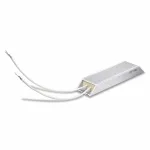
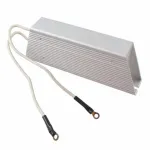
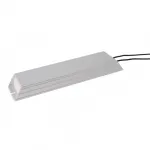
Third: where it sits. The resistor heats to 200-400°C. It needs a 50-100 mm gap from other components and a ventilated cabinet. In a damp site we ship the IP enclosure version. In a dry cabinet a bare aluminum heatsink works. We keep the Bosch Rexroth lineup in stock from 0.1 to 80 kW dissipation, resistances 3.2-2000 ohms. Factory warranty 12-24 months. We ship from our Kyiv warehouse in 1-3 days. Resistor sizing for your VFD model is free – send us the inverter datasheet.
| Model | Dissipation Power | Resistance | Application |
|---|---|---|---|
| Bosch Rexroth R912004613 | 50 kW | 3.7 Ohm | Industrial lines, VFD 110 kW |
| Bosch Rexroth R912001651 | 12.5 kW | 22 Ohm | Lifting mechanisms, VFD 55 kW |
| Bosch Rexroth R912001655 | 1.56 kW | 70 Ohm | Conveyors, lifts, VFD 7.5 kW |
| Bosch Rexroth R912001653 | 1.04 kW | 90 Ohm | Machine tools, VFD 5.5 kW |
| Bosch Rexroth R912004564 | 0.1 kW | 190 Ohm | Small mechanisms, VFD 0.75 kW |
Braking Resistor Manufacturers
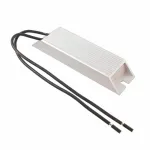
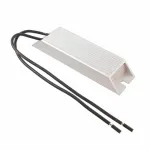
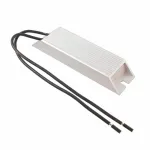
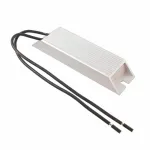
Our catalog features Bosch Rexroth braking resistors — from 0.1 to 80 kW dissipation power, for EFC3600, FE and FV series variable frequency drives. Aluminum housings with efficient heat dissipation, resistance range from 3.2 to 2,000 Ohm.
Related Categories
- Braking modules — external braking transistors (choppers) for VFDs without built-in module
- EMC filters — electromagnetic compatibility filters for VFDs
- All options — complete VFD accessories catalog
- Variable frequency drives — main equipment for which resistors are selected
Warranty and Delivery
Braking resistors come with official manufacturer warranty. Delivery across Ukraine — Kyiv, Kharkiv, Odesa, Dnipro, Lviv, and other cities.