Connecting a Hybrid Inverter to Solar Panels: Step-by-Step Guide
A hybrid inverter is the heart of a residential solar power system. It converts direct current from photovoltaic modules into 220 V AC, manages battery charging, and provides uninterrupted power even during blackouts. Proper connection of a hybrid inverter to solar panels determines the efficiency, safety, and longevity of the entire system.
In this guide, we cover the complete process — from system design to commissioning — with consideration of Ukrainian electrical codes (PUE), regional utility (oblenergo) requirements, and feed-in tariff (green tariff) connection specifics.
What You Need: Component Checklist
Before you start, make sure you have all the necessary components:
- Hybrid inverter — choose based on load capacity and number of MPPT trackers. Browse our hybrid inverter catalog.
- Solar panels — monocrystalline or polycrystalline modules. See our solar panel selection.
- Batteries — lithium iron phosphate (LiFePO4) or lead-acid (AGM/GEL). Check our solar station batteries.
- Cables and connectors — PV1-F solar cable with 4–6 mm² cross-section, MC4 connectors. Available in our cables and connectors section.
- Circuit breakers — DC breakers for solar strings (600–1000 V DC), AC breaker at inverter output.
- Surge protection devices (SPD) — DC SPD Type II for lightning and surge protection.
- Grounding — copper wire with minimum 10 mm² cross-section, grounding electrode.
- Distribution board with DIN rail for mounting protective devices.
Step 1. System Design and Calculation
Determining Power Requirements
Start by calculating total site consumption. A typical private home in Ukraine consumes 5–15 kWh per day. For backup power of critical loads (lighting, refrigerator, heating pump, router), a 3–5 kW inverter is usually sufficient.
Selecting Solar Panels
Total panel array power typically ranges from 1.2 to 1.5 times the inverter’s rated power. For example, a 5 kW inverter optimally pairs with 6–7.5 kW of panels to compensate for losses and ensure adequate winter generation.
String Configuration: Series vs Parallel Connection
This is the most critical design stage. Errors here can destroy the inverter.
- Series connection (string) — panel voltages add up while current remains constant. For example, 10 panels at 40 V = 400 V string.
- Parallel connection — voltage remains equal to one panel while currents add up.
- Combined — multiple series strings connected in parallel via Y-connectors or separate MPPT inputs.
Critical rule: the string open-circuit voltage (Voc) at minimum operating temperature (-25°C for most Ukrainian regions) MUST NOT exceed the MPPT tracker’s maximum input voltage. Verify this using the formula with your panel’s Voc temperature coefficient.
Step 2. Solar Panel Installation
Location and Orientation
In Ukraine, the optimal orientation is due South with a tilt angle of 30–35° from horizontal. For flat roofs, use mounting systems with adjustable angles. Ensure no shadows from chimneys, antennas, or neighboring buildings fall on the panels during daylight hours.
Mechanical Installation
- Install mounting rails (aluminum profiles) on the roof using appropriate fasteners for your roof type.
- Secure panels to rails using clamp clips (end and mid-panel).
- Verify every connection is secure — panels must withstand wind loads up to 60 m/s.
- Ensure grounding of panel frames and mounting structure.
Step 3. Electrical Connection of Solar Panels
Assembling Strings
Connect panels into strings according to your calculated configuration:
- Connect the “+” of the first panel to the “-” of the next using factory cables with MC4 connectors.
- Repeat for all panels in the string.
- The free “+” of the last panel and “-” of the first are the string leads that go to the inverter.
- Measure the string open-circuit voltage (Voc) with a multimeter. It should match the sum of individual panel Voc values (±5%).
Cable Routing
Use specialized PV1-F solar cable with double insulation, UV-resistant. Cross-section: 4 mm² for strings up to 15 A, 6 mm² for higher currents. Route in conduit or cable tray, avoid sharp bends.
Step 4. Installing Protective Devices
DC Side (Before the Inverter)
- DC circuit breaker per string — rated voltage not less than string Voc, rated current — 1.25 × panel Isc.
- DC SPD (surge protection device) Type II — installed near the inverter, protects against lightning and switching surges.
- DC disconnect switch — allows safe disconnection of panels from inverter for maintenance.
AC Side (After the Inverter)
- AC circuit breaker — rated according to inverter power (e.g., 25 A for a 5 kW inverter at 220 V).
- RCD (residual current device) or RCBO — 30 mA for electric shock protection.
- AC SPD Type II — for grid-side surge protection.
Step 5. Connecting the Inverter
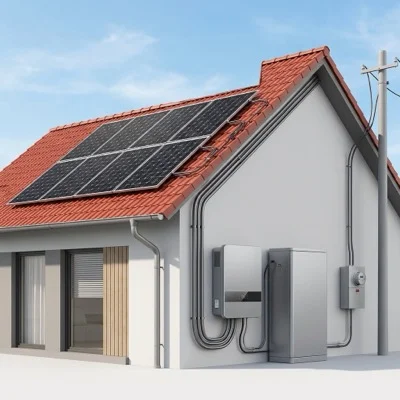
Typical Hybrid Inverter Wiring Diagram
Below is a text-based diagram of the typical wiring topology:
Solar Panels (Strings)
        |
   [DC Breaker + SPD]
        |
   [Inverter MPPT DC Input]
        |
  +-----------+
  |  HYBRID   |
  |  INVERTER |
  +-----------+
   |     |     |
  BAT   AC    GRID
   |    OUT    IN
   |     |     |
[Battery] | [Grid 220V]
        |       |
  [AC Breaker] [Meter]
        |       |
   [Home Loads]
Connection Sequence
- Grounding the inverter — connect the inverter PE terminal to the building grounding system using copper wire ≥10 mm².
- Connecting batteries — connect the battery to the inverter battery input. Observe polarity! Use cable with appropriate cross-section (typically 16–35 mm² depending on charge current). Install a DC fuse or breaker between battery and inverter.
- Grid connection (GRID) — connect phase (L), neutral (N), and ground (PE) from the input breaker to the inverter GRID terminals.
- Load connection (LOAD/AC OUT) — connect consumers through an AC breaker to the inverter output.
- Solar panel connection (PV) — this is done last! Connect “+” and “-” of each string to the corresponding MPPT input of the inverter. Ensure string DC breakers are OFF during connection.
Step 6. System Commissioning
Pre-Start Checklist
- Verify polarity of all DC connections with a multimeter.
- Confirm that each string voltage is within the MPPT allowable range.
- Check all screw connections are properly tightened (recommended torque values are in the inverter manual).
- Verify grounding is done correctly — grounding loop resistance ≤4 ohms.
- Check battery settings — type (Li-ion/AGM/GEL), voltage, charge current.
Power-On Sequence
- Turn on the AC breaker (grid → inverter).
- Power on the inverter using the button or switch.
- Wait for self-diagnostics to complete (typically 30–60 seconds).
- Turn on the battery breaker — the inverter should recognize the battery.
- Turn on the string DC breakers — the inverter begins MPPT tracking.
- Check the display for: PV voltage, charge current, generation power.
Step 7. Grid Connection and Feed-In Tariff
Utility Requirements
For legal connection of a solar station to the grid in Ukraine, you need:
- Technical conditions (TU) — submit an application to your local distribution network operator (oblenergo).
- Project documentation — single-line diagram, equipment specifications, grounding certificate.
- Bidirectional meter — installed by the utility, records consumed and exported electricity.
- Commissioning certificate — after inspection and connection.
- Green tariff agreement — with the utility for private households up to 30 kW.
Important Considerations
The hybrid inverter must have anti-islanding capability — automatic disconnection from the grid when external power is lost. This is a safety requirement to protect utility workers repairing the line. Most modern hybrid inverters have this function built in.
Common Connection Mistakes and How to Avoid Them
| Mistake | Consequences | How to Avoid |
|---|---|---|
| Exceeding MPPT Voc | Inverter failure, warranty void | Calculate Voc at -25°C with temperature coefficient |
| Reverse polarity | Burned protection diodes or MPPT controller | Always verify polarity with multimeter before connecting |
| Insufficient cable cross-section | Overheating, power losses, fire hazard | Calculate per PUE tables with 25% safety margin |
| Missing grounding | Electrocution risk, lightning damage | Ground ALL metal parts: panel frames, structure, inverter |
| Mixed panel wattage in one string | Up to 30% generation loss | Use identical panels within each string |
| Connecting PV to energized inverter | Electrical arc, connector damage | Always turn off DC breakers before working with PV cables |
Post-Connection Maintenance
After successful system launch, follow a regular maintenance schedule:
- Monthly: check generation metrics via app or inverter display, visual panel inspection.
- Quarterly: clean panels from dust and dirt (soft brush with water, no abrasives).
- Annually: check tightness of all connections, cable condition, protective device operation, grounding resistance.
- After storms: inspect SPD — if the indicator shows activation, replace the module.
Frequently Asked Questions (FAQ)
Can I connect a hybrid inverter without batteries?
Yes, most hybrid inverters support operation without batteries in grid-tied mode. However, this mode loses the backup power function during grid outages.
How many solar panels can be connected to one inverter?
This depends on the inverter power and MPPT tracker specifications. The maximum PV array power is typically listed in the inverter datasheet. Usually it ranges from 1.0 to 1.5 times the inverter’s rated power.
Is it mandatory to connect a hybrid inverter to the grid?
No, a hybrid inverter can operate fully off-grid using solar panels and batteries. However, grid connection is required for the feed-in (green) tariff.
What should I do if the inverter shows an error after connection?
The most common causes are: PV overvoltage (check string Voc), reverse polarity (check with multimeter), grounding error (run ISO test). Refer to the inverter manual for the specific error code.
Do I need a permit to install a solar station in Ukraine?
For private households up to 30 kW, no NEURC license is required. You need to obtain technical conditions from the utility, install a bidirectional meter, and sign a green tariff agreement.