What a 6-axis industrial robot is
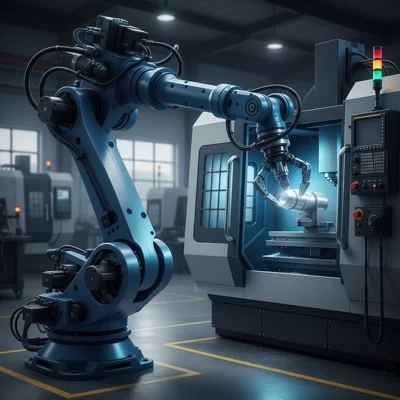
A 6-axis industrial robot (articulated, six-axis articulated robot) is a manipulator with six degrees of freedom: three axes handle positioning a point in space, the other three orient the wrist. Such a robot can reach any point inside its work envelope at any angle. Repeatability runs from ±0.02 to ±0.1 mm depending on the model; payload ranges from 3 kg to 2300 kg.
Simplified view: the first three axes (J1, J2, J3) work like a human shoulder — they lift and swing the "forearm." The other three (J4, J5, J6) form the wrist that rotates the tool. Upside: one robot welds, assembles, paints, palletizes — same hardware. Downside: more joints mean harder programming and a pricier gearbox set.
This guide walks through the six joints, compares 6-axis arms with SCARA and Delta, splits them by payload class with real KUKA, Veichi, and FANUC models, lines up the top 5 brands at Ukrainian prices, and shows how we actually pick a robot on site. No marketing — just what we see during installation.
6-axis robot anatomy: joints J1-J6
In a standard articulated arm every joint is revolute — each has its own servo motor, gear (Harmonic Drive or RV) and encoder. Here is what every axis does.
J1 — base rotation
The first axis rotates the whole body around the vertical axis. Typical range is ±180°, some models offer ±360°. J1 sets the horizontal reach. The largest RV gear sits here because it carries the weight of everything above plus the payload.
J2 — shoulder lift
The second axis raises and lowers the "shoulder." Range is usually +135° / -90°. J2 takes the highest dynamic load — the moment of the forearm, wrist and tool all act on it. If J2 wears out, accuracy drops on every joint downstream.
J3 — elbow lift
The third axis moves the "forearm" against the shoulder. Range is roughly +150° / -120°. J3 defines vertical reach and the ability to enter narrow spaces — for example a press mold or a cabinet.
J4 — forearm rotation
The fourth axis rotates the forearm along its long axis. Range ±180°, on some models endless. Lighter Harmonic Drive gears sit here. J4 matters when you need to rotate a welding torch or gripper without moving the whole forearm.
J5 — wrist pitch
The fifth axis pitches the wrist up and down. Range ±125°. Without J5 you cannot approach a part at a right angle from above or from the side — this axis is the "head nod."
J6 — flange rotation
The sixth axis rotates the mounting flange where the tool attaches. Range ±360° or more, often with no mechanical stop. J6 handles the final orientation — torque angle of a nut, screwdriver alignment, bead direction for glue.
Tool Center Point (TCP)
None of the six joints gets programmed in joint coordinates. Engineers program through the TCP — the tool center point. You tell the robot where the torch tip, cutter or vacuum cup must land. The controller solves inverse kinematics for J1-J6. Swap a tool, redefine the TCP, and the whole program still works.
6-axis vs SCARA vs Delta
Short answer: 6-axis is the generalist, SCARA is fast in a horizontal plane, Delta is the sprinter for packaging. Here are the numbers.
| Criterion | 6-axis | SCARA | Delta |
|---|---|---|---|
| Number of axes | 6 | 4 | 4 (parallel arms) |
| Flexibility | Any angle in space | Horizontal plane | Fast pick & place |
| Cycle time | 1.5-3 s | 0.3-0.5 s | 0.2-0.3 s |
| Payload | 3-2300 kg | 1-25 kg | 1-8 kg |
| Typical jobs | Welding, assembly, palletizing, painting | Assembly, pick & place | Packaging, sorting |
| Repeatability | ±0.02-0.1 mm | ±0.01-0.03 mm | ±0.05-0.1 mm |
Bottom line: if the job lives in one horizontal plane and needs an ultra-short cycle, go SCARA. Need to move tiny parts every 0.3 s — Delta. For everything else, especially multi-angle approaches to a part, a 6-axis closes the task end to end. We covered SCARA in more depth in a dedicated SCARA robot category.
Payload classes of 6-axis robots
Articulated robots split into five payload classes. This is the first thing we look at, because the class sets reach, price and gear type.
- Ultra-light (3-6 kg) — cobots and small work cells. Electronics pick & place, lab stands, testing. Models: KUKA KR 6 R900, Veichi VCR6, Universal Robots UR5e.
- Light (6-20 kg) — the most popular class. Arc welding, mid-size pick & place, machine tending. Models: KUKA KR 16, Veichi VCR20, FANUC LR Mate 200iD.
- Medium (20-60 kg) — general machine building, CNC tending, spot welding. Models: KUKA KR 60, FANUC M-20iA, ABB IRB 4600.
- Heavy (60-300 kg) — palletizing, body handling, large-part work. Models: KUKA KR 210 Quantec, FANUC R-2000iC, Motoman MH180.
- Ultra-heavy (300+ kg) — heavy casting, car bodies, heavy industry. Models: KUKA KR 1000 Titan, FANUC M-2000iA (up to 2300 kg), ABB IRB 8700.
Our catalog holds mostly light and medium models. That tracks the market: more than 80% of Ukrainian orders are welding, CNC tending and pick & place. Ultra-heavy arms go into large facilities as bespoke projects.
Top 5 brands of 6-axis robots in Ukraine
We supply five major brands. Each has a signature: KUKA — German build plus an approachable stack; Veichi — Chinese price with decent mechanics; FANUC — the reference for CNC integrations; ABB — old-school automotive; Motoman — champion in welding. Here is the side-by-side.
| Brand | Available series | Payload range | Price from, UAH |
|---|---|---|---|
| KUKA | KR Agilus, Cybertech, Quantec, Fortec, Titan | 3-1300 kg | from 850,000 |
| Veichi | VCR, VCRC, VCRP | 3-20 kg | from 350,000 |
| FANUC | LR Mate, M-series, R-2000 | 3-2300 kg | from 700,000 |
| ABB | IRB 120, 1200, 4600, 6700 | 3-800 kg | from 900,000 |
| Motoman | HP, MH, GP | 3-900 kg | from 800,000 |
For small and mid-size clients we usually recommend Veichi VCR — the price gap with KUKA is 2-2.5×, while mechanics and accuracy in the light class differ less than people expect. Big lines with hard repeatability and 10-year lifetime requirements still pick KUKA. Full catalog lives in the industrial robots section.
How to choose a 6-axis robot: 7 steps
Weight and reach first, tool and budget later. That is the order we follow on the ground.
- Sum up tool + part weight. Gripper, torch, hoses, cables — everything together. Add 20% margin. If the result is 8 kg, buy a 10-12 kg robot, not an 8 kg one.
- Measure maximum reach. From the center of the base to the farthest point you need to hit. Add 10% margin. A 900 mm-reach robot working at its envelope edge is unstable.
- Define required repeatability. Arc welding — ±0.1 mm is plenty. Electronics assembly — ±0.02-0.05 mm. Palletizing — ±0.5 mm is fine.
- Check IP rating. Paint booth — IP67 wrist minimum. Dusty shop — IP54. Cleanroom — IP30 is enough.
- Estimate cycle speed. Need 4 parts per minute? Look at cycle time in the datasheet — but remember it usually refers to small 25 mm moves, not real trajectories.
- Pick the programming language. KUKA — KRL, FANUC — KAREL + TP, ABB — RAPID, Motoman — INFORM. If you already have a KUKA engineer, do not switch to FANUC without a reason.
- Budget the commissioning. The robot itself is 50-60% of the spend. The rest: fence, light curtains, teach pendant, integration with PLCs and HMIs, operator training, grippers. A proper cell is robot × 1.8-2.
First time buying a robot? Start with a simple job — pick & place or spot welding. Painting and complex arc welding need an experienced integrator.
Typical jobs for 6-axis robots
Real installations we saw at Ukrainian plants over the past two years.
- Ag-machine frame welding. KUKA KR 16 arc plus a two-axis positioner driven by Veichi SD7 servos. One robot replaces 3-4 welders, runs three shifts.
- Palletizing 25 kg sacks. KUKA KR 180 PA with a vacuum gripper. 900 sacks/hour, 24/7. Feed, sugar, flour.
- Metal-structure painting. FANUC P-series or KUKA KR 60 HA, explosion-proof build. Paint savings 30-40% vs manual spraying.
- CNC tending. Veichi VCR20 on a 4 m linear track serves three CNC machines. A single operator only supervises.
- Electronics pick & place. Veichi VCR6 assembles PCBs, places components, tests contacts. 1.8 s cycle per op.
- Gluing and sealing. KUKA KR 6 R900 with an SCA glue dispenser. Car windshields, appliances.
Task-specific categories — welding robots, palletizing robots, collaborative robots. Each category highlights the right models.
Lifetime, operation, IP protection
Gears decide the lifetime. A 6-axis uses Harmonic Drive units on the light joints (J4-J6) and RV gears by Nabtesco on the heavy ones (J1-J3). Average life runs 25-40 thousand hours — that is 10-15 years at two-shift use.
- Lubrication change — every 5-10 thousand hours. Skip it and the gear dies in half a year.
- IP54 — the shop-floor default. Dust and drops are fine, direct water jets are not.
- IP67 — dusty or wet environments, pressure wash after shift. Adds 15-20% to the price.
- Annual calibration — accuracy check and axis-zero correction. Skip it and repeatability drifts.
- Temperature watch — a loaded robot heats up. +40°C ambient means either ventilation or Class H motors.
We detailed robot technical specs in a separate article. It covers the parameters catalogs usually skip: wrist inertia, motor class, allowable torque at full speed.
Integrating a 6-axis robot with our components
The robot itself is only 50-60% of the system. Everything else is the periphery that turns a manipulator into a working cell. Here is the typical build we supply alongside a robot.
- Part positioner — single or two-axis rotary table. Two Veichi SD7 servos plus gearboxes, controlled via a robot digital I/O or Profinet.
- Part-feed conveyor — belt or chain, driven by a Veichi AC310 VFD. Synced to the robot cycle.
- Master PLC — coordinates robot, conveyor, periphery, safety devices. Delta AS or Mitsubishi FX5U, EtherCAT or Profinet.
- HMI panel — Veichi HMV or Weintek, shows cycle state, count, alarms. Modbus TCP to the PLC.
- Safety sensors — light curtains, two-hand buttons, E-stops per ISO 13849-1 PLd.
- Safety fence — 2 m mesh around the cell, interlocked doors, polycarbonate windows.
We covered the industry context and trends in the piece understanding the robotics industry. It shows where the market is heading and why light 6-axis models currently sell the most.
Frequently Asked Questions
How much does a 6-axis robot cost in Ukraine in 2026?
Veichi VCR6 (6 kg, 1400 mm reach) — from 350,000 UAH without commissioning. KUKA KR 6 R900 in the same class — from 850,000 UAH. Medium class (20 kg) — Veichi VCR20 around 500,000 UAH, KUKA KR 16 from 1.3 million UAH. Palletizer KUKA KR 180 PA — from 3-3.5 million UAH. A turnkey cell with fence, PLC and commissioning is robot × 1.8-2.
Which repeatability should I pick?
Arc welding — ±0.1 mm is plenty because the bead is wider than the error. Spot welding of car bodies — ±0.05 mm. Electronics assembly and small-component pick & place — ±0.02-0.03 mm, premium class. Palletizing big sacks — even ±0.5 mm is invisible. Do not overbuy accuracy: every 10 µm costs money.
Can I program a robot without an experienced specialist?
For simple jobs (pick & place, fixed palletizing patterns) — yes, through the teach pendant after one or two days of operator training. For welding, painting and complex trajectories — no, you need an integrator with hands-on experience on that exact brand. We recommend buying commissioning with the robot: 10-15% of the robot price, but you get a cell that actually starts on time.
When IP54 vs IP67?
IP54 — standard shop with dust, coolant, light splashes. Covers 80% of jobs. IP67 — direct pressure wash (food, pharma), heavy dust (grinding), welding zones with slag. An IP67 robot costs 15-20% more because every joint gets sealed.
How long does a 6-axis robot gearbox last?
Harmonic Drive and Nabtesco RV gears — 25-40 thousand hours with proper service. That is 10-15 years on two shifts. Regular lubrication every 5-10 thousand hours is the key. Skip the service and lifetime drops 3-4×, while replacing a heavy-axis gear costs 150-300 thousand UAH.
Final take
A 6-axis robot is the generalist tool that covers 90% of automation jobs — welding, assembly, palletizing, painting, machine tending. The win condition when buying is weight plus reach first, then IP class, programming and commissioning budget. Do not save on integration — a robot without a proper cell is expensive scrap metal.
For a pilot project we suggest Veichi VCR6 or VCR20 — fair price, adequate accuracy in the light class, service available. For series production with strict requirements — the KUKA KR series. Not sure where to start? Contact us, we will match a robot to your task and quote a turnkey cell with servo, PLC, HMI, and fence. Full catalog in the industrial robots section.