Braking module: when an external chopper is needed
A braking module (braking unit, chopper) goes onto a VFD from 30 kW up that does not have a built-in braking transistor, or where the regenerated energy is more than the built-in can handle. Our typical customer this year: elevators and crane bridges, centrifuges, winders on light industry lines, high-power servo drives with frequent reversals. In those setups the motor flips to generator at deceleration and dumps kilowatts back into the VFD in seconds.
How the module works. It sits between the inverter DC bus and the braking resistor. When DC voltage exceeds the threshold (around 760-800 V for 3-phase 400 V drives), the IGBT opens and dumps energy into the resistor where it turns into heat. Without a chopper the VFD throws OV (overvoltage) and trips. Small VFDs up to 22-30 kW carry the chopper built-in, so an external module is pointless there. From 30 kW up some models include it and some do not – check the datasheet.
What we ask before you order a braking module
First: VFD model. We need to know whether there is a built-in chopper. If there is, you only need the resistor. If not, we go to the Bosch Rexroth catalog matched to Fe, Fv, EFC families where module and VFD are designed as a pair. Second: drive power. We carry three popular ratings: up to 30 kW, up to 45 kW, above 45 kW. Third: braking cycle. Effective duty (ED%) is the share of time the module is active. Elevators run 5-10%. Centrifuges 30-50%. Winders 60% and more. Higher ED means larger module and resistor.
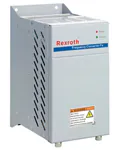
Fourth: mounting. The module sits in the cabinet next to the VFD. Cable between them no longer than 5 m (otherwise noise and losses). The resistor sits up to 10 m from the module on shielded cable. We keep Bosch Rexroth R912001499 (up to 30 kW), R912001500 (up to 45 kW), R912004611 (above 45 kW) in stock. Factory warranty 12-24 months. Ship from our Kyiv warehouse in 1-3 days. Sizing of module plus resistor for your VFD model is free at our shop. Send us the inverter datasheet and the braking parameters.
| Model | Drive Power | VFD Series | Application |
|---|---|---|---|
| R912001499 | up to 30 kW | Bosch Rexroth Fe/Fv | Conveyors, fans, pumps |
| R912001500 | up to 45 kW | Bosch Rexroth Fe/Fv | Cranes, elevators, centrifuges |
| R912004611 | above 45 kW | Bosch Rexroth EFC/Fe | Heavy industrial machinery |
For correct operation, the module connects to the (+) and (−) terminals of the VFD DC bus, while the braking resistor connects to the module BR+ and BR− outputs. Cable length from VFD to module should not exceed 5 m; module to resistor — up to 10 m.
Braking Module Manufacturers
Our catalog features braking modules from a leading European industrial drive manufacturer:
- Bosch Rexroth — modules for Fe, Fv, EFC series rated from 30 to 160+ kW. German engineering quality with full Rexroth drive compatibility.
Braking Modules by Specifications
Select braking equipment by parameters:
- Braking Resistors — pair with a module for a complete braking system
- EMC Filters — EMI protection during dynamic braking
- All Options & Accessories — full catalog of additional equipment
Warranty & Support
All braking modules come with official manufacturer warranty. We provide technical consultation for selecting the right module for your specific drive and load. Delivery across Ukraine: Kyiv, Kharkiv, Odesa, Dnipro, Lviv — via Nova Poshta or direct shipping. Payment by bank transfer for businesses or cash on delivery.