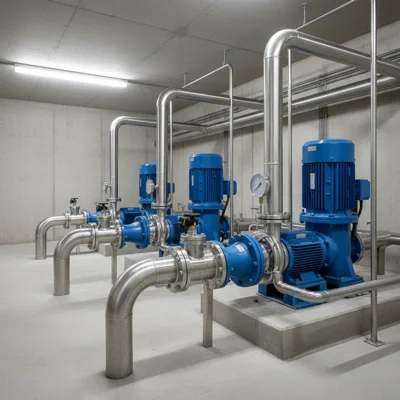
Key Advantages
A variable frequency drive controls motor speed directly, delivering these essential advantages to water supply and circulating pumping systems:
- Precise Pressure Maintenance (PID Control): The drive smoothly adjusts frequency (20–50 Hz), keeping discharge pressure rock-steady regardless of how many taps or valves are opened.
- Energy Savings of 30% to 50%: Pump power consumption follows affinity laws and is proportional to the cube of speed (P ∝ n³). Reducing speed by just 20% cuts energy consumption by nearly half.
- Complete Water Hammer Elimination: Controlled acceleration and deceleration ramps (3–10 s) prevent pressure surges, protecting pipes, check valves, and mechanical seals.
- Reduced Starting Currents: Soft starting keeps inrush current within 1.0–1.2x rated current (compared to 6–8x on direct-on-line start), relieving electrical infrastructure and backup generators.
- Comprehensive Motor Protection: Built-in dry-run detection (monitoring undercurrent or low power factor), phase loss, stall, undervoltage, and thermal overload protections.
- Compact Expansion Vessel: A small 8–24 liter vessel replaces bulky 100–300 liter pressure tanks, as the drive dynamically compensates for flow changes.
Centrifugal pumps consume up to 20% of all industrial electricity. In practice, installing a VFD on a 7.5 kW pump at an average 65% load saves 8,000–12,000 kWh annually, delivering a full payback within 4–6 months.
Centrifugal pumps consume up to 20% of all industrial electricity. Most of them run with excess capacity: the motor spins at full speed while a throttle valve or bypass wastes the surplus pressure. This is like driving a car at full throttle while braking at the same time. A variable frequency drive (VFD) allows smooth speed regulation so the pump delivers exactly the flow the system needs at any given moment.
In practice, installing a VFD on a 7.5 kW water supply pump running at an average 65% load saves 8,000-12,000 kWh per year. At a rate of UAH 3.5/kWh, that is UAH 28,000-42,000 annually. The drive itself costs from UAH 12,000 for this power range, so the payback period is 4-6 months.
Affinity Laws: Why the Savings Are So Significant
The effectiveness of variable speed pump control is explained by three affinity laws. These formulas describe the relationship between impeller speed and pump parameters:
- Flow is proportional to speed: Q2 = Q1 x (n2/n1). Reduce speed by 20% and flow drops by 20%.
- Head (pressure) is proportional to the square of speed: H2 = H1 x (n2/n1)squared. Reduce speed by 20% and pressure drops by 36%.
- Power is proportional to the cube of speed: P2 = P1 x (n2/n1)cubed. Reduce speed by 20% and power consumption drops by 49%.
The cubic relationship between power and speed is what makes VFDs so effective for pumps. At 80% speed, the pump consumes only 51% of rated power. At 60% speed it is just 22%. At 50% speed it is only 12.5% of nominal power.
These formulas are accurate for speed changes up to 25% from nominal. Beyond that, pump efficiency decreases and actual savings will be somewhat less than calculated. But even accounting for efficiency losses, a 30-50% reduction in consumption is a typical result for water supply systems.
Comparison of Centrifugal Pump Control Methods
In practice, three main methods are used to control a centrifugal pump: a throttle valve, a soft starter, and a variable frequency drive. Each has its advantages.
| Parameter | Throttle Valve | Soft Starter | Variable Frequency Drive |
|---|---|---|---|
| Flow regulation | Yes, by throttling | No, start/stop only | Yes, by speed control |
| Starting current | 6-8x In (direct start) | 2-4x In | 0.5-1.5x In |
| Energy savings | 0% | 0% (active during start only) | 30-50% |
| Water hammer protection | No | Partial (smooth stop) | Yes, full control |
| Pressure maintenance | Manual | No | Automatic via sensor |
| Motor protection | Minimal | Thermal, phase | Full (current, temperature, dry run) |
| Cost (7.5 kW) | UAH 500-1,500 | UAH 4,000-7,000 | UAH 12,000-22,000 |
| Payback period | N/A | N/A | 4-12 months |
A soft starter is a good choice when the pump operates in start/stop mode without the need for smooth flow regulation. But if you need automatic pressure control or energy savings, there is no alternative to a VFD. Read more about the differences in our article top questions about VFDs and soft starters.
How to Select a VFD for a Pump
The main rule: select the drive by the motor rated current, not by power. The power on the motor nameplate and the VFD power rating may not match due to different operating conditions.
Step-by-Step Selection Guide
- Find the motor rated current on the nameplate. For example, 15.4 A at 380 V.
- Choose a VFD with 10-15% current margin. For 15.4 A, you need a drive rated at least 17-18 A.
- Check the supply voltage: 220 V single-phase, 380 V three-phase, or 220 V three-phase. The VFD input must match your supply.
- Select the control mode: for pumps, always choose the fan/pump (variable torque) mode, not the general-purpose (constant torque) mode.
- Consider the IP rating: for wet environments use IP54 or IP65. For dry electrical cabinets, IP20 is sufficient.
Browse our catalog of frequency converters for pumps with filtering by power and voltage.
VFD Parameter Setup for Centrifugal Pumps
After installation, at least 8-10 key parameters need to be configured. Without proper setup, the motor may overheat, vibrate, or fail to maintain the required pressure.
Key Parameters for Centrifugal Pump Applications
- Acceleration time: 10-30 seconds. Too fast (under 5 s) causes water hammer. Too slow (over 60 s) overheats the motor.
- Deceleration time: 15-45 seconds. Smooth stopping prevents reverse water hammer. For long pipelines, increase to 60 s.
- Minimum frequency (Fmin): 15-20 Hz. Below 15 Hz motor cooling is insufficient, and pump bearings operate without a lubricating film.
- Maximum frequency (Fmax): 50 Hz (for 50 Hz mains). Do not exceed the nominal without consulting the pump manufacturer.
- V/f characteristic: quadratic (for pumps and fans). This reduces consumption at low speeds.
- Carrier frequency: 4-8 kHz. Higher values reduce motor noise but increase VFD heating and generate more EMI.
- Dry run protection: set minimum current threshold (typically 30-40% of nominal). If current falls below the threshold, the pump is running dry.
- PID controller: set the pressure setpoint, connect a 4-20 mA or 0-10 V sensor. See our detailed guide on setting up a VFD with a pressure sensor.
Common Setup Mistakes
Based on our service department experience, 70% of VFD-pump issues stem from three mistakes:
- Linear V/f curve instead of quadratic. The motor overheats at low speeds, consumption is 15-20% higher than necessary.
- Minimum frequency set too low (5-10 Hz). The pump cavitates, bearings wear out, vibration appears.
- No dry run protection. The pump runs without water for 3-5 minutes and the mechanical seal fails.
Pressure Sensor Operation: Automatic Pressure Control
The most common scenario is maintaining constant pressure in a water supply network. The VFD receives a signal from a pressure sensor and automatically adjusts pump speed. When a consumer opens a tap, pressure drops and the VFD increases speed. When the tap closes, pressure rises and the VFD reduces speed or enters sleep mode.
A single-pump system requires a pressure transducer with a 4-20 mA output and the built-in PID controller of the drive. For cascade pumping stations (2-4 pumps), an external controller or a VFD with cascade control functionality is used.
Practical example: a water supply system for a residential community with 3 pumps rated at 5.5 kW each. Before VFD installation, the pumps ran alternately at full speed with an average consumption of 11 kW. After installing three drives with cascade control, average consumption dropped to 5.8 kW. Annual savings exceeded 45,000 kWh.
VFD Applications with Different Pump Types
Submersible (Borehole) Pumps
For submersible pumps, the cable length between the VFD and motor is critical. For cables longer than 50 m, an output reactor is required to reduce reflected voltage waves that destroy motor insulation. Minimum frequency should be no lower than 25 Hz, as motor cooling depends on water flow.
Heating Circulation Pumps
Heating systems require minimum circulation even at minimum load. Set the minimum frequency to 20-25 Hz and sleep timer to at least 5 minutes to prevent pipe freezing during cold weather.
Sewage and Drainage Pumps
Variable speed control for sewage is less common since start/stop mode with a soft starter is usually sufficient. However, for long pressure pipelines (500+ m), a VFD prevents water hammer during shutdown, extending pipe service life.
Installation and Wiring: Safety Guidelines
A VFD generates high-frequency interference that can affect other equipment. Follow these rules during installation:
- The cable from VFD to motor should be shielded or run in a metal tray. Maximum length without a reactor is 50 m for drives up to 15 kW, 100 m for larger units.
- Grounding requires a separate PE conductor from VFD to motor and from VFD to the grounding system. Ground resistance must not exceed 4 ohms.
- Install the pressure sensor after the check valve on the discharge pipe, at least 10 pipe diameters from any elbow.
- A check valve is mandatory on the pump discharge side. Without it, reverse flow spins the pump backward during shutdown.
- Cabinet or room ventilation: calculate 50 W of heat dissipation per 1 kW of VFD power rating.
If the pump is powered by a generator, account for frequency and voltage instability. Read more in our article on starting motors from a generator.
Real Energy Saving Examples
Several examples from our projects over the past 2 years:
| Facility | Pump Type | Power | Before VFD | With VFD | Annual Savings |
|---|---|---|---|---|---|
| Apartment building water supply | Centrifugal, 2 units | 2 x 11 kW | 154,000 kWh | 89,000 kWh | UAH 227,500 |
| Farm irrigation system | Submersible | 15 kW | 42,000 kWh | 26,000 kWh | UAH 56,000 |
| Boiler room circulation | Circulation | 5.5 kW | 38,000 kWh | 19,000 kWh | UAH 66,500 |
| Car wash water supply | Centrifugal | 4 kW | 18,000 kWh | 9,500 kWh | UAH 29,750 |
Calculations are based on a rate of UAH 3.5/kWh for commercial consumers. For residential users, monetary savings are lower, but the percentage reduction is the same: 35-50% lower consumption.
Frequently Asked Questions (FAQ)
Why use a variable frequency drive (VFD) for a pump?
A variable frequency drive automatically adjusts pump motor speed to match actual water demand, maintaining constant pressure in the system. It eliminates hydraulic water hammer during starts and stops, protects the pump against dry running and overloads, and saves 30–50% on energy costs by reducing motor speed during low-demand periods.
How does a VFD work with a pump?
The VFD receives continuous feedback from a pressure transmitter (typically 4–20 mA) installed on the discharge pipe. The built-in PID controller compares actual pressure with the setpoint: if a valve opens and pressure drops, the drive smoothly accelerates the motor. When water demand stops, the drive slows down to a minimum sleep threshold and shuts off until demand returns (Sleep Mode).
How to configure a VFD for a pump?
Basic setup involves five critical steps: (1) entering motor nameplate data (voltage, rated current, frequency, RPM); (2) configuring the analog input for the pressure sensor (e.g., AI1 = 4–20 mA, scale 0–10 bar); (3) enabling PID control and setting the target pressure; (4) defining minimum safe frequency (20–25 Hz for surface pumps, at least 25–30 Hz for submersible pumps) and sleep timers; (5) setting undercurrent detection for dry-run protection.
How to wire and connect a VFD to a pump?
Mains supply connects to input terminals L1, L2, L3 (or L, N for single-phase inputs) through a circuit breaker. The motor is wired to output terminals U, V, W using a shielded cable with proper PE grounding. Never place contactors or switches between the VFD and the motor. The 4–20 mA pressure transducer connects to +24V and analog input AI. If the motor cable length exceeds 50 meters, an output motor reactor must be installed.
Can one VFD control multiple pumps?
Yes, with limitations. One VFD can run multiple identical pumps in parallel on a common manifold as long as the combined motor current does not exceed the VFD's rated output current. However, all motors will run at the exact same speed. For staged cascading control, drives with dedicated multi-pump macros (such as INVT GD200A or Danfoss FC-101) or external PLC panels are used.
What is the minimum safe frequency for a pump?
For surface centrifugal pumps, the minimum safe speed is typically 15–20 Hz. For borehole submersible pumps, the minimum frequency is higher: at least 25–30 Hz. Submersible motors rely on water flow past the motor sleeve for cooling. Running below 25 Hz drops the flow velocity below the required 0.15 m/s threshold, risking motor overheating and winding failure.
How much electricity does a VFD actually save on a pump?
Savings depend on the demand profile. Because power is proportional to the cube of speed according to affinity laws (P ∝ n³), running a pump at 80% speed cuts power consumption by nearly 50%. In variable-demand water supply systems, typical annual energy savings range between 35% and 50% compared to throttle-valve or on/off control.