What is a VFD control station
A VFD control station (also referred to as a motor control center with variable frequency drive, or a VFD control panel) is a ready-to-connect electrotechnical assembly that integrates a variable frequency drive (VFD), protective and switching apparatus, indication and monitoring instruments within a single enclosure (cabinet) rated to a specific IP protection class. These control stations are used for soft starting, speed regulation, and protection of asynchronous electric motors ranging from 0.4 kW to 500 kW and above.
Unlike a standalone frequency converter, a VFD control station is a complete turnkey solution that includes an input circuit breaker, contactors for power switching, fuses, protection relays, terminal blocks for connecting external signals and sensors, as well as a bypass circuit for direct-on-line motor starting in the event of a VFD failure.
Purpose and fields of application
VFD control panels address several critical requirements in industrial production and building engineering systems:
- Pumping stations and water supply — maintaining set pressure in the pipeline network, cascade control of pump groups (from 1 to 6 units), dry-run protection. Energy savings achieved through variable frequency pump control reach 30-50% compared to throttle-based regulation.
- Ventilation and air conditioning (HVAC) — regulating fan output in accordance with the actual demand of the served space. For a detailed overview, refer to our article on VFDs for ventilation systems.
- Industrial conveyors and material handling — precise belt speed regulation, multi-drive synchronization across conveyor sections.
- Compressor equipment — maintaining target pressure in pneumatic systems with minimal energy consumption.
- Crushers, mills, and mixers — smooth acceleration of high-inertia mechanisms without peak loads on the power grid.
Virtually every facility operating asynchronous motors that require speed regulation or soft starting can benefit from a VFD control station. As an alternative for applications where speed control is unnecessary, soft starters are commonly employed.
Types of VFD control stations by design
Depending on operating conditions, motor power rating, and customer specifications, control stations differ in their structural design, protection rating, and functional capabilities.
| Station type | Protection rating | Motor power | Application | Key features |
|---|---|---|---|---|
| Wall-mounted compact | IP21 / IP31 | 0.4-7.5 kW | Clean dry rooms, electrical switchgear rooms | Minimal footprint, single motor, basic protection |
| Floor-standing cabinet | IP54 | 7.5-250 kW | Production floors, machine rooms | Forced ventilation, bypass circuit |
| Outdoor-rated enclosure | IP65 / IP66 | 0.75-160 kW | Outdoor installations, pumping stations | Anti-corrosion coating, cabinet heater, dust and moisture protection |
| Multi-drive cascade | IP54 / IP65 | Motor groups up to 6 units | Cascade pumping, ventilation systems | Rotation, redundancy, PLC logic, network interface |
| With integrated SCADA/DCS | IP54 | Up to 500 kW | Complex process control | PLC + HMI panel, SCADA integration, Modbus/Profibus |
VFD control station components: what is included
A typical VFD control station is equipped with the following components:
- Input circuit breaker — provides short-circuit and overload protection at the panel input. For VFDs up to 30 kW, molded case circuit breakers (MCCBs) are commonly used; for higher power ratings, air circuit breakers (ACBs) are specified.
- Line (input) reactor or choke — attenuates harmonic distortion generated by the frequency converter and protects the input circuits from voltage transients. For more details on the role of reactors, refer to our article on line and motor reactors in VFD applications.
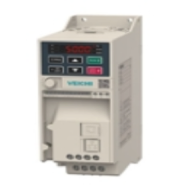
- Variable frequency drive (inverter) — the central component of the station that converts the mains frequency of 50 Hz to an adjustable output frequency of 0-400 Hz. Leading manufacturers available on the Ukrainian market include ABB (ACS150, ACS180, ACS580 series), Schneider Electric (Altivar), Siemens (SINAMICS), Danfoss (VLT), INVT, Delta Electronics, and Mitsubishi Electric.
- Output (motor) reactor — protects motor windings from voltage spikes that occur on long cable runs (exceeding 50 m) between the VFD and the motor.
- EMC filter — reduces electromagnetic interference emitted by the frequency converter, which is critical for facilities with sensitive electronic equipment.
- Bypass circuit — enables direct-on-line motor connection in the event of a VFD malfunction, ensuring continuity of the technological process.
- Contactors and relays — for switching power circuits and implementing control logic (reversal, motor selection, emergency shutdown).
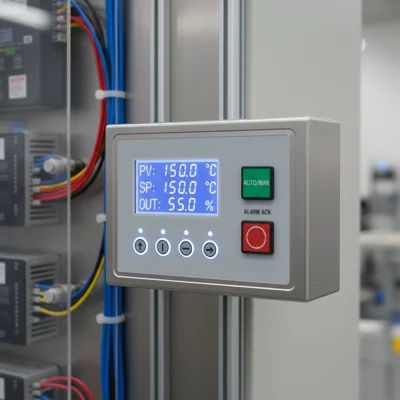
- Indication instruments — ammeters, voltmeters, status indicator lights (running, fault, mains), and on modern panels an HMI touchscreen or a remote VFD operator keypad.
- Terminal blocks — for connecting external signals: pressure sensors (4-20 mA), temperature sensors (Pt100/Pt1000), discrete inputs/outputs, and an RS-485 interface for integration with the plant automation system.
Selecting the appropriate IP protection rating for the control panel
The enclosure protection rating (IP code) is one of the most important parameters when selecting a VFD control station. It determines where the panel can be safely installed:
- IP20/IP21 — suitable only for clean, dry environments (electrical switchgear rooms, server rooms). Provides protection against accidental contact with live parts but offers no dust or moisture protection.
- IP54 — a universal choice for industrial environments. Protects against dust ingress and water splashes from any direction. This is the most commonly specified rating for manufacturing facilities.
- IP65/IP66 — fully dust-tight with protection against water jets. Required for outdoor installations, pumping stations, and agricultural facilities.
When specifying a high protection rating (IP65 and above), forced ventilation or air conditioning of the enclosure must be provided, since the VFD dissipates a significant amount of heat (2-5% of the motor power rating).
Control configurations: single drive vs. cascade
Depending on the number of motors and reliability requirements, different configurations are used for VFD control stations:
Single-drive configuration (1 VFD - 1 motor) — the simplest arrangement for a single pump, fan, or conveyor. The VFD directly controls the speed of one motor. A bypass circuit provides direct-on-line motor operation in the event of a VFD failure.
Cascade configuration (1 VFD - multiple motors) — a single frequency converter is sequentially connected to different motors via contactors. This is typically used for pumping stations where system pressure must be maintained by bringing additional pumps online as demand increases. The built-in PLC or the VFD internal logic manages pump rotation (lead-lag alternation) to ensure even wear across all units.
Multi-drive configuration (multiple VFDs - multiple motors) — each motor has its own dedicated frequency converter. This is the most expensive but also the most reliable option, offering maximum control flexibility. It is deployed at mission-critical water supply and heating facilities.
Integrating the control station into the automation system
Modern VFD control stations rarely operate in standalone mode — they are typically part of the overall plant automation system. Integration is achieved through:
- 4-20 mA analog signal — from a sensor (pressure, temperature, level) directly to the VFD analog input. The drive automatically adjusts motor speed to maintain the setpoint using its built-in PID controller.
- RS-485 interface (Modbus RTU) — connection to a PLC or SCADA system for remote monitoring and control. Data transmitted includes speed, current, voltage, fault status, and start/stop commands.
- Industrial networks (Profibus, Profinet, EtherNet/IP) — for complex automation systems with dozens of drives. For more information on electric drive systems, refer to our article on frequently asked questions about inverters and soft starters.
Advantages of VFD-based control stations
Compared to direct-on-line motor starting or using a standalone frequency converter without a proper enclosure, a VFD control station delivers significant advantages:
- Energy savings — variable frequency speed control of pumps and fans reduces electricity consumption by 30-50%. For a facility running a 30 kW motor around the clock, annual savings can amount to UAH 80,000-150,000.
- Motor protection — soft starting eliminates inrush currents (5-7 times the rated value), extending the service life of motor windings and bearings.
- Process continuity — the bypass circuit allows continued motor operation from the mains supply in the event of a VFD fault.
- Centralized control — all protection, indication, and switching components are housed in a single panel, simplifying maintenance and diagnostics.
- Standards compliance — the control station is designed in accordance with electrical installation codes and EN 61439 (low-voltage switchgear and controlgear assemblies).
VFD vs. soft starter in a motor control panel
| Parameter | VFD (variable frequency drive) | Soft starter |
|---|---|---|
| Speed control | Smooth 0-100% | None (start/stop only) |
| Inrush current limiting | Down to 1.5 In | Down to 2-4 In |
| Energy savings during operation | 30-50% | Minimal (1-3%) |
| Cost (relative to power rating) | Higher | Lower (by 30-50%) |
| Cabinet dimensions | Larger | Smaller |
| Typical application | Pumps, fans, conveyors | Compressors, mills, crushers |
If the only requirement is limiting inrush current without speed control, consider using soft starters. For variable-load applications such as pumps and ventilation systems, a VFD-based control station is the optimal choice.
Installation and maintenance recommendations
Proper installation of the control station is critical to ensuring reliable operation and long equipment service life:
- Temperature management — most VFDs are rated for ambient temperatures up to +40...+50 degrees C. The enclosure must provide adequate ventilation or air conditioning to keep the internal temperature within the permissible range.
- Cabling — shielded cables are recommended for the motor connection to the VFD. When cable length exceeds 50 m, a motor output reactor must be installed. For detailed guidance on three-phase motor wiring, refer to our article on connecting a three-phase motor to a 380 V supply.
- Grounding — both the panel enclosure and the motor must be properly grounded. Cable shields should be grounded at both ends.
- Clearances — maintain minimum distances from walls and adjacent cabinets to ensure adequate air circulation (at least 200 mm above and 100 mm on each side).
- Scheduled maintenance — every 6-12 months: verify terminal connection torque, clean ventilation fan filters, inspect VFD DC bus capacitors, and check the condition of contactors.
How to order a VFD control station
Chastotnik offers comprehensive solutions for building VFD control stations based on frequency converters from leading manufacturers including ABB, Schneider Electric, Siemens, Danfoss, INVT, Delta Electronics, and others. We will help you select the optimal control panel configuration for your application, whether it is a simple single-drive station for a pump or a complex multi-drive system with full plant automation integration.
To calculate the right control station for your needs, we require: motor power and type (kW, voltage), required enclosure protection rating (IP), operating conditions (indoor or outdoor), automation requirements (sensors, communication interfaces), and whether a bypass circuit is needed. Contact our specialists and we will engineer the right solution and ensure delivery of all equipment required to build your control station, drawing from our full catalog of variable frequency drives and accessories available in Ukraine with the shortest lead times.
Review our guide to selecting a VFD for a water pump to determine the required power rating and drive series for your application.