Variable Frequency Drives in Curb Stone and Decorative Stone Production: Complete Guide
Curb stone and decorative stone production involves dozens of technological operations: raw material crushing, concrete mixing, product forming on vibratory presses, conveyor transportation, and finished product packaging. At each of these stages, electric motors ranging from 1.5 to 75 kW are running, and variable frequency drives (VFDs) enable controlling them with maximum efficiency.
Over the past 10 years, stone processing plants across Ukraine and Europe have been massively adopting variable frequency drives. The reason is straightforward: a vibratory press running through a VFD consumes 25-40% less electricity, while a conveyor line with frequency control reduces component wear by 2-3 times. Let us examine each production area separately.
Where VFDs Are Applied in Stone Processing Plants
Vibratory Presses and Vibrating Tables
The vibratory press is the heart of any curb stone production facility. It forms products under pressure of 10 to 50 tonnes while simultaneously vibrating. Without a VFD, the vibrator motor operates at a fixed frequency of 50 Hz, which does not allow adjusting vibration parameters for a specific mixture or product type.
A variable frequency drive solves this problem. The operator can set vibration frequency from 30 to 200 Hz depending on:
- Mixture type (stiff concrete requires 40-60 Hz, semi-dry mix needs 80-120 Hz)
- Product dimensions (curb stone 1000x200x80 mm — 50 Hz, decorative tile 300x300x30 mm — 100 Hz)
- Required density of the finished product (increasing frequency by 20% raises density by 5-8%)
In practice, this means a single vibratory press can manufacture both massive curb stones and thin decorative tiles simply by changing the VFD settings. Without this capability, separate equipment would be needed for each product type.
Conveyor Systems
A typical stone processing plant operates 5 to 15 conveyors: raw material feeding, inter-stage transport, and finished product discharge. Conveyor motors run 16-20 hours per day, and this is where VFDs deliver the greatest savings.
Key advantages of frequency-controlled conveyors:
- Smooth start without jerks — the belt does not slip, joints do not wear out. Starting current drops from 6-8 times rated to 1.5 times rated
- Speed regulation from 10 to 100% — when partially loaded, the conveyor runs slower, saving up to 35% of electricity
- Synchronization of multiple conveyors — VFDs ensure coordinated speed across the entire line without material accumulation at junctions
- Overload protection — if the conveyor jams or clogs, the VFD limits current and triggers an alarm
Crushers and Pulverizers
Jaw and cone crushers for concrete aggregate preparation require powerful motors from 15 to 75 kW. Without frequency control, each crusher start creates a current surge 6-8 times above rated value, overloading the plant electrical network and accelerating bearing wear.
A VFD provides smooth crusher acceleration over 10-30 seconds, distributing the load evenly. Additionally, the ability to reduce rotation speed when processing softer rock decreases electricity consumption by 20-30%.
Concrete Mixers
Curb stone quality directly depends on concrete mix homogeneity. A VFD on the mixer motor enables programming the mixing cycle: slow start when loading dry components (15-20 Hz), gradual acceleration when adding water (30-40 Hz), intensive mixing (50 Hz), and deceleration before discharge.
This approach improves mix homogeneity by 15-20% compared to constant-speed operation, directly affecting the finished product strength.
Packaging and Palletizing Systems
Modern curb stone packaging lines include turning tables, wrapping machines, and roller conveyors. The practical experience of British company Aggregate Industries (UK) Ltd, which has specialized in decorative stone for over 20 years, demonstrates the effectiveness of this approach. At their facility, two conveyors are connected through a combination of optical and mechanical sensors, and a turning table rotates pallets 90 degrees before feeding them into the wrapping machine — all controlled by variable frequency drives.
Comparison: Production With and Without VFDs
| Parameter | Without VFD | With VFD |
|---|---|---|
| Motor starting current | 6-8 times rated (grid impact) | 1.0-1.5 times rated (soft start) |
| Electricity consumption | 100% (constant power) | 60-75% (load-dependent) |
| Vibration frequency control | 50 Hz only (fixed) | 30-200 Hz (stepless) |
| Motor bearing life | Replacement every 8,000-12,000 hours | Replacement every 20,000-30,000 hours |
| Conveyor belt life | Replacement every 2-3 years | Replacement every 5-7 years |
| Production flexibility | 1-2 product types | 5-10 product types on a single press |
| Product compaction quality | Average (fixed mode) | High (optimal mode per product) |
| Workplace noise level | 85-95 dB | 70-80 dB (at reduced speed) |
| Payback period | — | 8-14 months |
How to Select the Right VFD for Stone Processing Equipment
Determining Power Rating
The first step is identifying the electric motor rated power. Typical values for stone processing equipment:
- Vibratory press vibrator: 1.5-7.5 kW
- Vibratory press hydraulic unit: 7.5-22 kW
- Feed conveyor: 2.2-5.5 kW
- Crusher: 15-75 kW
- Concrete mixer: 5.5-15 kW
The VFD should be selected with a 15-20% margin above the motor rated power. For a 5.5 kW motor, choose a 7.5 kW VFD; for a 15 kW motor, select an 18.5 kW unit.
Selection by Load Type
Vibratory presses and crushers create heavy loads with frequent starts and overloads. They require VFDs with 150-180% overload capacity for 60 seconds. Conveyors and mixers operate under normal duty, where 120% overload for 60 seconds is sufficient.
Ingress Protection Rating
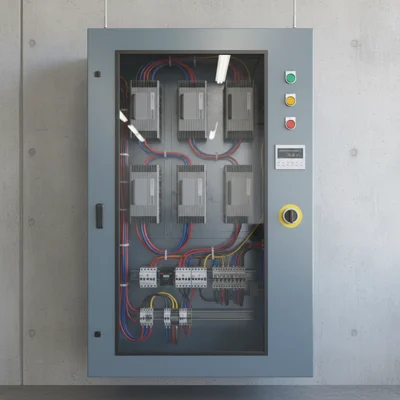
Stone processing environments involve dust, moisture, and vibration. The minimum VFD protection rating for workshop installation is IP54. When mounted in a separate control cabinet, an IP20-rated VFD with appropriate cabinet protection can be used.
Economic Impact of VFD Implementation
Consider a specific example: a curb stone plant producing 500 units per hour with 4 conveyors at 3 kW each, a 7.5 kW vibratory press, and a 22 kW crusher.
Total installed power: 41.5 kW. Operating 16 hours per day, 250 days per year, average consumption without VFDs is approximately 166,000 kWh per year.
After installing VFDs on all motors, actual consumption reduction is 30-35%, yielding savings of 49,800-58,100 kWh per year. At a rate of 3.5 UAH/kWh, this equals 174,000-203,000 UAH per year.
The cost of a complete VFD package for such a plant is approximately 180,000-250,000 UAH depending on the manufacturer. This means full payback within 10-14 months from electricity savings alone, without accounting for reduced maintenance and repair costs.
Alternative: Soft Starters
For equipment where speed control is unnecessary but smooth starting matters — for example, crushers operating at constant speed — soft starters are worth considering. They cost 2-3 times less than VFDs and provide smooth motor acceleration, reducing starting currents to 2-3 times rated value.
However, a soft starter cannot regulate speed during operation, so for vibratory presses and conveyors, a VFD remains the optimal solution.
Common Mistakes When Implementing VFDs in Stone Processing
- Insufficient power margin. A vibratory press motor during loaded mold start momentarily draws 2-3 times the rated current. An undersized VFD will trip on fault
- Missing output reactor. With cable lengths exceeding 30 m from VFD to motor, an output reactor is required; otherwise, motor insulation degrades from PWM pulse reflections
- Improper grounding. In dusty and humid environments, poor grounding leads to VFD malfunctions due to electromagnetic interference
- Ignoring EMC filter. Without an input EMC filter, the VFD generates interference that can affect sensors and vibratory press control systems
- Installation without ventilation. VFDs generate heat, and without proper cabinet ventilation, their service life is cut in half
Useful Resources for Equipment Selection
If you are planning VFD implementation at a stone processing facility, we recommend reviewing our materials:
- Top questions about frequency converters and soft starters
- Practical examples of frequency converter applications in industry
- Frequency converters for ventilation — a related task in stone production
- Frequency converter setup for compressors
- Connecting a three-phase motor to a 380V network — diagrams and expert advice
To select the specific VFD model for your equipment, browse our frequency converter catalog or contact our engineers for a consultation.