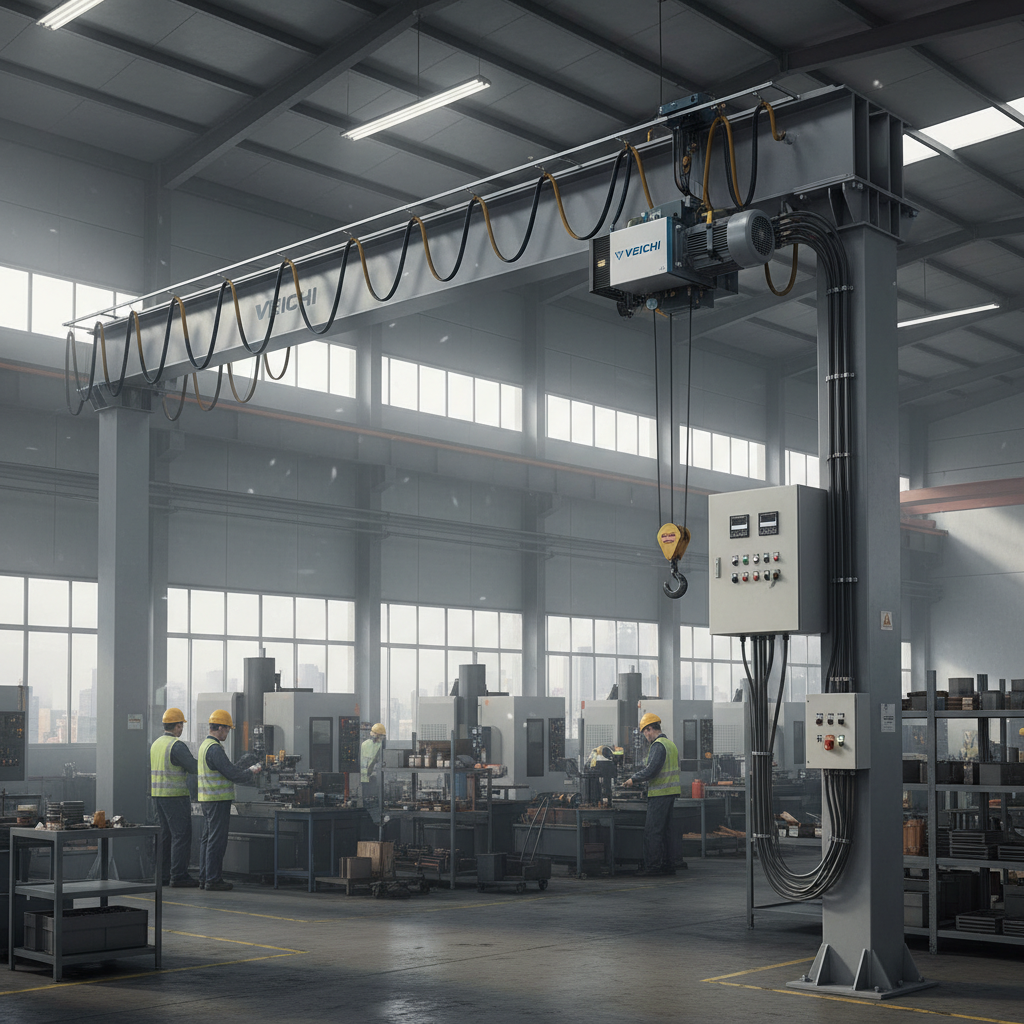
Why Use VEICHI AC310 Variable Frequency Drive on a Crane
Overhead, gantry, and jib cranes operate in demanding cyclic duty modes. The hoist motor starts and stops dozens of times per shift, while the load on the hook requires stable holding at any height. The traditional control method using contactors and resistor-based speed regulation leads to high inrush currents, rope jerks, and premature brake pad wear.
The VEICHI series AC310 variable frequency drive (VFD) is designed for asynchronous and synchronous motors rated 4 to 75 kW at 380 V supply. It enables smooth acceleration and deceleration of the crane drive, precise torque control at the motor shaft, and recovery of braking energy to the DC bus or external braking resistor. The result: reduced mechanical stress, lower power consumption, and safer operator working conditions.
Crane Mechanisms Where VFDs Are Applied
The VEICHI AC310 is suitable for controlling all main mechanisms of a load-lifting crane:
- Hoist mechanism -- the primary crane drive. The VFD provides jerk-free starting, load holding at zero speed, and controlled lowering even without the mechanical brake engaged.
- Bridge travel mechanism -- horizontal crane movement along rails. Smooth acceleration eliminates load sway and reduces wear on travel wheels.
- Trolley travel mechanism -- transverse load positioning. The VFD enables precise trolley placement directly above the unloading point.
- Slewing mechanism -- boom rotation on gantry or tower cranes. Frequency-controlled deceleration eliminates inertial swing at stop.
Technical Advantages of VEICHI AC310 for Cranes
Sensorless Vector Control
The AC310 employs field-oriented vector control (FOC). This allows the drive to deliver 150-180% of rated torque at frequencies as low as 0.5 Hz -- essentially from standstill. For the hoist mechanism, this means confident starting under full load without brake slippage. Speed regulation accuracy is 0.2% without encoder feedback.
Built-in Protection Functions
Crane duty demands elevated protection levels. The AC310 includes hardware protection against output short circuits, DC bus overvoltage, supply undervoltage, power module overheating, and motor overload. Phase loss detection on both input and output sides is implemented separately, which is critical for safety during lifting operations.
Braking and Load Holding
During load lowering, the motor operates in regenerative mode. The VEICHI AC310 supports an external braking resistor to dissipate regenerated energy. This ensures stable, controlled lowering even at full load capacity. The DC injection braking function locks the motor shaft before the mechanical brake engages, virtually eliminating brake pad wear.
Communication Capabilities
The standard Modbus RTU interface allows integration of the drive into the crane automation system. Optional expansion modules support PROFIBUS-DP, CANopen, and PROFINET protocols. This enables building a complete crane fleet dispatching system with real-time status monitoring of every drive.
Comparison: VFD vs Direct Start for Cranes
The table below compares two approaches to crane motor control: traditional contactor starting (direct or through starting resistors) and variable frequency drive control using the VEICHI AC310 frequency converter.
| Parameter | Direct Start (Contactor) | VEICHI AC310 (VFD) |
|---|---|---|
| Starting current | 6-7x rated (inrush) | Does not exceed rated (smooth) |
| Brake pad wear | High, replacement every 3-6 months | Minimal, replacement every 2-3 years |
| Speed regulation | 2-3 fixed steps | Smooth, 0-100% stepless |
| Load sway | Significant at start/stop | Minimal due to S-curve ramps |
| Power consumption | Baseline (100%) | Reduced by 30-40% |
| Positioning accuracy | Low (operator-dependent) | High (up to 0.2%) |
| Motor protection | Thermal relay, fuses | Full electronic protection |
| Gearbox wear | Increased due to jerks | Reduced by smooth torque delivery |
| Operating noise | High (contactors, jerks) | Reduced |
| Motor service life | Shortened by 30-40% | Extended through protection |
Selecting VEICHI AC310 Power Rating for Cranes
Choosing a VFD for crane applications differs from general industrial use. The hoist motor experiences overloads up to 200% when breaking a load free, so the VFD must be selected with current margin.
Key Selection Rules
- For the hoist mechanism, select a VFD one power step above the motor rating. For example, a 15 kW motor requires AC310-T3-018G/022P-B (18.5 kW).
- For bridge and trolley travel mechanisms, selection at motor rated power is acceptable since loads are lower.
- Supply voltage is 3-phase 380 V (T3 series). For single-phase applications, the AC310 is not suitable; consider the VEICHI AC10 series for 220 V.
- A braking resistor is mandatory for the hoist mechanism. Resistor power should be 50-100% of VFD rating depending on cycle intensity.
Recommended Models for Typical Cranes
| Crane capacity | Hoist motor | Recommended VFD | Travel motor | Recommended VFD |
|---|---|---|---|---|
| 3.2 t | 4 kW | AC310-T3-004G/5R5P-B | 1.5 kW | AC01-T3-1R5G-B |
| 5 t | 7.5 kW | AC310-T3-011G/015P-B | 2.2 kW | AC01-T3-2R2G-B |
| 10 t | 15 kW | AC310-T3-018G/022P-B | 4 kW | AC310-T3-004G/5R5P-B |
| 16 t | 22 kW | AC310-T3-030G/037P | 5.5 kW | AC01-T3-5R5G-B |
| 32 t | 45 kW | AC310-T3-055G/075P | 11 kW | AC310-T3-011G/015P-B |
Configuring AC310 for Crane Duty
After installing the VFD, basic parameter configuration for crane applications is required. Below are the key parameters that differ from factory defaults.
Hoist Mechanism Parameters
- Acceleration time (F0.14) -- recommended 5-10 seconds depending on lifting capacity. Excessively fast acceleration causes rope jerk.
- Deceleration time (F0.15) -- 5-8 seconds. Slow deceleration reduces load sway.
- S-curve (F0.16, F0.17) -- enable for smooth torque ramp-up and ramp-down. Recommended at 20-30% of acceleration time.
- Braking resistor -- enable the dynamic braking function and set the DC bus voltage threshold.
- Overload protection -- set threshold at 150% for 60 seconds for S4 crane duty rating.
Travel Mechanism Parameters
- Acceleration time -- 8-15 seconds to reduce load sway during bridge start.
- Deceleration time -- 8-12 seconds. Abrupt bridge or trolley braking creates pendulum swinging.
- Maximum frequency -- limit according to crane travel speed (typically 30-50 Hz).
VFD Wiring to Crane Motor
A typical wiring scheme for connecting the VEICHI AC310 to an asynchronous three-phase motor on a crane includes the following components:
- Input circuit breaker -- short-circuit protection on the supply side. Rating is selected based on VFD input current.
- Line reactor (optional) -- reduces harmonic distortion and protects the drive from voltage spikes common in crane power networks.
- Terminals R, S, T -- three-phase 380 V supply connection.
- Terminals U, V, W -- motor winding connections. Star or delta winding as specified in the motor nameplate.
- Terminals PB, (+) -- external braking resistor connection for dissipating regenerated energy.
- Mechanical brake -- connected via the VFD relay output. The AC310 automatically releases the brake after torque build-up and engages it before shaft standstill.
- Limit switches -- connected to VFD digital inputs for emergency stop at travel end positions.
Energy Savings and Payback
Based on operational data from industrial facilities, installing a VFD on a crane reduces power consumption by 30-40%. For a 10-ton crane operating in two shifts, this translates to savings of 15,000-25,000 kWh per year.
Additional savings come from reduced maintenance costs: brake pad replacements become 4-5 times less frequent, gearbox and bearing service life increases by 30-50%, and unplanned downtime decreases through electronic motor protection against overloads and overheating.
The average payback period for installing a VEICHI AC310 on a crane is 12-18 months depending on operating intensity. Drives in this series are available in the frequency converter catalog with delivery across Ukraine.
Crane Installation Considerations
Mounting a VFD on a crane structure presents unique challenges compared to stationary installation:
- Vibration -- the crane structure vibrates during travel and hoisting. The AC310 withstands vibration up to 5.9 m/s2 (0.6 g), but anti-vibration pads and secure mounting are recommended.
- Temperature -- temperatures in the crane cabin or electrical enclosure can reach +50C in summer. Ensure forced ventilation and maintain clearances around the drive (minimum 100 mm above and below).
- Dust and moisture -- crane equipment often operates in dusty workshops. Use a protective enclosure rated IP54 with filtered ventilation openings.
- Electromagnetic compatibility -- crane power networks are often noisy due to other equipment. An input line reactor and shielded cables between the VFD and motor will reduce interference levels.
Alternative: Soft Starter for Crane Applications
If full speed control is not required and the main goal is to reduce starting currents and mechanical jerks, a soft starter may be considered. It costs less than a VFD and is simpler to configure. However, a soft starter cannot regulate speed during operation, does not provide controlled load lowering, and does not save energy during steady-state running. For cranes with frequent hoist-lower cycles, the AC310 frequency converter remains the preferred solution.
Summary
The VEICHI AC310 variable frequency drive addresses the core requirements of crane electric drives: smooth starting without inrush currents, stepless speed control, controlled braking with load holding, and comprehensive electronic motor protection. For facilities upgrading existing cranes or engineering new ones, this solution delivers 30-40% reduction in operating costs with a payback period of 12-18 months.