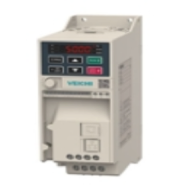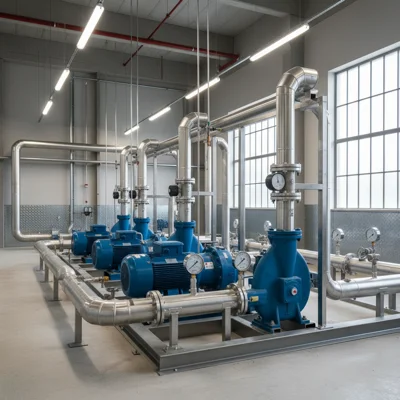
What is a multi-stage pump and why does it need a VFD
A multi-stage (multi-tap) pump features several impellers mounted in series on a single shaft. Each impeller adds pressure, so the total head increases proportionally with the number of stages. These units are used in water supply systems for multi-story buildings, irrigation, industrial cooling, and fire suppression. The flow range remains relatively narrow, and the Q-H curve is quite steep.
The problem with direct-on-line starting is that the motor draws an inrush current 5 to 7 times the rated value. For a 15 kW pump, that means a current spike up to 200 A, a water hammer in the pipeline, and accelerated wear on mechanical seals. A variable frequency drive (VFD) eliminates these risks: the motor accelerates smoothly from 0 to operating frequency over 5-30 seconds, and the starting current does not exceed 1.1-1.5 times the rated value.
How a VFD works in pump systems
A variable frequency drive changes the frequency and voltage supplied to an asynchronous motor. When water demand drops, the VFD reduces the speed from 2,900 to, say, 2,000 rpm. According to the affinity laws for turbomachinery, power is proportional to the cube of speed: a 30% reduction in speed cuts power consumption by 66%. In practice, this delivers energy savings of 25 to 60% depending on the load profile.
For multi-stage pumps, this is especially effective because their Q-H characteristic is steeper than that of single-stage centrifugal units. Even a modest reduction in speed significantly lowers head and, consequently, power consumption.
How pressure feedback works
A pressure transducer (4-20 mA or 0-10 V) is installed at the collector outlet or at a control point in the network. The signal is fed to the VFD analog input. The built-in PID controller compares the actual pressure with the setpoint and adjusts the frequency accordingly. If consumption rises and pressure drops, the frequency increases. When taps are closed, pressure rises, and the VFD reduces speed down to a minimum of 15-20 Hz. For a step-by-step guide on setting up a PID controller for pumps, see the article Setting up frequency inverters for pressure sensor operation.
Wiring configurations: one VFD or several
Configuration 1: one VFD per one pump
The simplest solution for installations with a single multi-stage pump. The VFD controls the motor, maintaining the set pressure via PID. Advantage: low cost, straightforward installation. Disadvantage: if the VFD or pump fails, the entire system stops. Suitable for private homes, small farms, and individual production lines.
Configuration 2: one VFD plus multiple pumps with cascade control
The VFD controls one lead pump while the others are started through contactors directly at full frequency. When the lead pump reaches maximum speed and pressure is still below the setpoint, the VFD signals the second pump to start. After the second pump starts, the VFD reduces the lead pump frequency to avoid pressure overshoot and resumes PID regulation. This is the optimal cost-performance solution for pump stations with 2-4 pumps.
Configuration 3: individual VFD for each pump
Each pump gets its own variable frequency drive. All VFDs are linked via RS-485 (Modbus RTU) or through a common controller. Advantages: maximum energy efficiency, even wear distribution, and built-in redundancy. Disadvantage: high initial investment. Used in mission-critical systems: water utilities, fire suppression, data centres.
Comparison of pump control methods
| Parameter | Direct-on-line | Soft starter | Single VFD + cascade | Individual VFD |
|---|---|---|---|---|
| Starting current | 5-7 In | 2-4 In | 1.1-1.5 In | 1.1-1.5 In |
| Pressure regulation | Throttle valve | None | Smooth | Smooth |
| Energy savings | 0% | 5-10% | 25-45% | 35-60% |
| Water hammer on start | Severe | Moderate | None | None |
| Dry-run protection | External relay | External relay | Built-in | Built-in |
| Approximate cost (for 7.5 kW) | USD 12 | USD 200 | USD 370 | USD 370 x N |
| Motor-hours equalisation | No | No | Pump rotation | Full |
The comparison shows that even a single VFD with cascade control significantly outperforms direct starting and a soft starter on most parameters. If the budget allows, an individual VFD for each motor delivers maximum savings and reliability.
Selecting a VFD for a multi-stage pump
Step 1: determine the motor power
Check the motor nameplate. Find the rated power (kW), rated current (A), supply voltage (single-phase 220 V or three-phase 380 V), and rotational speed. For pump loads, the VFD should be selected with a 10-20% power margin. If the motor is 7.5 kW, choose a VFD rated at 7.5-11 kW.
Step 2: determine the voltage class
Single-phase 220 V input is typical for domestic and farm systems up to 2.2 kW. Three-phase 380 V is for industrial loads from 1.5 kW upward. If the supply is single-phase but the pump motor is three-phase, a VFD with a 220 V single-phase input and 380 V three-phase output solves the problem. For more on running a three-phase motor from different supplies, see Connecting a three-phase motor to a 380 V network.
Step 3: check the protection features
For pump applications, the following features are critical: dry-run protection (minimum current monitoring), overload protection, automatic restart after power failure, and sleep mode (shutdown at minimum demand). The frequency inverter catalogue includes models with a full set of pump-specific functions.
Energy efficiency: real savings figures
Consider a real-world example. A water supply pump station for a 120-apartment residential complex runs two multi-stage Grundfos CR 15-3 pumps rated at 5.5 kW each. Before VFD installation, the pumps ran at full speed 18 hours a day, with pressure controlled by a throttle valve. Monthly consumption: 5.5 kW x 2 x 18 h x 30 days = 5,940 kWh.
After installing two VFDs, the average frequency dropped to 38 Hz instead of 50 Hz. By the cubic law: (38/50)^3 = 0.44. Actual consumption: 5,940 x 0.44 = 2,614 kWh. Savings: 3,326 kWh per month. At a tariff of USD 0.09/kWh, that is USD 299 per month. Two 5.5 kW VFDs cost approximately USD 740 together. Payback period: under 3 months.
Installation and commissioning details
Choosing the installation location
The VFD should be placed in an enclosed electrical cabinet with forced ventilation. Ambient temperature must not exceed 40 degrees C; otherwise, derate the load by 2-3% for each degree above the limit. Keep the cable distance from VFD to motor under 100 m. For longer runs, a motor choke is needed to protect winding insulation from high-frequency voltage spikes.
PID controller setup
Most modern VFDs have a built-in PID controller optimised for pump applications. Typical parameters for a multi-stage pump in a water supply system: proportional gain P = 3-8, integral time I = 2-5 seconds, derivative D = 0 (usually disabled for pumps). Set the acceleration time to 10-15 seconds and deceleration time to 5-10 seconds. Limit the minimum frequency to 20-25 Hz to prevent motor overheating.
Water hammer prevention
In addition to smooth acceleration, the VFD provides smooth deceleration with gradual check valve closure. It is also recommended to install a diaphragm expansion tank of 8-24 litres on the discharge header. This dampens residual pressure oscillations during sudden changes in water demand.
Common mistakes when implementing VFDs for pumps
- Insufficient power margin. If the VFD is sized exactly to the motor rated current, it will trip on overload during starts against high static pressure or when the impellers are fouled.
- Missing input choke or filter. Without a line reactor, the VFD injects harmonics into the supply, potentially damaging other equipment and causing nuisance trips.
- Incorrect minimum frequency setting. Running at 10-15 Hz leads to inadequate motor cooling since the shaft-mounted fan cannot generate sufficient airflow.
- Ignoring the sleep function. Without it, the pump may run at minimum speed even with zero demand, wasting energy and motor life.
- No bypass line. If the VFD fails, there is no way to start the pump directly from the mains. For critical installations, a bypass is mandatory.
Running multiple pumps in parallel with a VFD
When two or more multi-stage pumps feed a common header, the VFD provides cascade control. The algorithm for a typical cascade station:
- The first (lead) pump starts from the VFD. The frequency ramps from minimum to operating speed.
- If the frequency stays at maximum for 10-30 seconds while pressure remains below the setpoint, the VFD commands the second pump to start via a contactor.
- After the second pump starts, the VFD reduces the lead pump frequency so both pumps run in sync.
- As demand decreases, the frequency drops. When it falls below a threshold (e.g., 25 Hz) for 30 seconds, the second pump shuts down.
- The VFD automatically alternates the lead and lag pumps to equalise their running hours.
This mode is far more efficient than running both pumps at full speed. Pumps only start when needed, rather than running constantly on throttle control. Equipment selection for such systems is covered in the article Pumps with frequency inverters.
VFDs in irrigation and watering systems
In agriculture, multi-stage pumps often supply several irrigation lines or sprinkler blocks. Water demand varies with the number of active sections, time of day, and weather conditions. A VFD lets the pump adapt to the current load: when only one section out of four is active, the pump runs at 60% speed, consuming just 22% of rated power.
An additional benefit for systems powered by a generator or hybrid inverter: the VFD starts the motor smoothly without an inrush current spike, allowing the use of a smaller generator. For example, a 4 kW pump requires a 15-20 kVA generator for direct starting but only 6-8 kVA with a VFD. Instructions for setting up such a system are available in the article Running a pump from a generator: VFD setup.
Comparison of popular VFDs for pump applications
| Feature | INVT GD20 (7.5 kW) | VEICHI AC70E (7.5 kW) | Danfoss FC 51 (7.5 kW) | ABB ACS310 (7.5 kW) |
|---|---|---|---|---|
| Built-in PID | Yes | Yes | Yes | Yes |
| Cascade control | Up to 4 pumps | Up to 4 pumps | Up to 3 pumps | Up to 4 pumps |
| Dry-run protection | Yes | Yes | Yes | Yes |
| Sleep mode | Yes | Yes | Yes | Yes |
| Input voltage | 380 V, 3-phase | 380 V, 3-phase | 380 V, 3-phase | 380 V, 3-phase |
| Ingress protection | IP20 | IP20 | IP21 | IP20 |
| RS-485 (Modbus) | Built-in | Built-in | Built-in | Built-in |
| Approximate price | USD 295 | USD 335 | USD 690 | USD 790 |
Frequently asked questions
Can a single-phase pump be connected to a VFD?
Single-phase motors with a start capacitor are not suitable for VFD operation. A VFD generates three-phase variable-frequency voltage, and a capacitor-start motor cannot run on it. The solution is to replace the motor with a three-phase one and use a VFD with a single-phase 220 V input and three-phase output. This lets you run a three-phase pump on a domestic single-phase supply.
What is the minimum frequency that can be set for a pump?
For most self-ventilated asynchronous motors, the safe minimum frequency is 20-25 Hz (40-50% of the rated value). Below this threshold, the motor overheats due to insufficient cooling. If operation at lower frequencies is required, use a motor with forced ventilation or install an external cooling fan.
How many pumps can a single VFD control?
A single VFD directly controls one motor, but through cascade control it can coordinate the operation of 2 to 6 pumps. The lead pump receives smooth speed regulation from the VFD, while the others are switched on through contactors at full frequency. For full variable-speed control of each pump, a separate VFD is needed. For more on choosing between a VFD and a soft starter, read Top questions about frequency inverters and soft starters.
Is a check valve needed when using a VFD?
Yes, a check valve is mandatory on each pump in a multi-pump system. It prevents reverse flow through an idle pump. A VFD does not replace a mechanical check valve, but thanks to smooth deceleration it reduces the load on the valve and extends its service life.
How does a VFD protect a pump from dry running?
The VFD monitors the motor current. When a pump runs without water (dry running), the shaft load drops and the current falls below a set threshold, typically 30-50% of rated current. The VFD detects this condition and stops the motor after a 3-10 second delay. Additionally, a float switch or pressure relay can be connected to a VFD digital input for instant protection.